On this page
- 01Key takeaways
- 02What should you do with very limited time?
- 03What does each time budget buy?
- 04Why do replies matter more than posts?
- 05How do you make two hours go further?
- 06When should you buy the time instead?
- 07What does this look like in practice?
- 08What should you stop doing first?
- 09Next step
- 10Sources and further reading
- 11Frequently asked questions
Key takeaways
With under two hours a week, do not post at all: maintain a Google Business Profile and reply to messages. With four hours, run one channel at two posts a week. With six, run one channel properly. The reply habit matters more than the posting habit at every level.
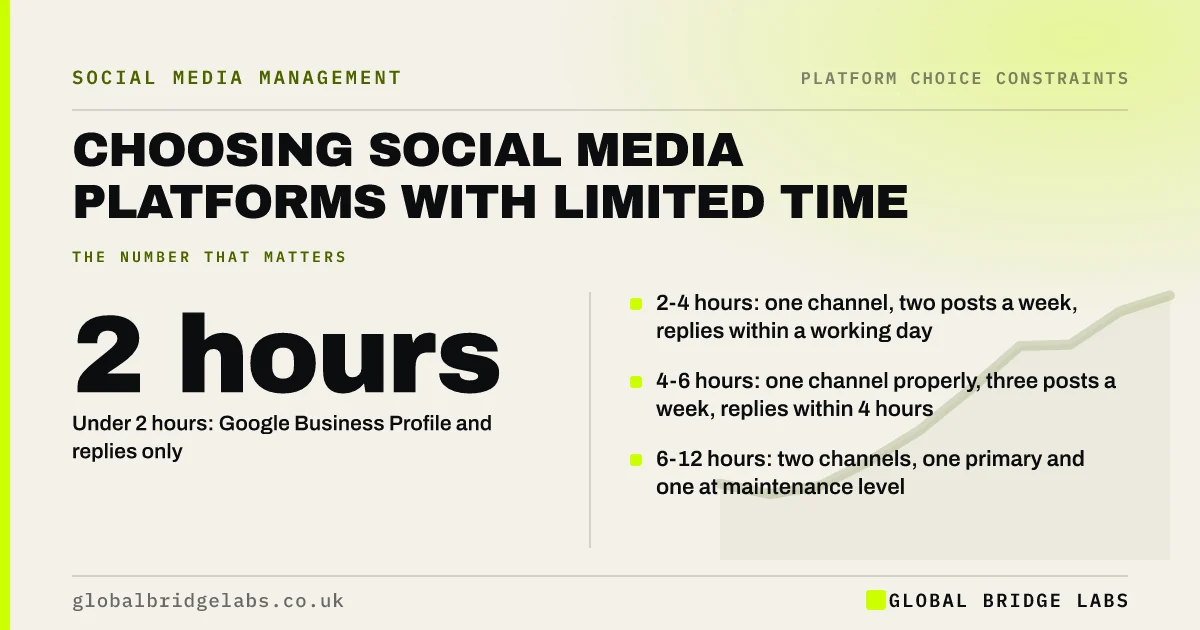
- Under 2 hours: Google Business Profile and replies only. No posting.
- 2-4 hours: one channel, two posts a week, replies within a working day.
- 4-6 hours: one channel properly, three posts a week, replies within 4 hours.
- 6-12 hours: two channels, one primary and one at maintenance level.
- Replies beat posts. A business that answers fast and posts weekly wins.
Two hours a week and no idea where to spend it? Ask us on WhatsApp.
Chat on WhatsApp →What should you do with very limited time?
Stop trying to post and start making sure people who find you can act. For a UK business with under two hours a week, a maintained Google Business Profile plus fast replies produces more enquiries than any posting schedule you could sustain.
This is unpopular advice because it feels like giving up. It is not: it is choosing the highest-return activity available within a real constraint, which is what every other business decision requires.
What does each time budget buy?
Be honest about the number and pick the corresponding row. Overreaching by one level is the most common cause of a channel dying in month three.
- Under 2 hours: profile maintenance, reviews, replies. No content production.
- 2-4 hours: one text or photo channel, two posts a week, batched fortnightly.
- 4-6 hours: one channel at full cadence with community management.
- 6-12 hours: two channels with a 70/30 split, or one video channel.
- Over 12 hours: two channels properly, or a hire, or an outsourced partner.
Why do replies matter more than posts?
Because most social enquiries arrive as messages, and an unanswered message is a lost customer rather than a missed impression. A business that posts once a week and answers within two hours will out-earn one that posts daily and answers in three days.
This also inverts the usual priority when time is short. The first thing to protect is the inbox, not the content calendar, and the first thing to cut is the fourth post of the week rather than the daily reply window.
We handle replies in UK hours so you can stay on the tools. Ask on WhatsApp.
Chat on WhatsApp →How do you make two hours go further?
By removing decisions, which consume more of a short session than production does. Four habits that reliably compress the work.
Batch everything into one fortnightly session. Keep a running note of customer questions so you never start from a blank page. Use three repeatable post formats rather than inventing each time. And photograph work as you do it, so the content exists before you sit down.
When should you buy the time instead?
When the hours you would spend are worth more elsewhere, which for most owner-managers is almost always. An hour spent on a chargeable job or a quote is usually worth considerably more than an hour spent editing a caption.
The comparison to make is not the cost of help against zero, it is the cost of help against what you could otherwise do with the same hour, plus the value of the channel finally being consistent. Many UK businesses find that outsourcing production while keeping replies in-house is the split that works.
What does this look like in practice?
A UK sole-trader plasterer tried to run two channels and managed roughly one post a fortnight in bursts, with messages answered when he remembered. Neither channel produced anything.
Dropping to a Google Business Profile with weekly photos and reviews, plus one channel with two posts a week photographed on site and written in the van, took him to about three hours a week. The diary filled within two months, mostly through the profile rather than the social channel, which is the outcome the hours ranking predicts.
What should you stop doing first?
Checking. Most time-poor owners spend more minutes looking at their accounts than producing anything, and the looking produces nothing at all.
Then stop planning in detail. A content calendar that takes an hour to maintain has consumed a quarter of your weekly budget before anything has been made. Three repeatable formats and a running list of customer questions replaces it entirely.
Finally, stop trying to keep up with a channel you have already lost. A profile that has been silent for four months does not need a catch-up run; it needs a decision about whether it is a channel at all.
Next step
Count your genuinely available weekly hours in your worst month and pick the matching row above. Then protect the reply window before the posting schedule, because that is where the enquiries actually are.
Message us on WhatsApp with your available hours and we will build the plan around them.
Chat on WhatsApp →Sources and further reading
- Google Business Profile Help · Google
- UK Customer Satisfaction Index · Institute of Customer Service
Frequently asked questions
What should you do if you have no time for social media?
Maintain a Google Business Profile and reply to messages quickly. For a UK business with under two hours a week, that reliably produces more enquiries than any posting schedule you could realistically sustain, and it takes no content production at all.
How many social media posts a week is enough?
Two a week is enough if your replies are fast. A business posting weekly and answering messages within two hours will out-earn one posting daily and answering in three days, because most social enquiries arrive as messages rather than as comments.
How do you make limited social media time go further?
Remove decisions. Batch into one fortnightly session, keep a running note of customer questions, use three repeatable formats instead of inventing each time, and photograph work as you do it so content exists before you sit down.
Is it better to outsource social media or do less?
Compare the cost of help against what you would otherwise do with that hour, not against zero. An hour on a chargeable job is usually worth more than an hour editing a caption. Many UK owner-managers find that outsourcing production while keeping replies in-house is the split that finally makes the channel consistent.
Written by
Global Bridge Labs (GBL) is a UK–Sri Lanka partner for social media, websites and BPO. Everything here comes from client delivery, not theory.