On this page
- 01Key takeaways
- 02Is quality or quantity more important on social media?
- 03What does quality mean for a business post?
- 04When does more volume help?
- 05How do you find your sustainable cadence?
- 06How do you stop quality drifting?
- 07What does this look like in practice?
- 08What do the options look like for a small team?
- 09When should you choose quantity?
- 10Next step
- 11Sources and further reading
- 12Frequently asked questions
Key takeaways
The real trade-off on social media is not quality versus quantity but sustainable versus unsustainable. The right answer for most UK small businesses is the highest cadence at which you can keep a consistent quality bar for a year. That is usually two or three good posts a week on one primary channel.
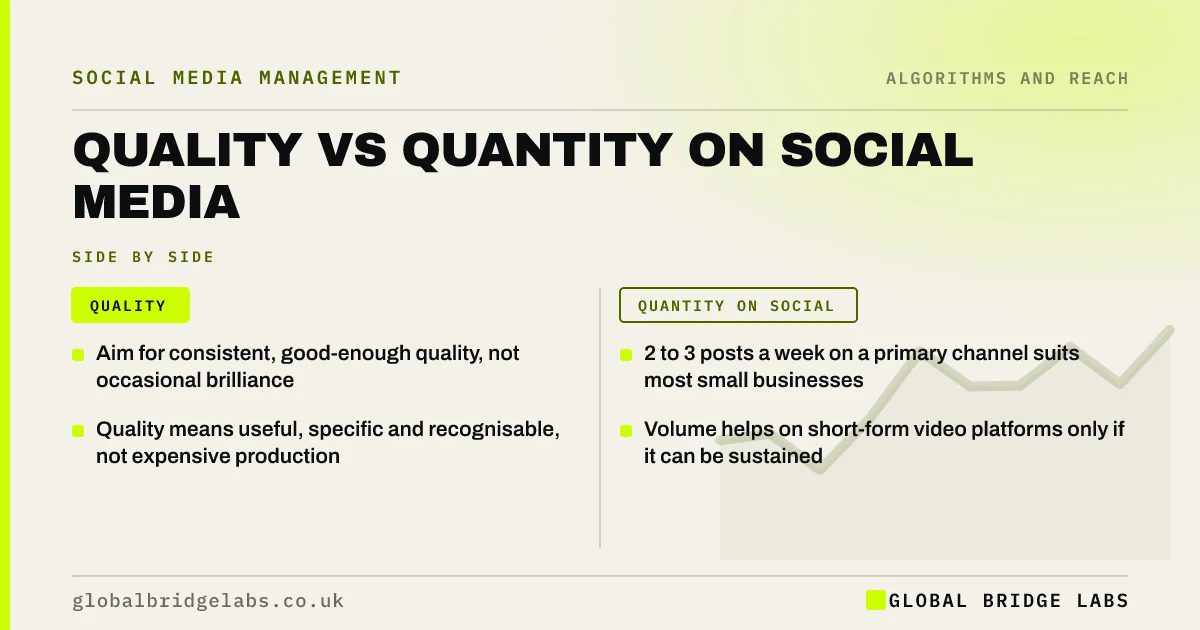
- Aim for consistent, good-enough quality, not occasional brilliance.
- 2 to 3 posts a week on a primary channel suits most small businesses.
- Quality means useful, specific and recognisable, not expensive production.
- Volume helps on short-form video platforms only if it can be sustained.
- Set a minimum quality checklist so standards do not drift.
Want to know the right balance for your team? Message us on WhatsApp.
Chat on WhatsApp →Is quality or quantity more important on social media?
Neither on its own. Posting a lot of weak content wastes time and trains your audience to ignore you. Posting perfect content rarely usually means posting too seldom to build recognition. The goal is consistent quality: a standard you can meet every week, at a cadence you can hold.
What does quality mean for a business post?
- Useful: it answers a question, shows a result or teaches something.
- Specific: it includes real details, numbers, places or examples.
- Recognisable: it looks and sounds like your business.
- Clear: the point is obvious within the first line or three seconds.
- Correct: facts, prices and claims are accurate and compliant.
When does more volume help?
Volume helps most on recommendation-led platforms such as TikTok and Instagram Reels, where each video is a separate chance to reach new people. It helps less on LinkedIn and Facebook, where posting too often can lower engagement per post.
Even on video platforms, volume only helps if you can sustain it. Five videos a week for a month and then silence is worse than two a week indefinitely.
How do you find your sustainable cadence?
- Estimate how long a good post takes you, including the caption and replies.
- Check how many hours you have in your busiest month, not your average one.
- Divide, then round down.
- Hold that cadence for 12 weeks before changing it.
- Increase only if quality holds and you have spare time.
Send us your hours on WhatsApp and we will work out your sustainable cadence.
Chat on WhatsApp →How do you stop quality drifting?
Write a five-point checklist based on the quality definition above and check every post against it before publishing. Use templates for recurring formats so design quality is consistent without effort. Review a sample of posts monthly.
What does this look like in practice?
A UK interior design studio posted daily for two months, mostly quick phone photos with short captions. Engagement fell and the designer was spending an hour a day on it. We cut to three posts a week: a project story, a design tip and a before-and-after. Each took longer to make but engagement per post rose, and total time fell to about three hours a week.
What do the options look like for a small team?
- 1 post a week: minimum viable. Protects trust but builds little new reach.
- 2 to 3 posts a week: the sweet spot for most small businesses on one channel.
- 4 to 5 posts a week: suits short-form video platforms if production is batched.
- Daily: rarely sustainable for small teams without outside help, and quality often slips.
When should you choose quantity?
Choose more volume when you are testing on a recommendation-led platform, when each post is cheap to make from a template, and when the team can keep it up through busy months. Volume is useful for learning quickly what your audience responds to, provided quality does not drop below your minimum checklist.
Choose fewer, stronger posts when each post needs expertise, approval or careful production, as in professional services, healthcare and regulated sectors.
Next step
Define what a good post means for your business in five points, then choose the cadence at which you can meet that bar every week.
Message us on WhatsApp and we will help you set a quality bar and a cadence you can hold.
Chat on WhatsApp →Sources and further reading
- How TikTok recommends videos #ForYou · TikTok Newsroom
- LinkedIn relevance: optimising the member experience · LinkedIn Help
- Meta Business Help Centre · Meta
Frequently asked questions
Should I post less but better quality?
Often yes, if your current cadence is producing rushed or unhelpful posts. But posting too rarely also hurts. Aim for the highest cadence you can sustain with consistent quality, typically two or three posts a week on one primary channel.
Does posting more increase engagement?
Not necessarily. More posts can mean more total engagement but lower engagement per post, especially on LinkedIn and Facebook. On short-form video platforms volume helps more, but only if quality and consistency hold.
What counts as a high-quality social media post?
One that is useful, specific, recognisable, clear and correct. It does not need expensive production. A phone photo of a finished job with a specific caption often outperforms a polished graphic with generic text.
How long should a social media post take to make?
A post in an established format typically takes 30 to 60 minutes including the caption. Short videos take longer, often one to three hours. Templates and batching reduce the time significantly.
Is it better to post daily or three times a week?
For most small businesses, three strong posts a week beats seven rushed ones, because quality and engagement per post hold up and the routine is sustainable. Daily posting suits short-form video platforms only when production is batched and the team can maintain it through busy months.
Written by

Global Bridge Labs (GBL) is a UK–Sri Lanka partner for social media, websites and BPO. Everything here comes from client delivery, not theory.