On this page
- 01Short answer
- 02Why does a small business need one?
- 03What should it cover about brand accounts?
- 04What can you reasonably ask of personal accounts?
- 05What about employee advocacy?
- 06How do you make it actually used?
- 07What should happen when someone leaves?
- 08How do you introduce a policy without it landing badly?
- 09Next step
- 10Sources and further reading
- 11Frequently asked questions
Short answer
A social media policy for a UK small business should fit on two pages and cover three things: who may post as the business, what employees may and may not say about work on personal accounts, and what happens when something goes wrong. Keep it proportionate, and take advice before using it as a disciplinary basis.
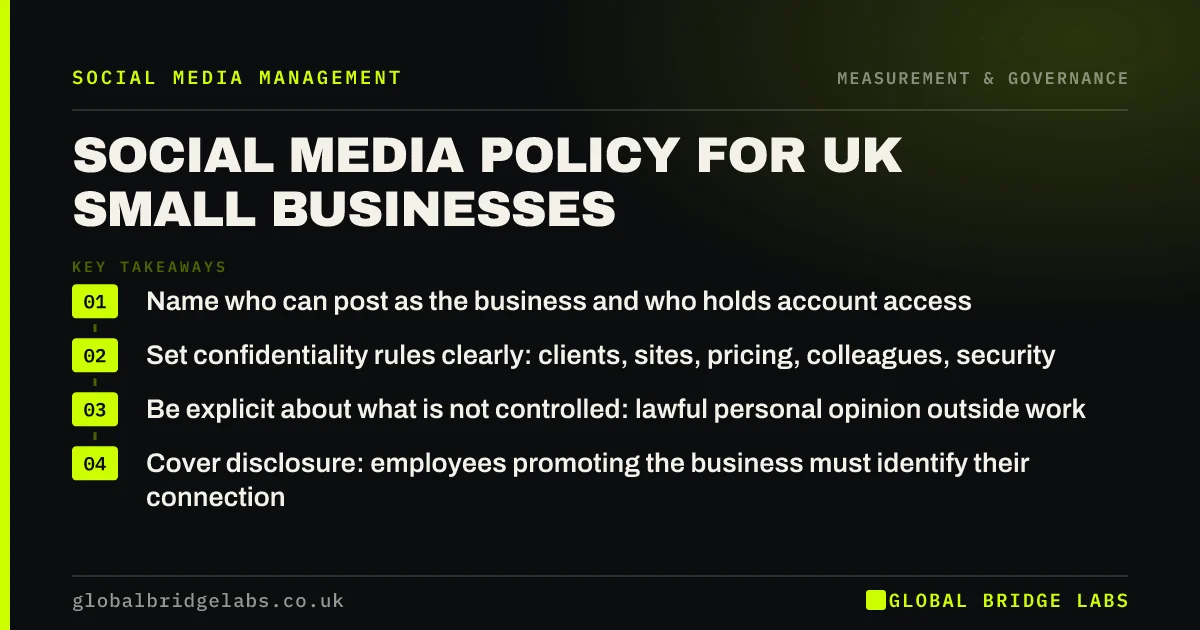
- Name who can post as the business and who holds account access.
- Set confidentiality rules clearly: clients, sites, pricing, colleagues, security.
- Be explicit about what is not controlled: lawful personal opinion outside work.
- Cover disclosure: employees promoting the business must identify their connection.
- Include the escalation route when something is published in error.
Want a two-page policy drafted for your team? Message us on WhatsApp.
Chat on WhatsApp →Why does a small business need one?
Because the alternative is deciding these questions in the middle of an incident. A policy written calmly is a far better document than one written after a post has caused a problem.
It also protects employees, which is the framing that gets it accepted. Most staff want to know what is acceptable to post about work, and an unwritten rule enforced retrospectively is unfair to them and legally risky for you.
What should it cover about brand accounts?
Ownership, access, approval and escalation. Who owns the accounts, who may publish, what requires sign-off, and what to do if something goes out that should not have.
Include the practical rules that prevent most incidents: no publishing from personal devices without account separation, two-factor authentication on every account, and immediate access removal when someone leaves.
What can you reasonably ask of personal accounts?
You can require confidentiality, prohibit harassment of colleagues, require disclosure when promoting the business, and prohibit content that would clearly damage the business, such as identifiable client sites or customer details.
You cannot control lawful personal expression outside work simply because you dislike it. Employment law in the UK protects employees in this area, and dismissals connected to personal social media use have frequently been found unfair where the connection to the business was weak or the policy was unclear. Take professional advice before acting on anything contentious.
- Reasonable: confidentiality, no harassment, no client data, disclosure of connection.
- Reasonable: no posting on behalf of the business without authorisation.
- Not reasonable: controlling lawful personal opinion unconnected to work.
- Grey area: content that identifies the employer while causing reputational harm. Take advice.
What about employee advocacy?
Encourage it, and make disclosure a requirement. Employees sharing company content reach audiences a business page cannot, and on LinkedIn in particular this is the main distribution mechanism available to a small firm.
Two rules make it safe. Employees must identify their connection to the business when promoting it, which the CAP Code requires, and they must never present personal opinion as an official position. Provide content they can share rather than asking them to invent it.
We will draft the policy and the advocacy guidance together. Message us on WhatsApp.
Chat on WhatsApp →How do you make it actually used?
Two pages, plain language, covered at induction, and signed. A policy in a handbook nobody has read provides very little protection and no practical guidance.
Review it annually and whenever platforms change materially. Include three worked examples of acceptable and unacceptable posts, because examples teach faster than rules, exactly as they do in brand voice guidelines.
What should happen when someone leaves?
Run a fixed offboarding sequence, because this is where the most expensive social media failures in small businesses actually occur.
Remove their access from every page, ad account and scheduling tool on the day. Change any shared passwords they knew, which is a reason not to have shared passwords in the first place. Transfer ownership of anything created under their personal account. Check whether the account recovery email is theirs. And review any scheduled content they queued.
Do the same when an agency relationship ends, including reclaiming ownership of the ad account and exporting creative files and audience definitions before access is withdrawn on either side.
- Remove access from pages, ad accounts and tools on the day.
- Transfer anything created under a personal account.
- Confirm recovery emails point to a shared business address.
- Review and clear content they had queued.
- Apply the same sequence when an agency contract ends.
How do you introduce a policy without it landing badly?
Frame it as protection rather than restriction, and be specific about what it does not cover. A policy introduced without that framing is read as surveillance, and the result is a team that stops sharing company content altogether.
Say plainly in the document that you are not monitoring personal accounts and that lawful personal expression unconnected to work is not your business. That single paragraph does more for acceptance than anything else in it.
Introduce it at a team meeting rather than by email, take questions, and use three real examples. Most of the questions people actually have are practical, such as whether they can mention where they work or post a photo taken on site, and answering those in the room removes most of the anxiety.
- Frame as protection, and say what is not covered.
- State explicitly that personal accounts are not monitored.
- Introduce in person, not by email.
- Answer the practical questions with real examples.
Next step
Two pages written calmly now is worth considerably more than any amount of drafting during an incident.
Message us on WhatsApp for a social media policy and advocacy guide for your team.
Chat on WhatsApp →Sources and further reading
- Lawful basis for processing personal data · Information Commissioner's Office
- Recognising ads: brand-owned and paid social media · ASA / CAP
Frequently asked questions
Does a small business need a social media policy?
Yes, even with a handful of staff. Two pages covering who may post as the business, confidentiality expectations, disclosure when promoting the company, and what to do when something goes out in error prevents most incidents and protects employees as well.
Can I discipline an employee for a personal social media post?
Only in limited circumstances, and you should take professional advice first. UK employment law protects lawful personal expression, and dismissals connected to personal social media use have frequently been found unfair where the policy was unclear or the link to the business was weak.
Should employees be encouraged to share company content?
Yes. Employee sharing reaches audiences a company page cannot, particularly on LinkedIn. Require them to identify their connection to the business, which the CAP Code expects, and supply content to share rather than asking them to create it.
What should a social media policy not do?
It should not attempt to control lawful personal expression unconnected to work, and it should not be so long that nobody reads it. Two pages of plain language covered at induction provides far more practical protection than a detailed document in a handbook.
Written by

Global Bridge Labs (GBL) is a UK–Sri Lanka partner for social media, websites and BPO. Everything here comes from client delivery, not theory.