On this page
- 01Short answer
- 02What content actually sells product?
- 03Which formats work?
- 04How do you handle delivery and returns questions?
- 05Where does paid social fit?
- 06Should you sell in-feed or on your own site?
- 07What does this look like in practice?
- 08How do you use social around peak trading?
- 09How do you use social for retention, not just acquisition?
- 10Next step
- 11Sources and further reading
- 12Frequently asked questions
Short answer
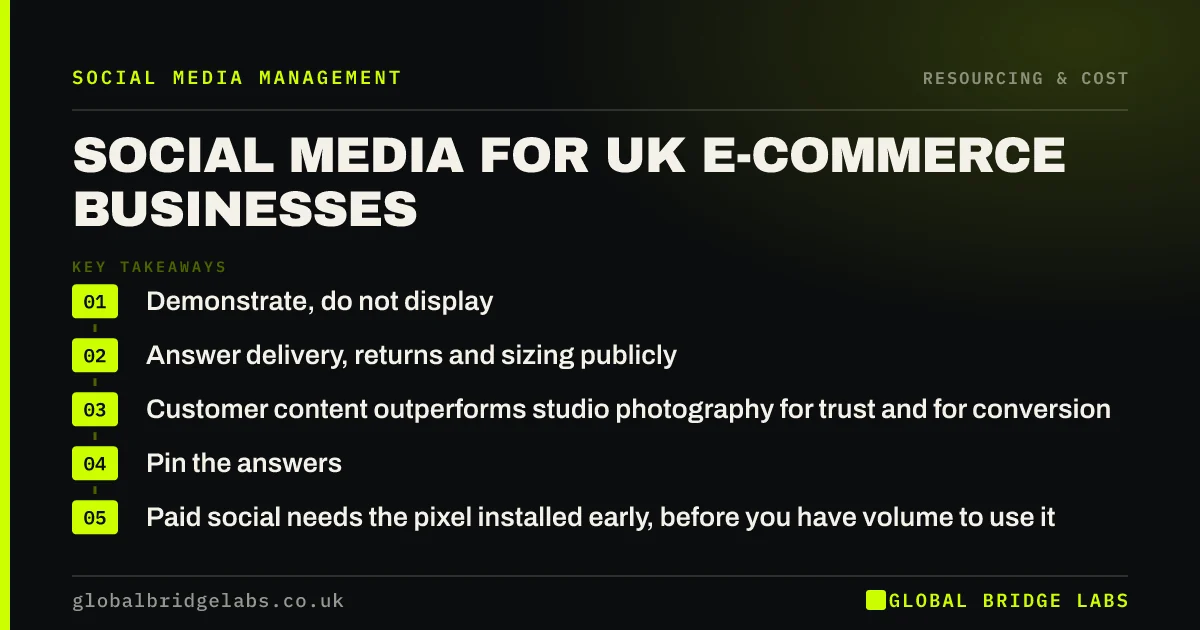
E-commerce social media works when it removes purchase friction rather than showing products attractively. The content that sells answers sizing, delivery, returns and whether the product does what the photo implies. Video demonstration plus customer content outperforms studio photography for almost every UK small brand.
- Demonstrate, do not display. Show the product being used, at real scale.
- Answer delivery, returns and sizing publicly. They are the top three purchase blockers.
- Customer content outperforms studio photography for trust and for conversion.
- Pin the answers. Most profile visitors arrive with the same three questions.
- Paid social needs the pixel installed early, before you have volume to use it.
Want a content plan built around your top purchase blockers? Message us on WhatsApp.
Chat on WhatsApp →What content actually sells product?
Content that resolves doubt. Most people who do not buy have a specific unanswered question, and the same three or four questions account for most abandoned purchases in any given catalogue.
Find yours by reading pre-purchase messages and returns reasons. Then make content that answers each one directly, and pin it. This is unglamorous and it consistently outperforms aspirational content for small UK brands without the budget to build desire at scale.
Which formats work?
Four, and they are consistent across categories.
- Demonstration: the product used in real conditions, at real scale, unedited.
- Comparison: this versus the cheaper alternative, honestly.
- Unboxing and first impressions, ideally filmed by a customer.
- Problem-solving: the situation the product exists for, shown before the product appears.
How do you handle delivery and returns questions?
Publicly, repeatedly, and in the caption rather than only in a policy page. Delivery timing and returns terms are the most common comment questions on UK e-commerce posts, and leaving them unanswered in a comment section costs sales from everyone else reading.
Under UK consumer law, distance selling gives consumers a cancellation right for most goods, and the clearer you are about how returns work, the fewer purchase hesitations you create. Treating the returns policy as marketing content rather than legal text is a genuine conversion advantage.
We will build the content that answers your top purchase blockers. Message us on WhatsApp.
Chat on WhatsApp →Where does paid social fit?
Earlier than for service businesses, because e-commerce has the conversion volume for platforms to optimise properly.
Install the pixel or conversions API before you need it, so retargeting audiences accumulate. Then start by promoting organic content that already performed, and move to conversion-optimised campaigns once you exceed roughly 50 purchases a month, which is the point at which the platform can learn from your data.
Should you sell in-feed or on your own site?
Both, selectively. In-feed checkout suits impulse-priced lines under about £50 where the purchase decision is quick. Higher-value and repeat-purchase products belong on your own site, where margins and customer data are yours.
Model the commission and the higher return rates that in-feed purchases produce before committing a catalogue to it, because both are usually worse than expected and can eliminate margin on thinner lines.
What does this look like in practice?
A pattern in e-commerce: strong studio photography, healthy reach, and a conversion rate that will not move, with comment sections full of the same three questions about sizing, delivery timing and material.
One pinned video answering all three, the answers added to the first line of product captions, and customer footage posted alongside studio images is what shifts it. Conversion improves without any change in traffic, because the content finally addresses what was actually stopping people.
How do you use social around peak trading?
Decide the cut-off dates and publish them early, because delivery certainty converts better than discounting during UK peak periods.
Three things earn their place: the last order dates for each delivery option, stated plainly and repeated; stock honesty, including what has sold out, which builds more trust than pretending everything is available; and a clear returns extension over the gifting period if you offer one, since it removes the main hesitation on gift purchases.
Plan the content in September and keep post-peak January content ready as well. The period immediately after peak is when returns, exchanges and first-time customers all arrive at once, and it is usually the least prepared-for month in the year.
- Publish last order dates early and repeat them.
- Be honest about sold-out lines. It builds trust.
- State any returns extension clearly for gift purchases.
- Prepare January content in advance. Post-peak is the least planned month.
How do you use social for retention, not just acquisition?
Most e-commerce social budget goes to finding new customers, while the cheapest revenue available sits with people who have already bought once.
Three things work. Content that helps people use what they bought, which reduces returns as well as prompting repeat purchase. Restock and new-line announcements aimed at existing customers rather than at everyone. And genuinely responding to tagged posts from customers, which is the most reliable way to produce more of them.
Measure it separately. Repeat purchase rate among people who follow you, compared with those who do not, is a number most small brands have never looked at and one that frequently justifies the whole channel on its own.
- Post content that helps people use what they bought.
- Aim restock and new-line posts at existing customers.
- Respond to every tagged customer post.
- Measure repeat purchase rate among followers separately.
Next step
If reach is fine and conversion is not, the answer is almost always in your comment sections and your returns reasons.
Message us on WhatsApp for an e-commerce social media plan built around your purchase blockers.
Chat on WhatsApp →Sources and further reading
- Online and distance selling for businesses · GOV.UK
- Publishing consumer reviews and complying with consumer protection law · Competition and Markets Authority
Frequently asked questions
What should an e-commerce brand post on social media?
Content that resolves doubt: demonstrations at real scale, honest comparisons, customer footage and answers to sizing, delivery and returns questions. The same three or four unanswered questions account for most abandoned purchases in any catalogue.
Does user-generated content outperform studio photography?
For trust and conversion in small UK brands, usually yes. Customer footage shows the product at real scale in real conditions, which is exactly what resolves the doubt studio images create. Use both, with customer content doing the persuading.
When should an e-commerce business start paid social?
Install the pixel immediately so retargeting audiences accumulate, then start by promoting organic content that already performed. Move to conversion-optimised campaigns once you exceed roughly 50 purchases a month, which is when the platform can learn effectively.
Should I sell through social platforms or my own website?
In-feed checkout suits impulse lines under about £50. Keep higher-value and repeat-purchase products on your own site, where margin and customer data are yours. Model platform commission and higher in-feed return rates before committing.
Written by

Global Bridge Labs (GBL) is a UK–Sri Lanka partner for social media, websites and BPO. Everything here comes from client delivery, not theory.