On this page
- 01Key takeaways
- 02Which platform should lead a product launch?
- 03What does the three-phase structure look like?
- 04Why does the waiting list matter so much?
- 05Which platform suits which launch type?
- 06What should you avoid on launch day?
- 07What does this look like in practice?
- 08What should you do the week after launch?
- 09Next step
- 10Sources and further reading
- 11Frequently asked questions
Key takeaways
Launch on the channel where you already have an audience, not the one that suits the product. A launch needs existing attention on day one, and no platform will build that from nothing in the four weeks before your date.
- Launch where your audience already is. Building a new channel for a launch fails.
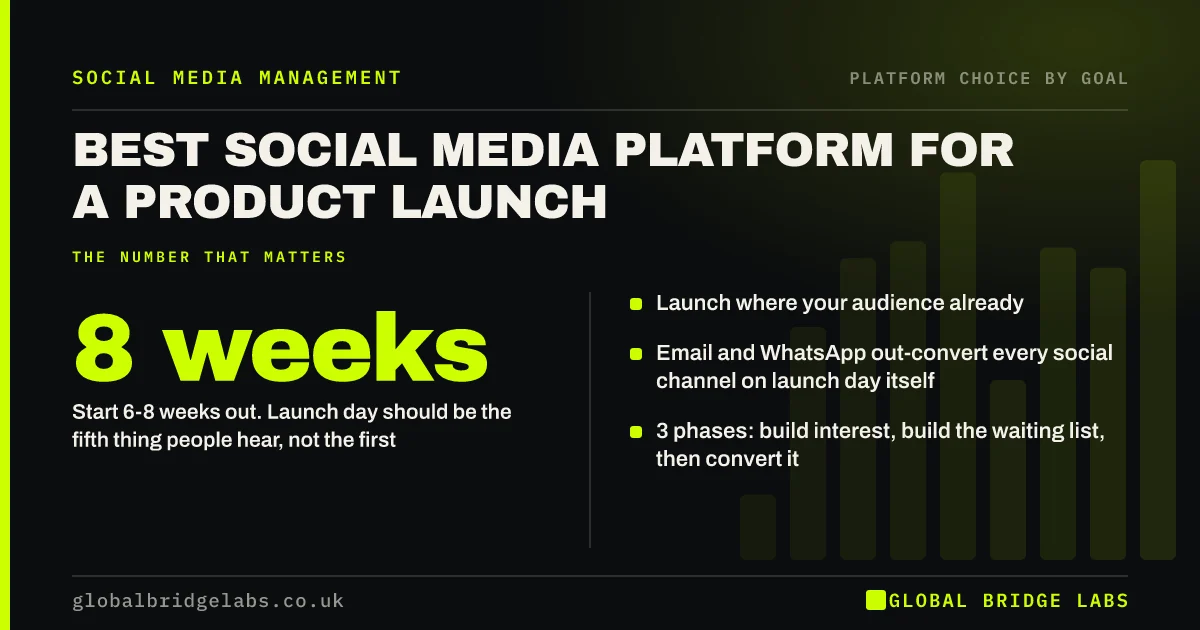
- Start 6-8 weeks out. Launch day should be the fifth thing people hear, not the first.
- Email and WhatsApp out-convert every social channel on launch day itself.
- 3 phases: build interest, build the waiting list, then convert it.
- The waiting list is the launch. Everything before it exists to build that list.
Planning a launch? We will build the 8-week plan with you on WhatsApp.
Chat on WhatsApp →Which platform should lead a product launch?
Whichever one already has your audience's attention, because a launch consumes attention rather than creating it. The single most common UK small business launch mistake is starting a new channel six weeks before launch day and expecting it to deliver.
The corollary is that your best launch channel is usually email or WhatsApp rather than social at all, because those reach everyone you send to. Social builds the list; the list produces the launch day revenue.
What does the three-phase structure look like?
Eight weeks, three phases, with the waiting list as the central mechanic rather than an afterthought.
- Weeks 1-3, interest: talk about the problem, not the product. Build relevance.
- Weeks 4-6, list: show enough to make people want it and open a waiting list.
- Week 7, preview: give the list something the public does not get.
- Week 8, launch: convert the list first, then announce publicly.
- Post-launch: the first customers become the proof for the next four weeks.
Why does the waiting list matter so much?
Because it converts launch day from a hope into an arithmetic problem. A list of 300 people who asked to be told is a known quantity with a predictable conversion rate. A social post on launch day is not.
It also gives you something to measure while there is still time to react. A waiting list growing slowly in week five is a signal that the positioning is wrong, and you can change it. A quiet launch day is a signal you can do nothing about.
We will set up the waiting list mechanics for your launch. Ask on WhatsApp.
Chat on WhatsApp →Which platform suits which launch type?
The product type shifts the emphasis, though the structure stays the same.
Consumer products with visual appeal launch well on Instagram and TikTok, where discovery can add reach to the list you built. B2B products and services launch on LinkedIn, where the buyer's colleagues are also reachable. Anything bought as part of a project benefits from Pinterest before the launch, because the saving behaviour starts months ahead of the purchase.
What should you avoid on launch day?
Announcing to strangers. A launch post to an audience that has heard nothing for eight weeks reaches a fraction of your followers and converts almost none of them, which is why so many launches feel like shouting into a room.
Also avoid a single-day launch window. Spread it across a week with different angles: what it does on day one, who it is for on day three, what early customers say on day five. Most people who buy will not see your first post.
What does this look like in practice?
A UK skincare brand launched a new range with a single announcement post and a discount code. The post reached a small fraction of followers and first-week sales were disappointing despite good product and good photography.
The second launch used eight weeks, a waiting list of about 400 built through problem-led content, and a preview email two days early. First-week revenue was several times higher, and the largest single day was the day the list was emailed rather than the public announcement.
What should you do the week after launch?
Keep going, because most businesses stop the day after and lose the easiest sales of the whole campaign. The week following a launch is when your first customers can be shown using the thing, which is more persuasive than anything you said beforehand.
Plan four post-launch posts before launch day: the first customers, a question that came up repeatedly, what you got wrong and fixed, and a final reminder for anyone who meant to buy and forgot. That last one consistently outperforms the launch announcement itself.
Then stop and review while it is fresh. Note what the waiting list converted at, which post produced the most orders, and what people asked that you had not anticipated. Those three notes make the next launch materially better.
Next step
Work backwards eight weeks from your launch date and put the waiting list opening at week four. If your launch is sooner than that, delay the date rather than compressing the plan, because a compressed launch reaches the same small group twice.
Message us on WhatsApp and we will map your launch back from the date.
Chat on WhatsApp →Sources and further reading
- Meta Business Help Centre · Meta
- Electronic and telephone marketing under PECR · Information Commissioner's Office
Frequently asked questions
Which platform is best for launching a product?
Whichever one already holds your audience's attention. A launch consumes attention rather than creating it, so starting a new channel weeks before launch day reliably fails. Email and WhatsApp usually out-convert social on the day itself.
How far ahead should a product launch start?
Six to eight weeks, structured as three phases: build interest in the problem, open a waiting list, then convert the list before announcing publicly. Launch day should be the fifth thing people hear, not the first.
Why do social media launches underperform?
Because a single announcement post reaches only a fraction of followers and converts almost none of them. Without a waiting list built beforehand, launch day is a hope rather than a known quantity with a predictable conversion rate.
How long should a launch window last?
About a week, with different angles on different days: what it does, who it is for, what early customers say. Most people who eventually buy will never see your first post, so a single-day window wastes the build-up.
Written by
Global Bridge Labs (GBL) is a UK–Sri Lanka partner for social media, websites and BPO. Everything here comes from client delivery, not theory.