On this page
- 01Short answer
- 02Why does UGC work better than your own content?
- 03How do you ask for it?
- 04What permission do you actually need?
- 05How do you turn reviews into content?
- 06What about paid creators?
- 07What does this look like in practice?
- 08How do you organise the content you collect?
- 09Next step
- 10Sources and further reading
- 11Frequently asked questions
Short answer
User-generated content (UGC) is any photo, video, review or comment your customers create about your business that you then reuse in your own marketing. For small businesses it is the highest-trust content available and the cheapest to produce, but it requires explicit permission and a system for asking.
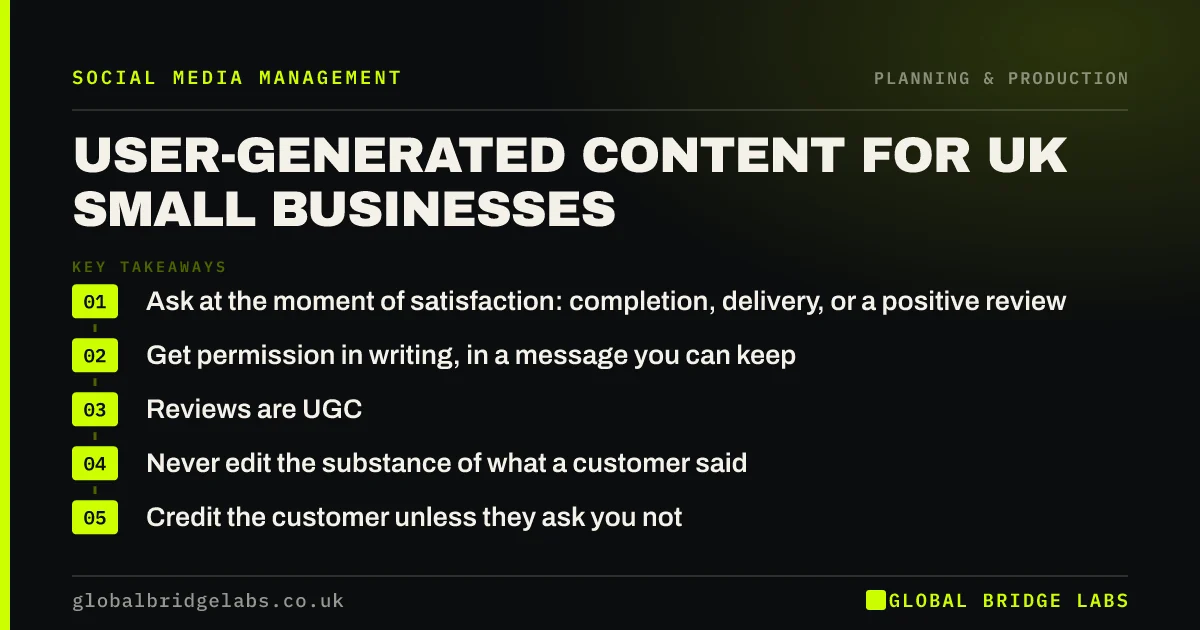
- Ask at the moment of satisfaction: completion, delivery, or a positive review.
- Get permission in writing, in a message you can keep. A comment saying yes is enough if you screenshot it.
- Reviews are UGC. Turn a strong review into a post with the reviewer's agreement.
- Never edit the substance of what a customer said. Trim for length only.
- Credit the customer unless they ask you not to.
Want the permission wording we use with UK clients? Message us on WhatsApp.
Chat on WhatsApp →Why does UGC work better than your own content?
Because the source is not the seller. A customer photograph of your work carries evidential weight that an identical photograph taken by you does not, for the same reason a review is more persuasive than a claim.
For small UK businesses competing against larger marketing budgets, this is one of the few structural advantages available: you are closer to your customers than a national competitor is, and that proximity produces content they cannot buy.
How do you ask for it?
Timing does most of the work. Ask when the customer is most pleased, which is usually within 48 hours of completion or delivery, and make the request specific and small.
Not: would you mind sharing some photos. Instead: if you get a chance to take a photo of the finished kitchen this week, we would love to show it, and we will tag you unless you would rather we did not. A specific request with a named subject and a time frame gets a response; a general one does not.
- Ask within 48 hours of the good outcome.
- Request one specific thing, not content in general.
- Make the default clear: tagged or anonymous, their choice.
- Give a reason it helps you. People help small businesses they like.
- Follow up once, never twice.
What permission do you actually need?
Two things: copyright permission from whoever took the photo or video, and, where a person is identifiable, a lawful basis under UK GDPR for using their image in marketing.
In practice, a written message saying yes, you can use these photos on your social media and website covers both for a small business, provided you keep the message. The Information Commissioner's Office treats marketing use of identifiable individuals as personal data processing, so keep a simple record of who consented and when, and honour a later withdrawal promptly.
We will draft a permission request and record-keeping process for your business. Message us on WhatsApp.
Chat on WhatsApp →How do you turn reviews into content?
Take one specific sentence from the review, not the whole thing, and build the post around the thing that was praised. A review that mentions you turned up when you said you would is a post about scheduling, illustrated with the job.
Never fabricate, edit for meaning, or incentivise reviews in a way that conditions them on being positive. The Competition and Markets Authority has been explicit that incentivised and fake reviews mislead consumers, and the reputational risk to a local business far exceeds any short-term benefit.
What about paid creators?
Paid creator content is not UGC, even when it looks identical, and treating it as such is where small businesses get into trouble. If you pay, gift, or provide anything of value in exchange for a post, it is advertising and must be clearly labelled under the CAP Code.
This is enforced, and the label has to be obvious rather than buried in hashtags. Use a clear ad disclosure at the start of the caption.
What does this look like in practice?
A pattern in e-commerce: hundreds of customer photos sitting in unread emails and tagged posts, none of it usable because nobody asked for permission.
One line added to the post-purchase email sequence and a saved reply for tagged posts is enough to fix it. Within a quarter the business has a consent-recorded library large enough to supply a meaningful share of the content calendar, at a production cost of effectively nothing.
How do you organise the content you collect?
Keep one folder with a consent record attached, because the constraint on using customer content is almost never supply and almost always being able to prove you were allowed to use it.
A workable structure: one folder per customer or job, containing the media and a screenshot or copy of the permission message, with the date in the folder name. When you want to use something eighteen months later, the evidence is beside it rather than somewhere in a phone.
Add a simple index with one line per item: what it is, who gave permission, when, and whether they wanted crediting. That index is what lets somebody else use the library safely, which matters if the person who collected it leaves or you bring in a delivery partner.
- One folder per customer, media and permission stored together.
- Date in the folder name.
- One-line index: item, permitter, date, crediting preference.
- The index is what makes the library usable by anyone else.
Next step
UGC is a systems problem, not a creative one. The businesses that have a lot of it are simply the ones that ask consistently.
Message us on WhatsApp to set up a UGC request and permission process for your business.
Chat on WhatsApp →Sources and further reading
- What is valid consent? · Information Commissioner's Office
- Publishing consumer reviews and complying with consumer protection law · Competition and Markets Authority
Frequently asked questions
Do I need permission to repost a customer's photo?
Yes. The customer owns the copyright in their photo, and if anyone is identifiable you also need a lawful basis under UK GDPR. A written message granting permission covers both. Keep the message, and honour any later request to remove the content.
Can I use a Google review in a social post?
Yes, reviews are published publicly, but good practice is to ask the reviewer first and to quote accurately without editing the meaning. Never fabricate reviews or incentivise positive ones, which the Competition and Markets Authority treats as misleading consumers.
How do I get more customers to send content?
Ask within 48 hours of the good outcome, request one specific thing rather than content in general, and make tagging optional. A specific, timely, small request gets responses. A general one at the wrong moment almost never does.
Is paid creator content the same as UGC?
No. If you pay, gift or provide anything of value in exchange for a post, it is advertising and must be clearly labelled under the CAP Code, at the start of the caption rather than buried in hashtags. Genuine unpaid customer content needs no ad label.
Written by

Global Bridge Labs (GBL) is a UK–Sri Lanka partner for social media, websites and BPO. Everything here comes from client delivery, not theory.