On this page
- 01Short answer
- 02What is social commerce?
- 03Which products actually sell in-feed?
- 04What are the real costs?
- 05What do you give up?
- 06How should you run both?
- 07What does this look like in practice?
- 08What are your obligations selling through social?
- 09How do you handle customer service in-platform?
- 10Next step
- 11Sources and further reading
- 12Frequently asked questions
Short answer
Social commerce works for low-consideration products under about £50 with strong visual appeal and a clear demonstration. Above that price point, or where the purchase needs research, social should drive traffic to your own site instead. Model the fees and returns before committing, because both are higher than most small businesses expect.
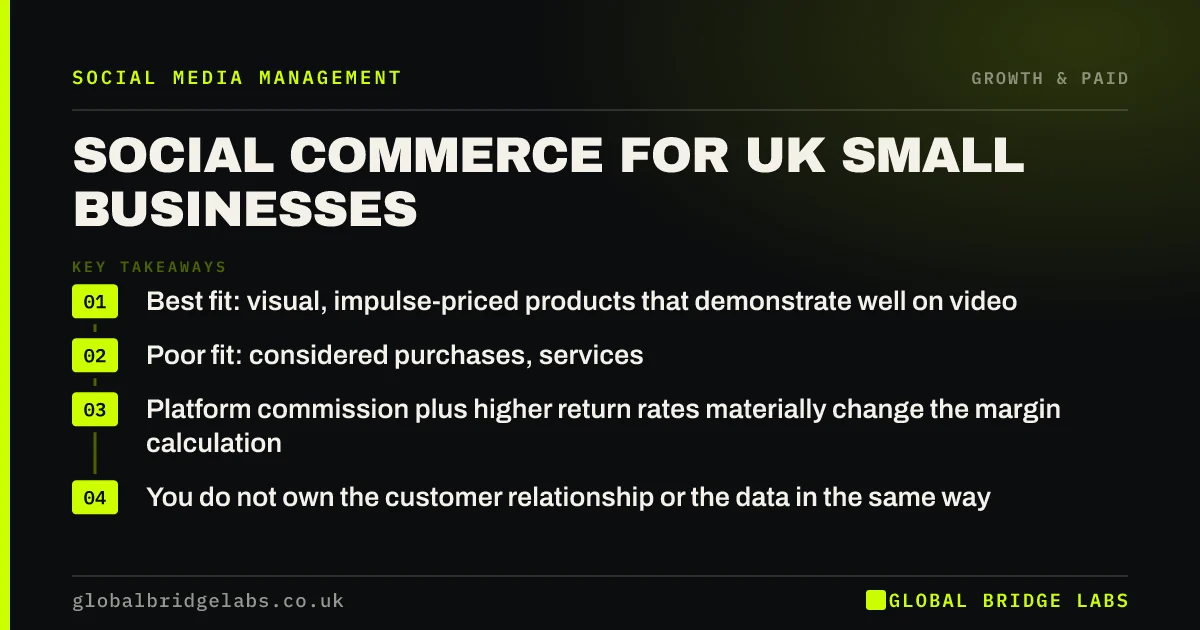
- Best fit: visual, impulse-priced products that demonstrate well on video.
- Poor fit: considered purchases, services, anything needing configuration or advice.
- Platform commission plus higher return rates materially change the margin calculation.
- You do not own the customer relationship or the data in the same way.
- Run both: in-feed checkout for impulse lines, your own site for everything else.
Want the margin modelled before you commit? Send us your product costs on WhatsApp.
Chat on WhatsApp →What is social commerce?
Social commerce is selling directly inside a social platform, with checkout completed in the app rather than on your own website.
The distinction from social-driven e-commerce matters. Driving traffic to your own shop is not social commerce, and it has different economics: lower fees, full data ownership, and more friction at the point of purchase.
Which products actually sell in-feed?
Products that can be understood in fifteen seconds, cost little enough to buy without deliberation, and look good on video.
That covers cosmetics, food and drink, accessories, homewares, craft products and low-cost tools. It does not cover furniture, services, bespoke work, anything requiring sizing judgement, or anything a buyer would want to research first.
- Under roughly £50, where impulse purchasing is realistic.
- Visually demonstrable: the product does something you can show.
- No configuration, sizing complexity or delivery conditions.
- Repeatable stock, because virality is unpredictable.
What are the real costs?
Three lines to model before you start: platform commission on each sale, higher return rates than your own site typically produces, and the cost of servicing customer questions inside the platform.
Return rates deserve particular attention. Impulse purchases made in a feed are returned more often than considered purchases made on a website, and for a small business with thin margins that difference can eliminate the profit entirely. Model it at a pessimistic rate and see whether it still works.
We will model fees, returns and margin with you before you commit. Message us on WhatsApp.
Chat on WhatsApp →What do you give up?
Customer data, direct relationship and pricing control, to varying degrees by platform.
For a business building a repeat-purchase base, this is a real cost. A customer who buys through a platform is the platform's customer as much as yours, and reaching them again typically means paying for it. For one-off impulse products the trade is often worth it; for anything with a repeat cycle, think carefully.
How should you run both?
Put a small number of impulse-priced lines into in-feed checkout and keep everything else on your own site, with social driving traffic to it.
That structure captures the impulse purchases that would not have survived the journey to a website, while keeping your higher-value and repeat-purchase business under your own control. It also gives you a clean comparison of conversion rates between the two routes.
What does this look like in practice?
A pattern worth modelling before you commit: a brand moves its full catalogue into in-feed checkout, including items well above impulse price. Sales rise and margin falls, because returns on the higher-priced lines run above the site average and commission applies to everything.
The fix is selective: a few impulse lines in-feed, everything else driving to the site. Total revenue lands in a similar place and contribution improves, which is the number that actually mattered.
What are your obligations selling through social?
The same consumer law obligations as any other distance selling, regardless of where the checkout sits. Clear pricing including VAT for consumers, clear delivery terms, and the statutory cancellation rights that apply to most goods bought at a distance.
Two things catch small businesses out specifically. Platform-driven urgency mechanics can conflict with the requirement not to mislead about availability. And returns handled through a platform still leave you responsible for your legal obligations to the consumer, whatever the platform's own policy says.
Write your terms once, make them available in the profile as well as the listing, and keep them identical to the ones on your website. Divergence between the two is where disputes start.
- Consumer distance selling rules apply wherever checkout happens.
- Prices to consumers include VAT; delivery terms stated clearly.
- Urgency mechanics must not misrepresent availability.
- Keep social and website terms identical.
How do you handle customer service in-platform?
Plan for it before you sell anything, because in-feed purchases generate service questions in comments and messages rather than through your normal support route, and those are visible to everyone.
Two arrangements make it manageable. Pin a comment on every selling post answering delivery timing, returns and sizing, which removes most of the repeat questions before they are asked. And set a rule that order-specific queries are moved to messages immediately, since order numbers and addresses should never be posted in a public comment.
Budget the time honestly. A selling post generates several times the comment volume of an ordinary post, and unanswered service questions under a product post cost sales from everyone else reading them.
- Pin an answer covering delivery, returns and sizing on every selling post.
- Move order-specific queries to messages immediately.
- Never let order numbers or addresses appear in public comments.
- Budget several times the usual comment volume on selling posts.
Next step
Social commerce is a margin question rather than a marketing question. Model it before you build it.
Message us on WhatsApp and we will model social commerce margins for your product range.
Chat on WhatsApp →Sources and further reading
- Online and distance selling for businesses · GOV.UK
- Publishing consumer reviews and complying with consumer protection law · Competition and Markets Authority
Frequently asked questions
Is social commerce worth it for small businesses?
For visual products under about £50 that demonstrate well on video, yes. Above that, or where buyers want to research first, drive traffic to your own site instead. Model platform commission and higher return rates before committing.
What are the fees for selling on social platforms?
Platforms charge commission per sale, which varies by platform and category and changes periodically. Model it alongside a pessimistic return rate, since impulse purchases made in-feed are returned more often than considered purchases made on a website.
Do I own the customer data from social commerce sales?
Not in the same way as a sale on your own site. Access to customer detail is limited and reaching those buyers again typically means paying the platform. For repeat-purchase businesses that is a meaningful long-term cost.
Should I sell on social media or my own website?
Both, selectively. Put a few impulse-priced lines into in-feed checkout to capture purchases that would not survive the trip to a website, and keep higher-value and repeat-purchase products on your own site where margins and data are yours.
Written by

Global Bridge Labs (GBL) is a UK–Sri Lanka partner for social media, websites and BPO. Everything here comes from client delivery, not theory.