On this page
- 01Key takeaways
- 02What makes a service sensitive?
- 03What tone should you use?
- 04What should you post?
- 05What should you never post?
- 06Which rules apply?
- 07How do people make contact, and how do you measure it?
- 08What does this look like in practice?
- 09Sensitive content checklist
- 10Next step
- 11Sources and further reading
- 12Frequently asked questions
Key takeaways
Social media content for sensitive services should inform quietly and never pressure. People facing illness, debt, bereavement or legal trouble read privately and act when ready. Explain what happens, what it costs and how to get help, in a calm voice, and judge success by enquiries, not engagement.
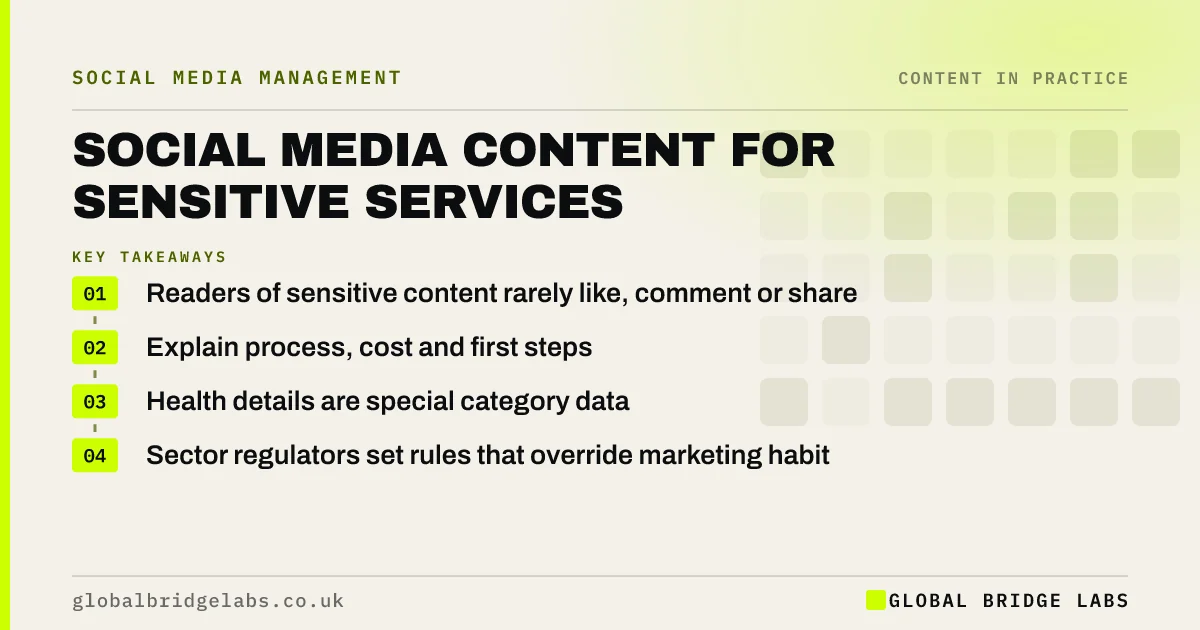
- Readers of sensitive content rarely like, comment or share.
- Explain process, cost and first steps. Never use fear.
- Health details are special category data. Never share them.
- Sector regulators set rules that override marketing habit.
Unsure how to post about a sensitive service? Message us on WhatsApp.
Chat on WhatsApp →What makes a service sensitive?
A service is sensitive when people need it at a difficult time or would not want others to know they are using it: funeral care, family law, debt advice, mental and sexual health, addiction support, care for relatives. The buyer is often anxious, and may be vulnerable.
What tone should you use?
Use a calm, plain, practical tone. Write as a knowledgeable person would speak to someone having a hard week: clear, unhurried and without euphemism or drama. Avoid exclamation marks, urgency and humour about the subject. Kindness in this setting is mostly clarity.
What should you post?
Post what removes uncertainty: what happens when someone contacts you, what the first conversation covers, what it is likely to cost, how long things take, and what their options are. Introduce the people they will speak to. These are the things an anxious person needs before making a call.
- What happens first, step by step.
- Typical costs and what affects them.
- The options, explained without bias.
- Who they will speak to.
- How to make contact privately.
Want sensitive topics drafted with care? Message us on WhatsApp and we will discuss your requirements.
Chat on WhatsApp →What should you never post?
Never post anything that could identify a client, exploits fear or guilt, promises an outcome or targets people because of their vulnerability. Information about someone's health is special category data under UK GDPR and needs the highest level of care. If in doubt, leave it out.
- Client stories without explicit, informed consent.
- Fear, guilt or shame as a motivator.
- Guaranteed outcomes.
- Before and after images of medical conditions without care.
- Replies in public that confirm someone is a client.
Which rules apply?
The advertising codes require marketing to be responsible and not to cause fear or distress without good reason. Sector rules add more: the Financial Conduct Authority (FCA) governs financial promotions including debt services, the Solicitors Regulation Authority (SRA) governs solicitors' publicity, and health advertising has its own restrictions. Check with your regulator.
How do people make contact, and how do you measure it?
People make contact privately, often by phone or a discreet message, and seldom from the post itself. Offer a private route in every post and never ask for comments. Measure enquiries and ask gently how people found you. Public engagement will be low and that is appropriate.
What does this look like in practice?
A pattern we see with UK firms in sensitive sectors: either no social media at all, from fear of getting it wrong, or generic awareness-day graphics. A small set of calm, factual posts explaining the first steps and costs is usually both safer and more useful than either.
Sensitive content checklist
Check every post.
- The tone is calm and plain.
- It explains a step, a cost or an option.
- No client could be identified.
- No fear, guilt or pressure is used.
- No outcome is promised.
- A private contact route is given.
- Sector rules have been checked.
Next step
Write one post explaining exactly what happens in the first conversation with your service. It is the question most people are too anxious to ask.
Message us on WhatsApp to talk through content for your service, or book a 30-minute consultation.
Chat on WhatsApp →Sources and further reading
- Special category data · Information Commissioner's Office
- Financial promotions and adverts · Financial Conduct Authority
- Transparency rules · Solicitors Regulation Authority
- Recognising ads: social media and influencer marketing · ASA / CAP
Frequently asked questions
How do you market a sensitive service on social media?
Inform calmly and never pressure. Explain what happens when someone gets in touch, what it is likely to cost, the options available and how to make contact privately. Avoid fear, guarantees and anything that identifies a client. Judge success by enquiries, not likes.
Can I share client stories for a sensitive service?
Only with explicit, informed consent, and often it is better not to. Health and similar details need special care under UK GDPR. A general description of a common situation is usually safer and just as helpful. If you do share one, let the client approve the final wording.
Why is engagement so low on sensitive topics?
Because people do not want to be seen engaging with them. They read privately and contact you by phone or message. Low public engagement is normal here. Measure enquiries and how people say they found you. Offer a private way to make contact in every post.
Are there special advertising rules for sensitive services?
Yes. Marketing must not cause fear or distress without justification, and sectors such as financial services, legal services and healthcare have their own regulators and publicity rules. Check your regulator's guidance before posting. When rules conflict with marketing habit, the rules win.
Written by

Global Bridge Labs (GBL) is a UK–Sri Lanka partner for social media, websites and BPO. Everything here comes from client delivery, not theory.