On this page
- 01Short answer
- 02What is brand voice on social media?
- 03Why do most tone of voice documents fail?
- 04How do you choose three voice traits?
- 05What belongs in the words list?
- 06How should the guidelines handle complaints?
- 07Show the before and after
- 08How do you keep the voice consistent across several people?
- 09Next step
- 10Sources and further reading
- 11Frequently asked questions
Short answer
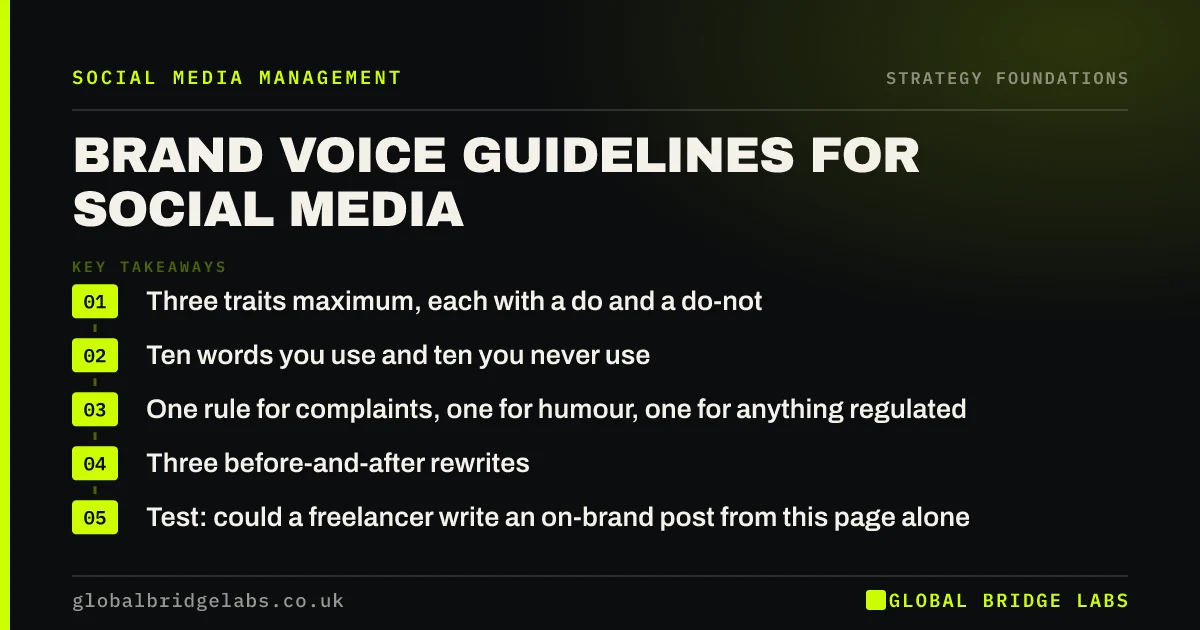
Brand voice guidelines should fit on one page: three voice traits, a short banned-words list, a rule for how you handle complaints, and three before-and-after rewrites. A 40-page brand bible is read once and then ignored by the person actually writing posts on a Tuesday.
- Three traits maximum, each with a do and a do-not.
- Ten words you use and ten you never use. Specific words, not adjectives about words.
- One rule for complaints, one for humour, one for anything regulated.
- Three before-and-after rewrites. These teach faster than any description.
- Test: could a freelancer write an on-brand post from this page alone?
Want the one-page version written for your business? Message us on WhatsApp.
Chat on WhatsApp →What is brand voice on social media?
Brand voice is the consistent set of language choices that makes your posts recognisable as yours before anyone sees the profile name.
Tone is the variable. Voice stays the same whether you are announcing a new hire or apologising for a missed appointment; tone moves between those two. Most guidelines fail because they describe a feeling rather than defining choices, and a feeling cannot be applied by a new team member under time pressure.
Why do most tone of voice documents fail?
Because they are written to be approved rather than to be used. Three traits like friendly, professional and approachable survive sign-off precisely because nobody disagrees with them, which is the same reason they change nothing.
A usable trait has an edge. Direct, meaning we state the price range even when the answer is it depends, is a trait, because it rules something out. Friendly does not rule anything out.
- Traits nobody could disagree with.
- No examples, so interpretation varies by writer.
- Rules about grammar, none about difficult situations.
- Written for the brand, not for the person posting at 4pm on a Friday.
How do you choose three voice traits?
Take the three things your best customers say about working with you, then write each as a language rule with a counter-example.
For a UK trades business that might be: Straight, we say what it costs and what it does not include. Calm, we do not use urgency language or countdowns. Proud of the work, we describe the job, not ourselves.
Each trait needs a sentence that shows what it forbids. If the trait forbids nothing, delete it and find one that does.
What belongs in the words list?
Two short columns. On the left, the words you use because they are how your customers speak. On the right, the words you never use because they make you sound like everyone else or create a claim you cannot support.
For UK SMEs, the right-hand column almost always includes guaranteed, game-changer, revolutionary, unlock, and cutting-edge. It should also include any absolute claim, because the Advertising Standards Authority applies the CAP Code to your social posts exactly as it does to paid advertising, and unsubstantiated claims are the most common reason small businesses get complaints upheld.
How should the guidelines handle complaints?
Write the rule before you need it. Ours, and the one we recommend to clients: acknowledge in public within one working hour, move detail to direct message, never argue about facts in a comment thread, and never delete a complaint unless it is abusive.
That single paragraph prevents the most damaging voice failure a small business can have, which is an owner replying personally at 11pm to a one-star review.
Show the before and after
Three rewrites teach more than three pages of description. Take real posts you have published, write the improved version beside them, and annotate what changed.
Before: We are excited to announce the launch of our brand new service offering. After: We now do emergency boiler repairs across LS1 to LS17, same day if you call before 2pm. What changed: removed the announcement framing, added the area, added the constraint that makes it useful.
Send us five of your recent posts on WhatsApp and we will send back the rewrites with the reasoning.
Chat on WhatsApp →How do you keep the voice consistent across several people?
Give everyone the same three references and review together rather than individually. Voice drifts when each writer is corrected privately, because nobody sees the pattern and the same corrections repeat for months.
Run a fifteen-minute review once a month where the team reads four recent posts against the guide and agrees what to change. It is faster than individual feedback, it teaches everyone at once, and it surfaces the cases where the guide itself is ambiguous.
Maintain a living examples file: every time a judgement call is made, add the before and after with a one-line reason. After a year that file teaches the voice better than the original page does, and it is what makes onboarding a new writer or an external partner straightforward.
- Monthly fifteen-minute group review of four recent posts.
- Correct in the open so everyone learns the same rule.
- Keep a living before-and-after examples file.
- When two people read the guide differently, the guide is wrong.
Next step
A one-page voice guide is the cheapest quality control a small marketing team can have, and it is the document that makes outsourcing production safe.
Message us on WhatsApp to get a one-page brand voice guide written for your business.
Chat on WhatsApp →Sources and further reading
Frequently asked questions
How long should brand voice guidelines be?
One page. It has to be readable in two minutes by whoever is writing a post under time pressure. Longer documents are approved and then ignored, which produces exactly the inconsistency the document was written to prevent.
Should tone of voice change by platform?
Tone flexes, voice does not. The same business can be more concise on LinkedIn and more conversational on Instagram while keeping identical rules about claims, pricing language and complaints. If the underlying rules change by platform, you have two brands.
Can we use humour as a small business?
Yes, if it is about the work rather than about people, and if one named person approves anything topical. Humour fails for small businesses when it borrows a national brand's informality without the name recognition that makes it read as confidence rather than carelessness.
Who should own brand voice if we outsource social media?
Keep voice in-house and outsource production against it. Voice depends on knowing your customers and your risk tolerance. Give your delivery partner the one-page guide, three worked rewrites and approval rights for anything regulated or topical.
Written by

Global Bridge Labs (GBL) is a UK–Sri Lanka partner for social media, websites and BPO. Everything here comes from client delivery, not theory.