On this page
- 01Key takeaways
- 02Why does regulation affect platform choice?
- 03What applies to financial services?
- 04What applies to healthcare and clinics?
- 05What applies to legal services?
- 06How should approval processes work?
- 07What does this look like in practice?
- 08What should a compliant content library contain?
- 09Next step
- 10Sources and further reading
- 11Frequently asked questions
Key takeaways
Check your regulator before you choose a channel, not after. Financial promotions, health claims, legal fee transparency and testimonial rules each restrict formats in ways that can make a platform unusable for your sector.
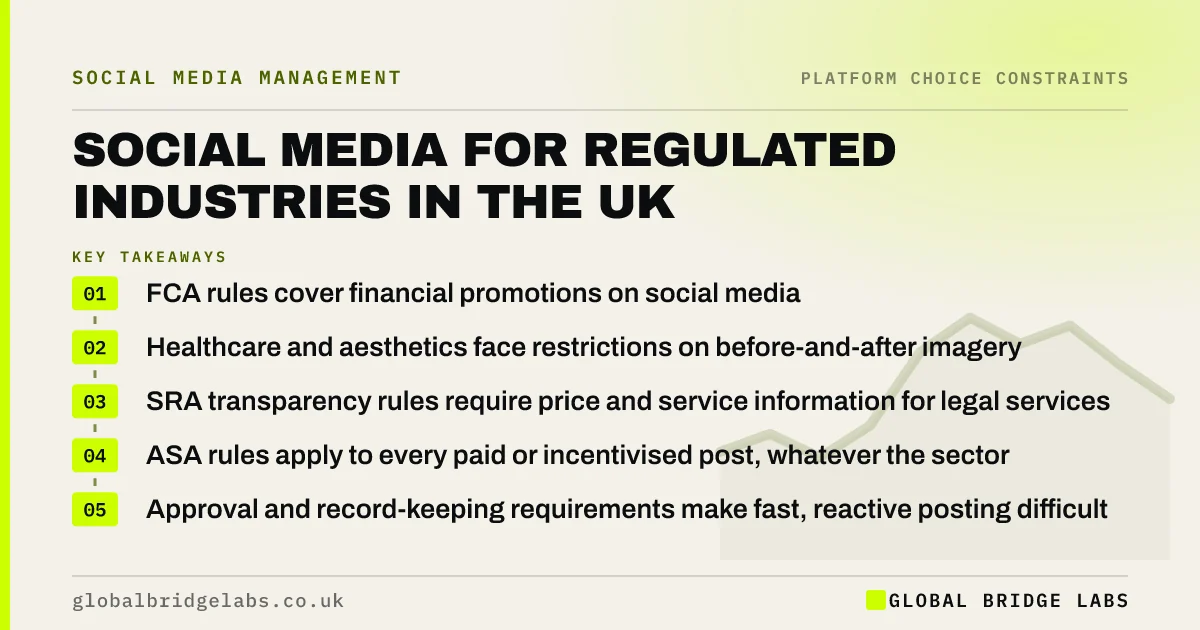
- FCA rules cover financial promotions on social media, including influencer content.
- Healthcare and aesthetics face restrictions on before-and-after imagery and claims.
- SRA transparency rules require price and service information for legal services.
- ASA rules apply to every paid or incentivised post, whatever the sector.
- Approval and record-keeping requirements make fast, reactive posting difficult.
In a regulated sector? We will check what you can post before you plan. Ask on WhatsApp.
Chat on WhatsApp →Why does regulation affect platform choice?
Because regulators restrict formats as well as claims, and some platforms are built almost entirely around the restricted format. A sector that cannot use before-and-after imagery or short-form outcome claims loses most of what makes a video-led platform work.
Checking first is far cheaper than discovering it in month four. We have seen UK clinics build a content plan around a format their regulator effectively prohibits, and the rebuild cost more than the original plan.
What applies to financial services?
The Financial Conduct Authority treats social media posts as financial promotions when they invite or induce someone into an investment or credit activity, and its expectations cover both firms and anyone promoting on their behalf.
Practically, that means promotions must be fair, clear and not misleading, risk warnings must be prominent rather than buried, and firms remain responsible for content posted by affiliates and influencers. Short formats are difficult because prominence of risk information is hard to achieve in a few seconds.
What applies to healthcare and clinics?
Several overlapping rules, depending on the service. CQC-registered providers must display their ratings. Claims about treatments must be substantiated, and the ASA has taken consistent action on health and beauty claims made on social media.
Before-and-after imagery is restricted for certain treatments and prohibited in some contexts, and testimonials referring to specific conditions or outcomes carry particular risk. Patient confidentiality applies to social media exactly as it does everywhere else, including in replies to public comments.
We will map your regulator's rules onto a content plan. Message us on WhatsApp.
Chat on WhatsApp →What applies to legal services?
Solicitors Regulation Authority transparency rules require certain price and service information to be published for specified areas of work, and firms must not make misleading claims about outcomes or expertise.
The practical effect on social media is that price content is not just permitted but expected, which is unusual and worth using. A firm that publishes clear fee information has a genuine advantage in a sector where most competitors are still vague about it.
How should approval processes work?
Built into the rhythm rather than bolted onto it, because compliance review is what kills reactive posting in regulated firms. The workable pattern is a pre-approved library plus a narrow reactive lane.
Approve a set of post templates and claims in advance so most content needs no individual sign-off. Keep a short list of subjects that may be posted same-day without review, and a clear rule that anything outside it waits. Record what was published and when, because several regulators expect it.
What does this look like in practice?
A UK mortgage brokerage built a content plan around short-form video showing rate comparisons, then discovered during compliance review that fitting required risk information into the format was not workable.
The plan was rebuilt around longer written posts explaining process rather than product, with rates handled only through properly approved material. Engagement was lower. Enquiries were better qualified, because the content attracted people who wanted to understand the process rather than chase a headline rate.
What should a compliant content library contain?
Pre-approved building blocks rather than finished posts, so the same review covers a year of content instead of a single week.
That means an approved description of each service, approved wording for any claim you make repeatedly, an approved risk or disclaimer line where one is required, and a list of subjects that may be discussed without further sign-off.
Add a short list of things that always need review before publishing: anything naming a price, anything describing an outcome, anything about a specific client, and anything reacting to news. With that split, most weeks need no compliance involvement at all, which is what makes the channel survivable.
Review the library annually rather than post by post, and update it whenever your regulator publishes new guidance. An hour a year keeps the whole system current.
Next step
Before you choose a channel, read your regulator's current guidance on promotions and check whether the format you are planning is workable. An hour of reading now avoids rebuilding a content plan later.
Message us on WhatsApp and we will plan a channel that fits your regulatory position.
Chat on WhatsApp →Sources and further reading
- Financial promotions and adverts · Financial Conduct Authority
- Transparency rules · Solicitors Regulation Authority
Frequently asked questions
Can regulated businesses use social media in the UK?
Yes, but the rules restrict formats as well as claims. Check your regulator's guidance before choosing a channel, because some platforms are built around formats, such as short outcome claims, that your sector effectively cannot use.
What are the rules for financial promotions on social media?
The FCA treats posts that invite or induce investment or credit activity as financial promotions. They must be fair, clear and not misleading, with risk warnings prominent rather than buried, and firms remain responsible for content posted by affiliates and influencers.
Can clinics post before and after photos?
It depends on the treatment and on your regulator. Such imagery is restricted for certain treatments and prohibited in some contexts, and any health claim must be substantiated. Patient confidentiality applies to replies to public comments exactly as it does everywhere else.
How should regulated firms handle content approval?
Pre-approve a library of templates and standard claims so that most posts need no individual sign-off, keep a narrow same-day reactive lane, and record what was published and when. Bolting a review onto every single post kills the channel within a quarter.
Written by
Global Bridge Labs (GBL) is a UK–Sri Lanka partner for social media, websites and BPO. Everything here comes from client delivery, not theory.