On this page
- 01The checklist
- 02Why start with an audit?
- 03How do you audit access properly?
- 04What should you look for in content performance?
- 05How do you audit the conversion path?
- 06What compliance items should you check?
- 07What do you do with the findings?
- 08What does a good audit output look like?
- 09Next step
- 10Sources and further reading
- 11Frequently asked questions
The checklist
Run this before any change to your social media strategy. Two hours, five sections, and it consistently surfaces problems that no amount of new content would have fixed.
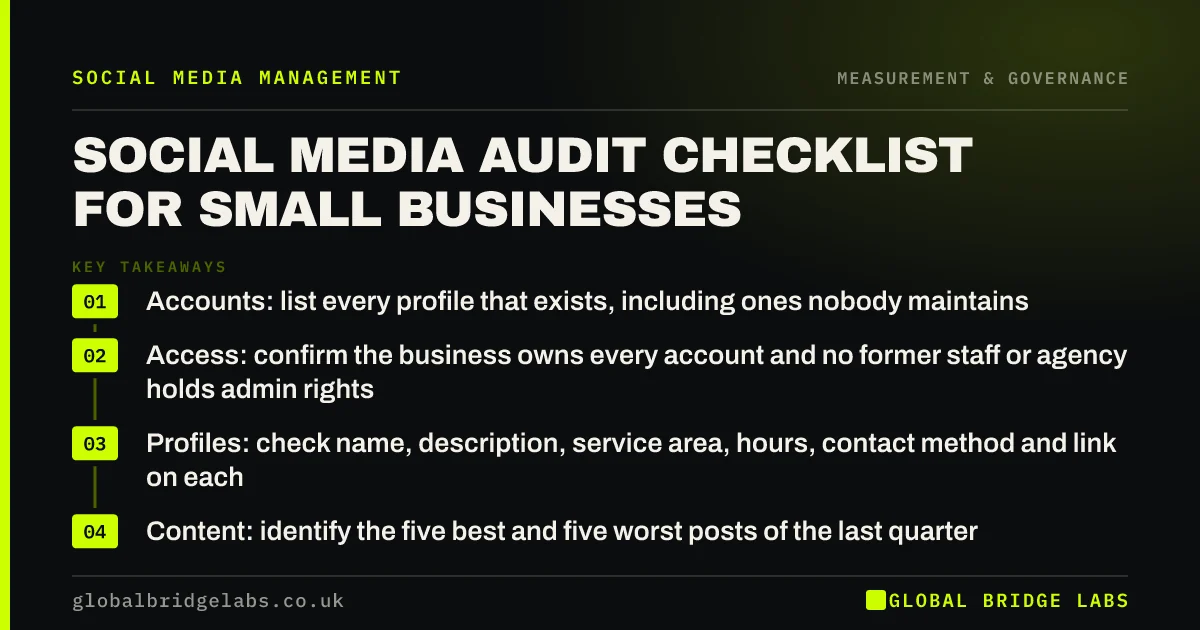
- Accounts: list every profile that exists, including ones nobody maintains.
- Access: confirm the business owns every account and no former staff or agency holds admin rights.
- Profiles: check name, description, service area, hours, contact method and link on each.
- Content: identify the five best and five worst posts of the last quarter and what they have in common.
- Conversion: follow your own enquiry path from post to reply, timing every step.
- Compliance: check ad labelling, claims, consent records and image permissions.
Want the audit run for you? Message us on WhatsApp and we will do it in a week.
Chat on WhatsApp →Why start with an audit?
Because the most common findings are not content problems, and changing your content strategy without knowing that wastes a quarter.
In practice, the issues that surface most often are dormant profiles ranking for the brand name, an old agency still holding administrator access, a bio that does not say where the business operates, and an enquiry path that takes three days to produce a reply.
How do you audit access properly?
List every account, then for each one identify who holds ownership, who holds administrator rights, and which email address the account recovery goes to.
The two failures worth checking specifically: accounts created on a personal account belonging to someone who has left, and pages where a previous agency is still an owner rather than a granted user. Both are common, and both are far harder to resolve after a relationship has ended than before.
- Business ownership of every page and ad account.
- Recovery email is a shared business address, not an individual's.
- No former employee or agency holds admin or owner rights.
- Two-factor authentication enabled on every account.
- Access review scheduled every six months and on every departure.
What should you look for in content performance?
Patterns, not individual posts. Take the five best and five worst of the last quarter and look for what they share in format, subject, length and time of publication.
Judge on saves, shares and comments containing questions rather than likes, because those correlate with commercial outcome. The usual finding is that one format is doing most of the work and has never been identified as such, which makes the next quarter's plan straightforward.
We audit UK client accounts before any strategy work. Message us on WhatsApp for what it covers.
Chat on WhatsApp →How do you audit the conversion path?
Walk it yourself, on a phone, with a timer. Start from a post, tap through to the profile, follow the link, and try to enquire. Then send a message from an account the business does not recognise and record how long a reply takes.
This step finds more lost revenue than any other part of the audit. Broken bio links, forms requiring nine fields, contact pages with an old phone number, and replies taking two days are all common and all invisible from the inside.
What compliance items should you check?
Four. Whether paid or gifted content carries a clear ad label. Whether any claims about results, prices or guarantees can be substantiated. Whether you hold consent records for customer photos and any marketing messaging list. And whether images containing identifiable people were used with permission.
None of these are difficult, and all of them are cheaper to fix during an audit than after a complaint.
What do you do with the findings?
Sort into three groups: fix this week, fix this quarter, and decide. Access problems and broken conversion paths are always this week. Profile and content improvements are this quarter. Channel closures and strategy changes are decisions for the strategy document.
Then set the next audit date. Twice a year is right for most small businesses, plus an access review on every staff or agency change.
What does a good audit output look like?
One page, three columns, and an owner against every line. Findings without owners are observations, and observations do not get fixed.
Column one is the finding, stated as a fact rather than a judgement: the bio does not name the service area. Column two is the action and the owner. Column three is the date, which for anything in the access or conversion sections should be inside seven days.
Keep the previous audit alongside the new one. The most useful thing an audit tells you in year two is which findings have appeared twice, because a repeat finding is a process problem rather than a task that was forgotten.
- Finding stated as fact, not judgement.
- One named owner per line.
- Access and conversion findings dated within seven days.
- Compare with the previous audit. Repeats indicate process failures.
Next step
An audit is two hours that routinely saves a quarter of misdirected effort. Run it before you change anything else.
Message us on WhatsApp for a full social media audit covering access, profiles, content and conversion.
Chat on WhatsApp →Sources and further reading
- Google Business Profile Help · Google
- Lawful basis for processing personal data · Information Commissioner's Office
Frequently asked questions
How often should you audit social media accounts?
Twice a year, plus an access review whenever a staff member or agency relationship ends. A full audit takes about two hours and usually surfaces access and conversion problems that no amount of new content would have fixed.
What does a social media audit include?
Account inventory, access and ownership, profile completeness, content performance patterns, the conversion path from post to reply, and compliance items such as ad labelling and image permissions. Access and conversion usually produce the most valuable findings.
What is the most common problem found in audits?
A broken or slow conversion path: a dead bio link, an over-long enquiry form, an old phone number, or replies taking days. These are invisible from inside the business and cost more than any content weakness.
Who should own our social media accounts?
The business, through a business account structure with a shared recovery email, granting individual access per person. Check that no former employee or previous agency retains owner or admin rights, which is far harder to resolve after a relationship ends.
Written by

Global Bridge Labs (GBL) is a UK–Sri Lanka partner for social media, websites and BPO. Everything here comes from client delivery, not theory.