On this page
- 01Short answer
- 02Who counts as a competitor on social media?
- 03What should you actually record?
- 04Where is the gap usually found?
- 05How do you read a comment section properly?
- 06What should you not copy?
- 07What does this look like in practice?
- 08How do you turn the audit into a plan?
- 09Next step
- 10Sources and further reading
- 11Frequently asked questions
Short answer
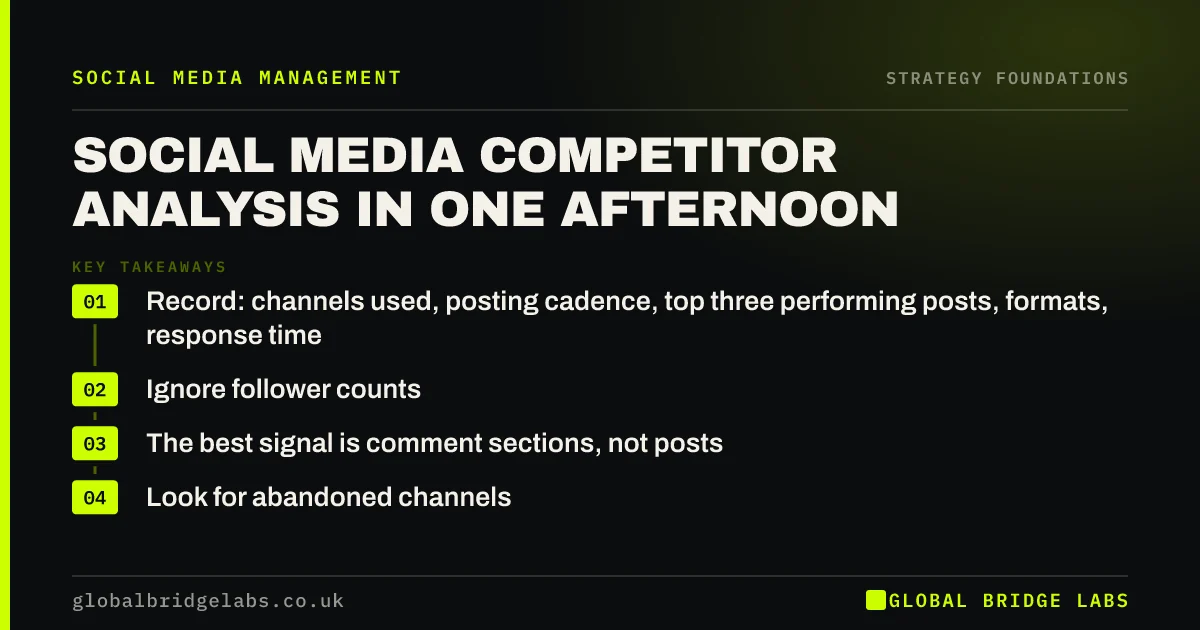
Pick three competitors, record six things about each, and look for what none of them are doing. The gap is the strategy. Copying the leader puts you second in a race they have a three-year head start in.
- Record: channels used, posting cadence, top three performing posts, formats, response time, and what they never talk about.
- Ignore follower counts. They are historic and often bought.
- The best signal is comment sections, not posts. That is where unmet demand is written down.
- Look for abandoned channels. An unmaintained competitor channel is a cheap opening.
- Repeat every six months, not monthly. Nothing changes fast enough to justify more.
Send us three competitor handles on WhatsApp and we will send back the gap we would go after.
Chat on WhatsApp →Who counts as a competitor on social media?
Three types, and most UK small businesses only analyse the first.
Direct competitors sell what you sell in your area. Attention competitors are whatever else fills your buyer's feed, including national brands with budgets you will never match. Substitute competitors are the alternative to hiring anyone, usually doing it themselves or doing nothing.
Your content has to beat the third one most often. Most lost deals for UK SMEs are lost to inaction, not to a rival.
What should you actually record?
Build a simple table with one row per competitor and these six columns. Half an hour each is enough.
- Channels: which are active, which are dormant, last post date on each.
- Cadence: posts in the last 30 days, by channel.
- Formats: photo, carousel, short video, text, stories. Note which gets engagement.
- Top three posts: what they were about, not how many likes they got.
- Response behaviour: do they reply to comments, how fast, in what tone.
- Silence: the subjects they never touch, especially price, process and mistakes.
Where is the gap usually found?
Almost always in the silence column. UK service businesses overwhelmingly avoid three subjects on social media: what things cost, what goes wrong, and what happens after you say yes.
Any one of those is a defensible content position, because it requires confidence rather than budget. A competitor with ten times your reach cannot copy price transparency quickly, because it needs internal agreement they do not have.
How do you read a comment section properly?
Read the last 50 comments across your three competitors and sort them into questions, complaints and praise. Questions are content briefs. Complaints are positioning. Praise tells you what the category is already good at, which means it is table stakes rather than a differentiator.
A note on tone: never reply to your competitor's comment section. It reads badly, and it is unnecessary. Take the question and answer it properly on your own channel where it also earns you the search value.
What should you not copy?
Do not copy cadence from a competitor with a full-time in-house team. Matching a schedule you cannot resource is how small teams burn out in six weeks.
Do not copy tone from a national brand. Their informality is backed by name recognition that absorbs the risk. A ten-person firm using the same voice reads as unserious to a facilities manager comparing quotes.
Do not copy a channel choice without checking whether it produces enquiries for them. Activity is visible from outside. Results are not.
What does this look like in practice?
A pattern in e-commerce: a brand benchmarks itself against a competitor posting daily and concludes it is losing on volume. A comment audit frequently says otherwise, showing the competitor's comment sections full of unanswered delivery questions.
The winning move is not more posts. It is a pinned, regularly refreshed post answering delivery, returns and sizing, plus replies to every comment inside four working hours. Same volume, different job.
How do you turn the audit into a plan?
Convert each finding into one of three decisions: match it, beat it, or ignore it. Matching is for table stakes, such as answering comments or keeping photos current. Beating is reserved for the one or two things in the silence column you can genuinely own. Ignoring is the largest category and the hardest discipline.
Write the output as five lines: the gap we are taking, the formats we will use, the cadence we can hold, what we are deliberately not doing, and the date we review it. That page is more useful than the spreadsheet it came from, and it is the only part anyone will read again.
- Match: the basics every credible competitor already does.
- Beat: one position in the silence column you can defend.
- Ignore: anything driven by a budget or a team you do not have.
- Record what you decided not to do, so it is not relitigated every month.
Next step
If you would rather have this done than do it, we will run the three-competitor audit and come back with the gap, the formats to use, and the first ten posts.
Message us on WhatsApp for a three-competitor social media audit.
Chat on WhatsApp →Sources and further reading
- Online Nation: how the UK uses online services · Ofcom
- Publishing consumer reviews and complying with consumer protection law · Competition and Markets Authority
Frequently asked questions
How many competitors should I analyse?
Three is enough: the local leader, the closest peer of your size, and the fastest-growing newcomer. Beyond three, patterns repeat and the extra hours produce no new decisions. Repeat the exercise every six months rather than adding more competitors.
What tools do I need for competitor analysis?
None to start. The native platform views, a spreadsheet and half an hour per competitor cover the six things worth recording. Paid tools help when you need historical data or share-of-voice tracking across many brands, which small businesses rarely do.
Should I copy what my most successful competitor does?
No. Copying puts you second at a format they already own, and you cannot see whether their activity produces enquiries. Analyse them to find what nobody in the category is doing, then take that position while it is uncontested.
Is it legal to use competitor content for research?
Viewing and analysing public posts is fine. Reproducing their images, copy or creative is copyright infringement, and imitating their branding closely enough to confuse buyers risks a passing-off claim. Take the insight, never the asset.
Written by

Global Bridge Labs (GBL) is a UK–Sri Lanka partner for social media, websites and BPO. Everything here comes from client delivery, not theory.