
On this page
- 01Key takeaways
- 02Mistake: reading only monthly figures
- 03Mistake: leaving abandoned calls out
- 04Mistake: forgetting shrinkage
- 05Mistake: treating every gap as a staffing gap
- 06Mistake: one target for every line
- 07What does this look like in practice?
- 08Service level mistakes checklist
- 09Next step
- 10Sources and further reading
- 11Frequently asked questions
Key takeaways
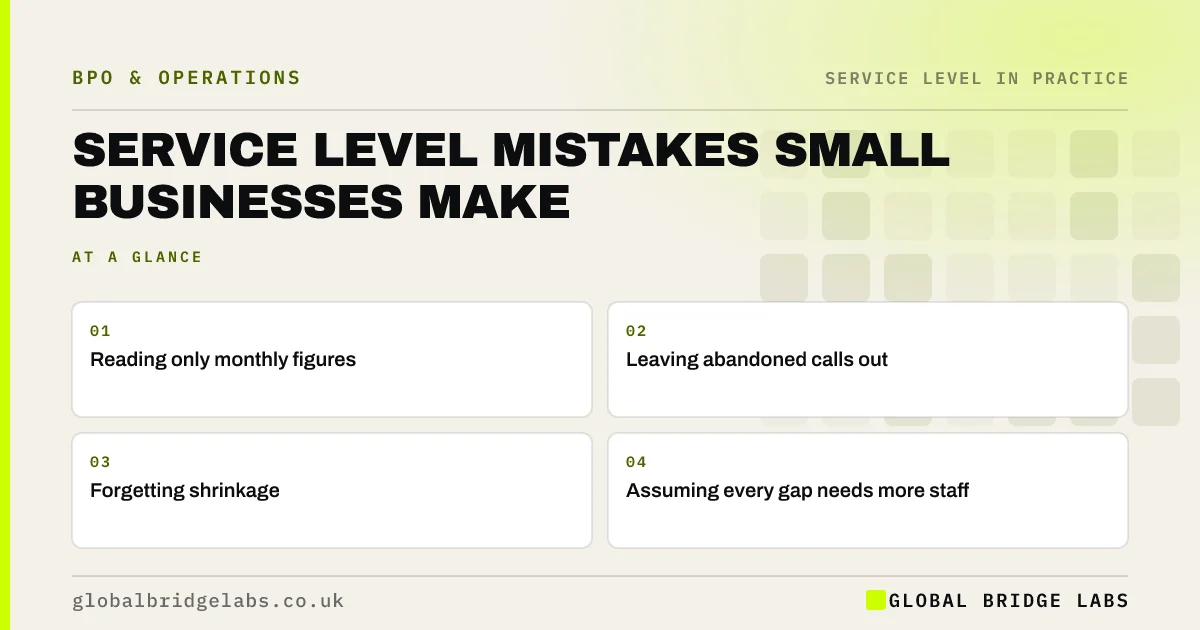
Most service level problems in small businesses come from a handful of avoidable mistakes: reading only monthly figures, excluding abandoned calls, ignoring shrinkage, staffing to daily averages and treating every problem as a staffing problem. Each one hides where callers really wait or leads to the wrong fix.
- Reading only monthly figures.
- Leaving abandoned calls out.
- Forgetting shrinkage.
- Assuming every gap needs more staff.
Want a quick check of your service level setup? Message us on WhatsApp.
Chat on WhatsApp →Mistake: reading only monthly figures
Monthly averages hide weak half hours. Callers experience the Monday morning or the lunchtime gap, not the month. Report by half hour and look for repeating gaps.
Mistake: leaving abandoned calls out
A formula that counts only answered calls flatters service level and hides lost callers. Count abandoned calls, excluding only very short abandons, and report abandonment alongside.
Mistake: forgetting shrinkage
Planning rotas to the on-phone figure, without allowing for breaks, holidays, sickness and training, means you are short most of the time. Add shrinkage to every plan.
Want your rota checked for these mistakes? Send it to us on WhatsApp.
Chat on WhatsApp →Mistake: treating every gap as a staffing gap
Many gaps come from break timing, long after-call work or avoidable calls. Check these first. Hiring into a badly timed rota or high avoidable demand rarely fixes the problem.
Mistake: one target for every line
Urgent and routine lines need different targets. One target either overstaffs routine lines or underserves urgent ones. Set targets by line where volumes allow.
What does this look like in practice?
A pattern we see: a business makes three of these mistakes at once, monthly reporting, answered-only formula and no shrinkage. Fixing the reporting first shows the true gaps, and the rota fix that follows costs far less than the hire originally planned.
The owner also finds that the provider handling evening calls had been using a different formula, which is corrected in the next contract review.
A second pattern is a team that sets one 80/20 target for every line and then hires to meet it on routine account calls, while urgent calls still wait at peak times. Setting separate targets by line puts the extra effort where callers most need it, and the planned hire turns out to be unnecessary.
Service level mistakes checklist
- Report by half hour.
- Include abandoned calls.
- Add shrinkage to rotas.
- Check non-staffing causes first.
- Set targets by line.
Next step
Check your current reports and rota against the five mistakes above, and fix the first one you find this week.
Message us on WhatsApp to avoid service level mistakes, or book a 30-minute consultation.
Chat on WhatsApp →Sources and further reading
- Measuring success · GOV.UK Service Manual
- Stop trying to delight your customers (Dixon, Freeman and Toman, 2010) · Harvard Business Review
Frequently asked questions
What is the most common service level mistake?
Reading only monthly or daily figures. They average out the half hours where callers wait longest, so problems stay hidden until complaints arrive. Reporting by half hour, alongside abandonment and the longest wait, shows the real picture and where to act.
Why does my service level look good when customers complain?
Possibly because the formula leaves out abandoned calls, the figure is monthly rather than by half hour, or menu time is not counted. Check how it is calculated, split it by half hour and look at the longest waits. Complaints usually point to a specific time or line.
Should I always hire when service level drops?
Not first. Check break timing, after-call work, avoidable calls and whether the target suits the line. These often explain the drop and are cheaper to fix. If demand still exceeds capacity after these fixes, then extra people or overflow make sense.
Written by

Global Bridge Labs (GBL) is a UK–Sri Lanka partner for social media, websites and BPO. Everything here comes from client delivery, not theory.


