On this page
Key takeaways
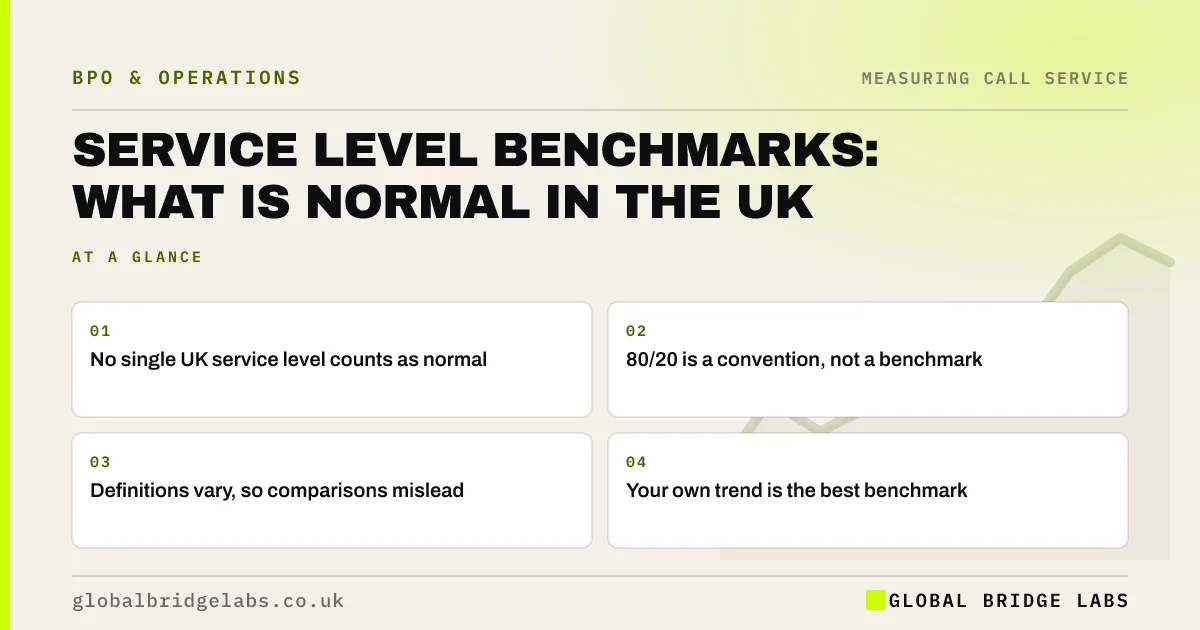
There is no single UK service level that counts as normal. 80/20 is a common convention, but published benchmarks vary by sector, size and definition, and few small businesses report in the same way. The most useful benchmark is your own performance over time, measured consistently, plus what your callers say about waiting.
- No single UK service level counts as normal.
- 80/20 is a convention, not a benchmark.
- Definitions vary, so comparisons mislead.
- Your own trend is the best benchmark.
Want a fair benchmark for your calls? Message us on WhatsApp.
Chat on WhatsApp →Why are benchmarks hard to compare?
Businesses use different thresholds, formulas, menus and opening hours. One firm's 80/20 may exclude abandoned calls; another's may include menu time. Without knowing the definition, comparing figures is like comparing prices in different currencies.
What comparisons are useful?
Your own figures over time, using the same definition. Your figures by line, half hour and season. And, where available, published satisfaction measures such as the UK Customer Satisfaction Index, which show how customers in your sector feel about service in general.
- Your own trend, same definition.
- By line, half hour and season.
- Sector satisfaction measures.
How do you set your own benchmark?
Take three months of consistent data, find your typical service level, abandonment and longest wait by line, and set targets a step better. Check the targets against what callers say in surveys and complaints. Revisit them each quarter.
Want your figures compared over the last year? Send us your data on WhatsApp.
Chat on WhatsApp →What about provider claims?
When a provider quotes a strong service level, ask for the definition, the hours covered, whether it is by half hour or monthly and whether it applies to accounts like yours. A figure without a definition tells you little.
What does this look like in practice?
A pattern we see: an owner is worried that their 75/20 is below an industry figure found online. Checking definitions shows the online figure excludes abandoned calls while theirs includes them. On the same basis, their service is in line, and attention moves to the lunchtime dip instead.
The owner then sets a target based on their own trend, a few points better each quarter, which the team finds far more motivating than an external number.
Benchmark checklist
- Write down your definition.
- Build your own three-month baseline.
- Compare by line and half hour.
- Check provider definitions.
- Review targets quarterly.
Next step
Build a three-month baseline of your service level, abandonment and longest wait using one definition, and set a target a step better.
Message us on WhatsApp to set your call benchmarks, or book a 30-minute consultation.
Chat on WhatsApp →Sources and further reading
- UK Customer Satisfaction Index · Institute of Customer Service
- Measuring success · GOV.UK Service Manual
Frequently asked questions
What is a good service level in the UK?
There is no single good figure. Many contact centres use 80/20 as a planning target, but definitions vary widely. A good service level is one that meets your callers' expectations, keeps abandonment low and long waits rare, measured consistently over time using a clear definition.
Where can I find call centre benchmarks?
Industry bodies, research firms and software vendors publish benchmark figures, but they often use different definitions and samples. Treat them as rough guides. The UK Customer Satisfaction Index is useful for how customers feel about service. Your own consistent trend is usually the most reliable benchmark.
Should I compare myself with large contact centres?
With care. Large centres have more staff to absorb peaks and often different call types. Small teams face more variation. Compare definitions first, then focus on your own trend and what your callers say, rather than matching a large centre's figures.
Written by

Global Bridge Labs (GBL) is a UK–Sri Lanka partner for social media, websites and BPO. Everything here comes from client delivery, not theory.