On this page
Key takeaways
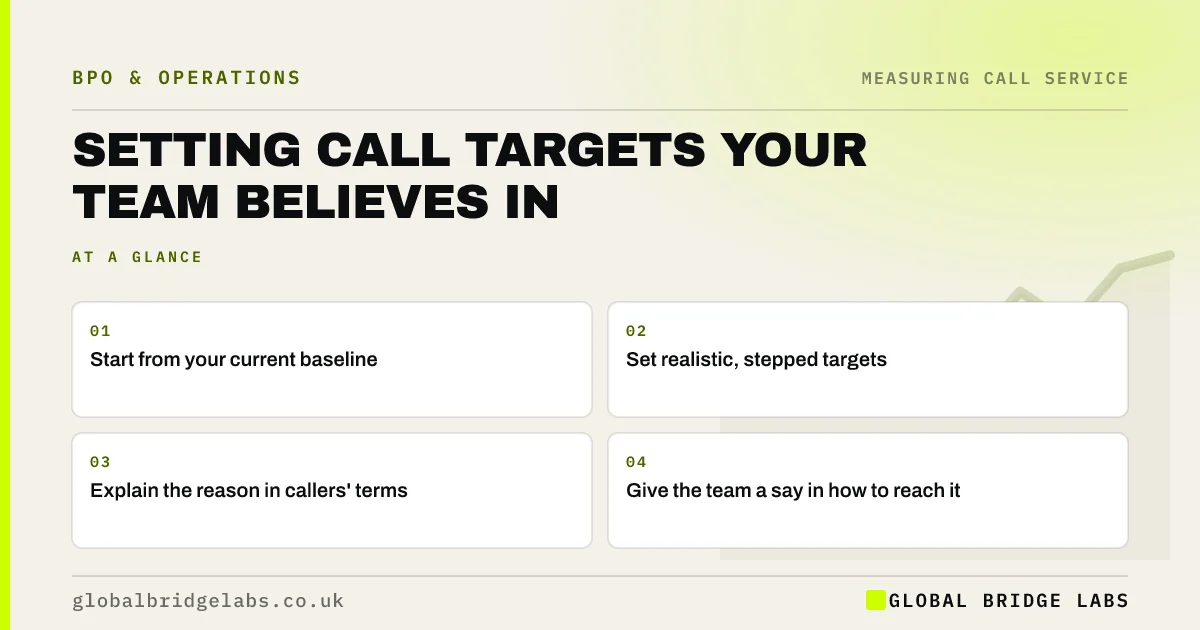
Targets work best when the team believes they are fair and achievable. Start from your current baseline, set a realistic step, explain why the target matters to callers and involve the team in planning how to reach it. Targets imposed without resources or explanation tend to create stress and shortcuts rather than better service.
- Start from your current baseline.
- Set realistic, stepped targets.
- Explain the reason in callers' terms.
- Give the team a say in how to reach it.
Want help setting call targets? Message us on WhatsApp.
Chat on WhatsApp →Why do some targets fail?
Targets fail when they ignore the baseline, come without the people or tools to meet them, or are used to blame individuals. Teams then chase the number, for example by rushing calls, rather than improving service. HSE guidance on work-related stress highlights demands and control as key factors.
How do you set a realistic step?
Look at your last three months by line and half hour. If you average 70/20, a first step of 75/20 with a plan for the weakest half hours is more credible than jumping to 90/20. Each step should come with a specific change, such as staggered lunches or a callback option.
How do you involve the team?
Share the data, explain what callers experience at different waits and ask the team where time is lost. People on the phones often know the causes: a slow system, a confusing letter or an unpopular rota pattern. Their ideas make the plan practical.
- Share the half-hour data.
- Explain the effect on callers.
- Ask where time is lost.
Want an outside view on your targets? Send them to us on WhatsApp.
Chat on WhatsApp →How should progress be shared?
Show the team weekly figures against the target and highlight improvements, including the effect of their ideas. Celebrate steps reached. When the target is missed, discuss causes as a team rather than singling out individuals.
What does this look like in practice?
A pattern we see: a manager announces a 90/20 target with no plan, and morale falls. Resetting to a 75/20 first step, with team ideas on lunch cover and a slow system, gets the step met within six weeks and builds confidence for the next one.
Because the team chose the fixes, they also keep to them, and the improvement holds when the manager is away.
Target setting checklist
- Build a three-month baseline.
- Set a realistic first step.
- Explain the reason to the team.
- Ask the team for ideas.
- Share progress weekly.
Next step
Share your three-month baseline with the team, agree a first-step target and collect three ideas from them for reaching it.
Message us on WhatsApp to set achievable call targets, or book a 30-minute consultation.
Chat on WhatsApp →Sources and further reading
- What are the Management Standards for work-related stress? · Health and Safety Executive
- Measuring success · GOV.UK Service Manual
Frequently asked questions
Should service level targets apply to individuals?
Generally no. Service level depends on staffing, rotas and call volumes that individuals do not control. Use it as a team and management target. For individuals, focus on quality, adherence and helpful coaching, always considering context such as complex calls or helping colleagues.
How often should targets change?
Review them quarterly and change them when you have met a step consistently or when circumstances change, such as a new line or a big shift in volumes. Changing targets too often confuses people and makes trends hard to read.
What if the team cannot meet the target?
Look at the cause before pushing harder. Check staffing, shrinkage, demand and tools. If the target needs more resources than you can provide, adjust it or reduce demand. A target nobody can meet usually damages morale and service rather than improving it.
Written by

Global Bridge Labs (GBL) is a UK–Sri Lanka partner for social media, websites and BPO. Everything here comes from client delivery, not theory.