On this page
- 01Key takeaways
- 02What is a service blueprint?
- 03What are the parts of a service blueprint?
- 04How is a service blueprint different from a journey map?
- 05Why does a service blueprint matter for your website?
- 06How do you draw a simple blueprint?
- 07When is a service blueprint unnecessary?
- 08What does this look like in practice?
- 09Service blueprint checklist
- 10Next step
- 11Sources and further reading
- 12Frequently asked questions
Key takeaways
A service blueprint maps what the customer does and sees alongside what your team and systems do behind the scenes to deliver it. For website planning, it shows whether the promises on your pages, such as 'reply within two hours', are backed by a real process. Draw one for your main enquiry-to-delivery journey before you publish promises the business cannot keep.
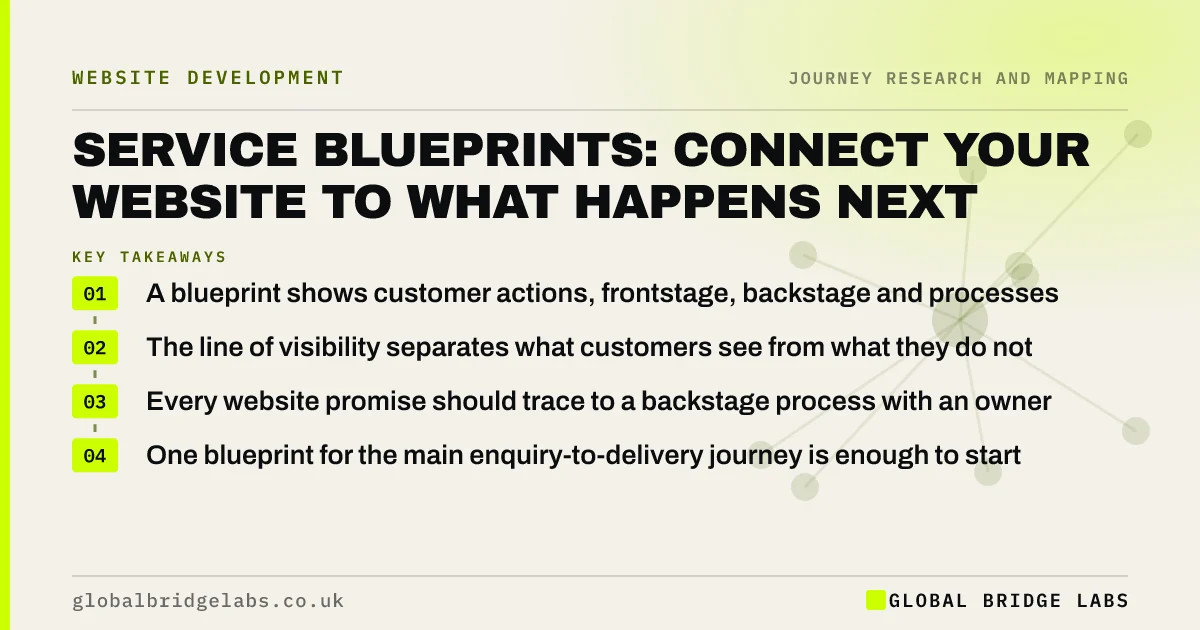
- A blueprint shows customer actions, frontstage, backstage and processes.
- The line of visibility separates what customers see from what they do not.
- Every website promise should trace to a backstage process with an owner.
- One blueprint for the main enquiry-to-delivery journey is enough to start.
Want to check your website's promises against how the service runs? Message us on WhatsApp.
Chat on WhatsApp →What is a service blueprint?
A service blueprint is a diagram that shows the relationships between the parts of a service: what customers do, what staff do in front of them, what happens behind the scenes and the systems that support it. Nielsen Norman Group defines it as a diagram that visualises the relationships between different service components. The idea dates back to Lynn Shostack's 1984 Harvard Business Review article on designing services.
What are the parts of a service blueprint?
A service blueprint has five layers. Customer actions are what the buyer does. Frontstage actions are what they see your people or technology do. Backstage actions support those out of sight. Processes are the internal steps and systems that make it all work. The line of visibility separates what customers see from what they do not.
- Customer actions: submits form, receives call, books visit, pays.
- Frontstage: confirmation page, reply email, phone call, visit.
- Backstage: enquiry assigned, diary checked, quote drafted.
- Processes: CRM, calendar, quoting tool, payment system.
- Line of visibility: what the customer sees above, what they do not below.
How is a service blueprint different from a journey map?
A journey map shows the customer's experience: what they do, ask and feel. A service blueprint shows how the business delivers that experience. You usually draw the journey map first, then a blueprint for the parts of the journey that depend on your internal process, such as the steps after an enquiry. The blueprint explains why a journey step works or breaks.
Why does a service blueprint matter for your website?
A service blueprint matters because the website makes promises the business must keep. 'We reply within two hours', 'book online in a minute' and 'free survey within 48 hours' are frontstage promises. If nobody owns the backstage step, the promise breaks and the buyer remembers the website as misleading. The blueprint checks every promise against a process.
How do you draw a simple blueprint?
Draw a simple blueprint by taking one journey, usually enquiry to first appointment, and writing the customer's steps across the top. Under each, add what they see from you, then what your team does behind the scenes, then which system is involved. Mark any step with no owner, no system or a long wait.
- Choose one journey: enquiry to first appointment is a good start.
- Write customer steps across the top.
- Add frontstage, backstage and process rows under each.
- Draw the line of visibility.
- Mark gaps: no owner, no system, long waits.
- List website promises that depend on each gap.
Want a blueprint drawn for your enquiry journey? Message us on WhatsApp.
Chat on WhatsApp →When is a service blueprint unnecessary?
A blueprint is unnecessary for very simple services where one person handles everything and the steps are obvious. It earns its place when several people, systems or suppliers touch the journey, or when the website is about to promise something new, such as online booking or same-day replies.
What does this look like in practice?
A pattern we see when blueprinting enquiries: the form sends an email to a shared inbox that three people check 'when they can'. The website promises a reply the same day. On busy days, enquiries wait until the next afternoon, and the buyers most likely to convert, the urgent ones, go elsewhere.
Assigning an owner and a check time, or routing enquiries to a dedicated team, makes the promise true. Across our client work we have seen a 2.4x enquiry rate from conversion changes of this kind. Global Bridge Labs (GBL) blueprints the steps behind the form when we build it.
Service blueprint checklist
- Pick one journey that depends on internal process.
- Map customer actions, frontstage, backstage and processes.
- Mark the line of visibility.
- Give every backstage step an owner.
- Check every website promise against a step.
- Fix or remove promises with no process behind them.
Next step
If your website promises fast replies or easy booking, it is worth checking the process behind it. We will blueprint the steps after your form and show any gaps.
Message us on WhatsApp for a service blueprint of your enquiry journey, or book a 30-minute consultation.
Chat on WhatsApp →Sources and further reading
- Service blueprints: definition · Nielsen Norman Group
- Designing services that deliver (Shostack, 1984) · Harvard Business Review
- Journey mapping 101 · Nielsen Norman Group
Frequently asked questions
What is a service blueprint used for?
A service blueprint shows how a service is delivered: what customers do, what they see from your team, what happens behind the scenes and which systems support it. It is used to find gaps between what customers experience and how the business works, and to check that promises can be kept.
What is the difference between a service blueprint and a customer journey map?
A customer journey map shows the buyer's experience: actions, questions and feelings. A service blueprint adds the business side: frontstage and backstage actions and supporting processes. Journey maps show what happens; blueprints show why it works or breaks.
Does a small business need a service blueprint?
A simple one helps when several people or systems handle an enquiry, or when the website promises something like same-day replies or online booking. A sole trader handling everything personally can usually skip it.
Written by

Global Bridge Labs (GBL) is a UK–Sri Lanka partner for social media, websites and BPO. Everything here comes from client delivery, not theory.