On this page
- 01Key takeaways
- 02What does it mean if your website and sales process do not match?
- 03What are the signs of a mismatch?
- 04How do you realign the website with sales?
- 05Should enquiries go straight into a CRM?
- 06When does a mismatch justify a redesign?
- 07What should sales send after a call?
- 08What does this look like in practice?
- 09Alignment checklist
- 10Next step
- 11Sources and further reading
- 12Frequently asked questions
Key takeaways
Your website and sales process do not match when the site asks buyers to take a step your team does not use, fails to answer questions sales keeps hearing, or lacks the proof sales needs to send after a call. Map the sales steps, then give each a page or asset. Most gaps are content; a mismatched enquiry route may need rebuilding.
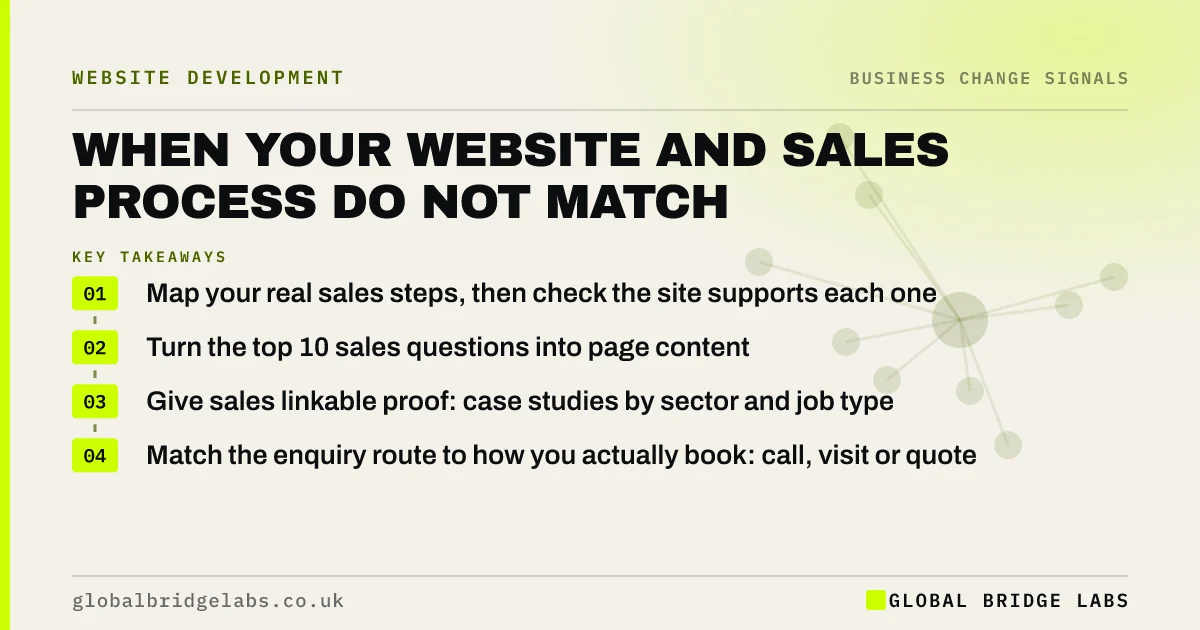
- Map your real sales steps, then check the site supports each one.
- Turn the top 10 sales questions into page content.
- Give sales linkable proof: case studies by sector and job type.
- Match the enquiry route to how you actually book: call, visit or quote.
Want your sales steps mapped to your website? Ask us on WhatsApp.
Chat on WhatsApp →What does it mean if your website and sales process do not match?
A website and sales process are misaligned when the site's calls to action, content and proof do not reflect how the business actually wins work. Buyers are asked for the wrong next step, sales staff answer the same questions repeatedly, and after a sales call there is nothing useful on the site to send.
What are the signs of a mismatch?
Ask the people who sell. They see these signs every week.
- The site says 'Buy now' but every sale needs a survey or call.
- The site offers a free quote but you only quote after a visit.
- Sales answer the same questions on every call.
- Sales send PDFs instead of website links.
- Enquiries arrive with none of the details sales needs.
Recognise these signs? Tell us which on WhatsApp.
Chat on WhatsApp →How do you realign the website with sales?
Write down each step from first contact to signed job, then give each step something on the website: a clear call to action for the first step, answers for the questions asked on calls, proof pages to send afterwards, and a process page that sets expectations.
- First step: a call to action that matches how you book.
- Discovery: answers to the top 10 sales questions.
- Proposal: case studies sales can link, by sector and job type.
- Decision: process, guarantees, terms and pricing guidance.
Should enquiries go straight into a CRM?
If sales uses one, yes. Enquiries that arrive by email and are retyped get lost or delayed. A form connected to the CRM, with source tracking, lets sales respond faster and shows which pages produce the enquiries that close.
When does a mismatch justify a redesign?
When the sales model has changed fundamentally, for example from one-off jobs to contracts, or from online orders to consultative sales, and the site's structure is built for the old model. Then the navigation, calls to action and page types all need changing together.
What should sales send after a call?
A link to a page that answers the questions raised in the call, with proof from a similar client. That might be a case study in the same sector, a process page that explains what happens next, or a pricing guide that confirms the ballpark discussed.
Build a short library of these pages and give sales a list of which to send when. It is faster than writing a new email each time, it is consistent, and it keeps buyers on your website, where they can find more proof and a clear next step.
- Case studies grouped by sector and job type.
- A process page explaining what happens next.
- A pricing guide or fee page.
- A list for sales of which page to send when.
What does this look like in practice?
A pattern in UK B2B services: the site pushes a 'Get a quote' form, but every deal starts with a discovery call and the form asks for details buyers cannot give yet. Replacing it with 'Book a 20-minute call', adding a process page and three sector case studies aligns the site with how deals really start.
Alignment checklist
Run this with whoever sells.
- Write down every step from enquiry to signed job.
- Check the site's main call to action matches step one.
- List the top 10 questions asked on sales calls.
- Add answers to the relevant pages.
- Create linkable case studies by sector.
- Connect the form to the CRM with source tracking.
Next step
If your team works around the website rather than with it, we will map your sales steps to the site with you in 30 minutes.
Message us on WhatsApp for a sales alignment review, or book a 30-minute consultation.
Chat on WhatsApp →Sources and further reading
- About key events · Google Analytics Help
- Structuring forms · GOV.UK Service Manual
- SEO Starter Guide · Google Search Central
Frequently asked questions
How can my website support my sales team?
Match the main call to action to how deals actually start, answer the questions sales hears most, provide case studies that can be linked after calls, explain your process, and send enquiries straight into the CRM with source details. Ask the sales team which pages they would send.
Why does my sales team not use our website?
Usually because it does not reflect what they sell or show proof they can share. Ask them exactly why and what they send instead. Their answers are a practical brief for the content and pages the site is missing. Update the site with what they tell you.
Should my website have a 'get a quote' or 'book a call' button?
Use the step that matches how you win work. If you quote from a short brief, a quote form works. If every deal needs a conversation or site visit first, 'book a call' or 'arrange a visit' sets the right expectation and gets more of the right enquiries.
Should website enquiries go into our CRM?
Yes, if the sales team uses a CRM. Direct integration avoids lost or delayed enquiries, records the source automatically and shows which pages and campaigns produce enquiries that turn into work. Review the connection each quarter. Test the connection each month.
Written by

Global Bridge Labs (GBL) is a UK–Sri Lanka partner for social media, websites and BPO. Everything here comes from client delivery, not theory.