On this page
Key takeaways
A small business migration needs about eight weeks of SEO work around the build: crawling and baselining at the start, redirect mapping and content checks in the middle, staging tests in the final fortnight, then launch-day checks and 90 days of monitoring. Most problems come from starting redirect work too late, when the new URLs are already fixed and launch is days away.
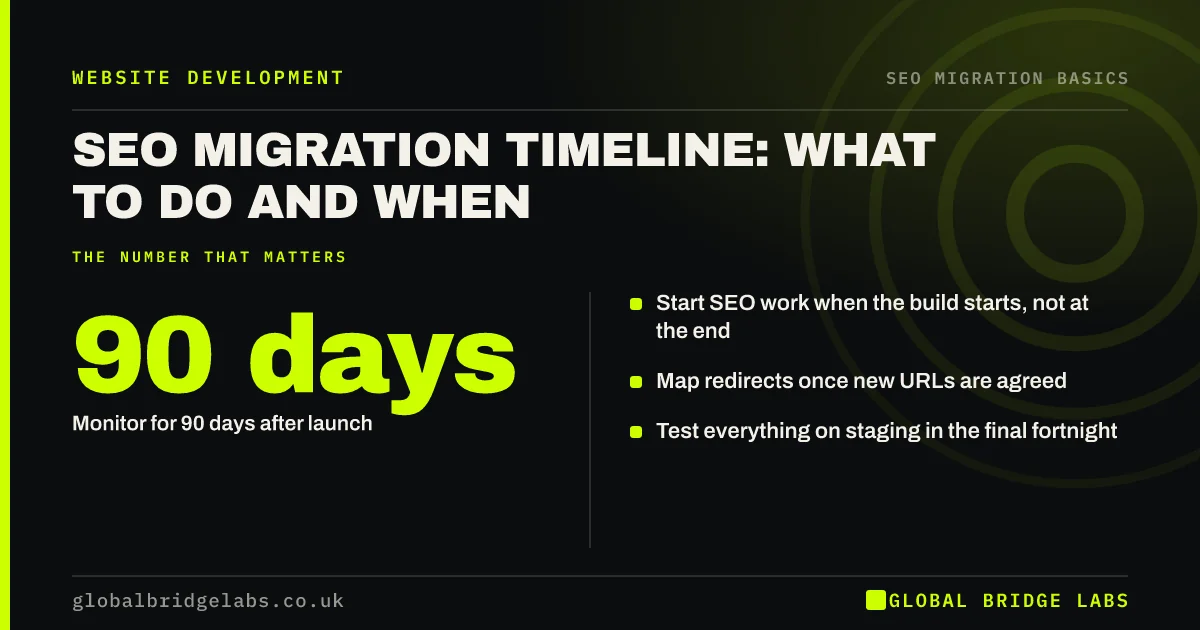
- Start SEO work when the build starts, not at the end.
- Map redirects once new URLs are agreed.
- Test everything on staging in the final fortnight.
- Monitor for 90 days after launch.
Planning a launch date? Message us on WhatsApp and we will sketch the timeline.
Chat on WhatsApp →What happens eight weeks before launch?
Start with the record stage. Crawl the old site, build a URL inventory from the crawl, sitemap, Search Console and analytics, and save a baseline of top pages, queries and landing pages. Agree which pages are staying, merging or going, and agree the new URL structure with the developer before templates are built.
This is also the point to write the SEO brief for the developer, so redirects, canonicals, sitemap and staging protection are in the build scope rather than added later.
What happens in the middle weeks?
Between eight and two weeks before launch, the work moves into mapping and mirroring. These tasks need the new URLs to exist on staging.
- Build the redirect map, one row per old URL.
- Carry titles, headings and content across to top pages.
- Rebuild internal links to new URLs.
- Add structured data and canonical tags.
- Keep the staging site password protected.
What happens in the final fortnight?
Freeze content on the old site so the inventory stays accurate. Load the redirects on staging and test every one. Crawl the staging site to check titles, headings, status codes and internal links. Agree the go-live criteria and who signs off, and prepare a rollback plan in case something goes badly wrong.
Then launch early in the week, run the first-hour checks and start the 90-day monitoring plan: daily checks for a week, weekly checks for three months.
- Content freeze: what to stop changing before launch
- How to test hundreds of redirects before launch
- Go-live criteria: who approves the new site
- The 90-day monitoring plan after a migration
Want a timeline template? Ask us on WhatsApp.
Chat on WhatsApp →What does this look like in practice?
A pattern we see: redirect mapping is left until the week of launch, when the new site is finished and the old URLs are half forgotten. The map gets rushed, blog posts and PDFs are missed, and traffic dips for months. When the same work is spread across the build, the launch week is quiet and the monitoring period is mostly confirming that things worked.
Migration timeline checklist
- Crawl and baseline at the start of the build.
- Agree the new URL structure early.
- Map redirects once staging URLs exist.
- Freeze content and test on staging in the final fortnight.
- Monitor for 90 days after launch.
Next step
Count back eight weeks from your planned launch date and put the record stage in the diary. If that date has already passed, move the launch rather than rushing the redirects.
Message us on WhatsApp to plan your migration timeline, or book a 30-minute consultation.
Chat on WhatsApp →Sources and further reading
- Site moves with URL changes · Google Search Central
- Google Search Console · Google
- What is a sitemap · Google Search Central
Frequently asked questions
How long does an SEO migration take?
For a small business site, allow about eight weeks of SEO work alongside the build, plus 90 days of monitoring after launch. Larger sites, online shops and domain changes need longer. Most of the effort sits in the inventory, redirect map and staging tests rather than on launch day itself.
When should SEO start in a website rebuild?
At the very start, before templates and URLs are fixed. That is when you can keep good URLs, plan the structure, brief the developer on redirects and staging protection, and save a baseline. Bringing SEO in at the end usually means rushed redirects and missed pages.
Can I launch a migration in under a month?
It is possible for a small site with few URL changes, but it leaves little room for testing. If the timeline is tight, keep URLs the same where you can, map the pages that bring most traffic first, and plan extra monitoring after launch to catch anything missed.
Written by

Global Bridge Labs (GBL) is a UK–Sri Lanka partner for social media, websites and BPO. Everything here comes from client delivery, not theory.