On this page
Key takeaways
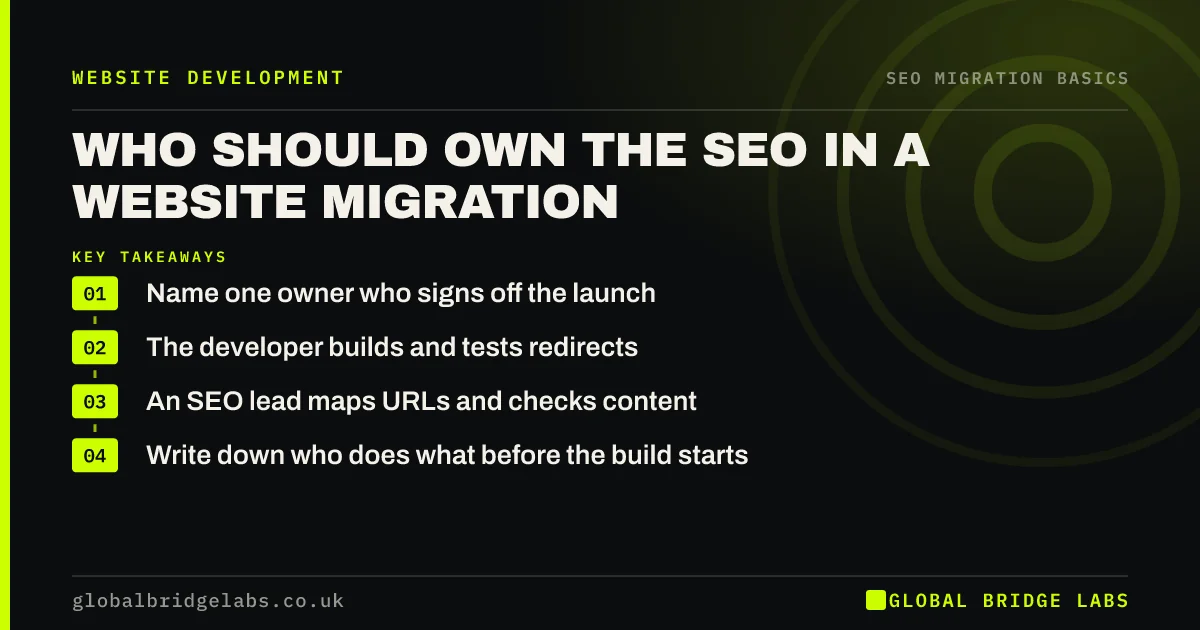
A migration needs one named owner who signs off the redirect map and the launch, even if specialists do the work. The developer builds and loads redirects; an SEO lead or experienced marketer maps URLs and checks content; a content editor carries copy across. Problems happen when everyone assumes someone else is handling redirects, so write the roles down at the start.
- Name one owner who signs off the launch.
- The developer builds and tests redirects.
- An SEO lead maps URLs and checks content.
- Write down who does what before the build starts.
Not sure who should handle your redirects? Message us on WhatsApp.
Chat on WhatsApp →Why does ownership matter?
Migrations involve several people, and the most important task, matching every old URL to a new one, sits between them. Developers often assume the marketing side will provide the map. Marketers assume the developer will handle redirects as part of the build. Agencies may assume the client knows which pages matter. Without a named owner, the map gets started late or not at all.
The owner does not need to be technical. They need to know the business, chase the tasks and refuse to launch until the agreed checks are done.
Who does what?
Small businesses often combine roles, but each task still needs a name next to it.
- Owner: agrees scope, approves the map, signs off the launch.
- Developer: builds templates, loads redirects, removes staging blocks.
- SEO lead: inventory, baseline, redirect map, content and technical checks.
- Content editor: carries copy, titles and images across.
- Analytics lead: checks tracking and key events before and after.
What should each person sign off?
Ask for a written sign-off at three points. The SEO lead signs off the redirect map once every old URL has a destination. The developer signs off the staging tests once redirects, status codes and staging protection have been checked. The owner signs off the launch once the go-live criteria are met and a rollback plan is ready.
After launch, the SEO lead owns the monitoring plan and reports to the owner weekly for three months.
- How to test hundreds of redirects before launch
- A rollback plan if the new site goes wrong
- The 90-day monitoring plan after a migration
Want a roles template for your project? Ask us on WhatsApp.
Chat on WhatsApp →What does this look like in practice?
A pattern we see: an agency builds a good site, the client approves the design, and launch happens with no redirects because the quote never mentioned them. Each side assumed the other had it covered. Adding one line to the brief, naming who builds the redirect map and who tests it, would have prevented weeks of lost enquiries.
Migration roles checklist
- Name the owner who signs off the launch.
- Name who builds the redirect map.
- Name who loads and tests redirects.
- Name who checks content and tracking.
- Name who monitors for 90 days after launch.
Next step
Write the five roles on one page with a name against each, and share it with your developer or agency before the build starts. Any blank line is a risk to fix.
Message us on WhatsApp to review your migration roles, or book a 30-minute consultation.
Chat on WhatsApp →Sources and further reading
- Site moves with URL changes · Google Search Central
- Google Search Console · Google
- SEO Starter Guide · Google Search Central
Frequently asked questions
Who is responsible for redirects in a website migration?
It should be agreed in writing at the start. Usually the SEO lead or marketer builds the redirect map, and the developer loads and tests it. The website owner signs it off. Problems happen when each side assumes the other is handling it, so name both people in the brief.
Do I need an SEO specialist for a migration?
Not always. A small site with few URL changes can be handled by a careful marketer and a good developer using a clear checklist. High-risk moves, such as a new domain, a new platform and a new structure together, benefit from someone who has run migrations before.
What does the website owner need to do?
Agree the scope, confirm which pages matter most to the business, approve the redirect map and refuse to launch until the agreed checks are complete. After launch, read the weekly monitoring report and make sure fixes are prioritised. The owner does not need technical skills, just clear authority.
Written by

Global Bridge Labs (GBL) is a UK–Sri Lanka partner for social media, websites and BPO. Everything here comes from client delivery, not theory.