On this page
Key takeaways
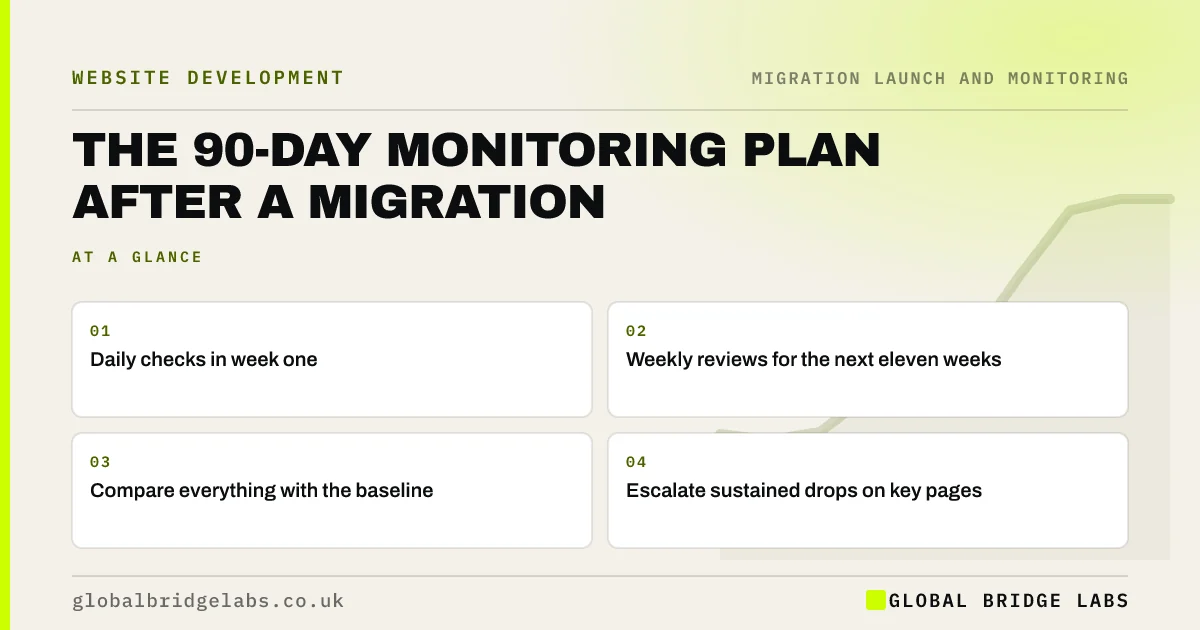
After a migration, monitor for 90 days against your baseline. In week one, check Search Console, the 404 log, enquiries and the site itself daily. For the next eleven weeks, review weekly: clicks for top pages, indexing status, new errors and key events. Escalate any sustained drop on important pages, and fix errors as they appear rather than in batches.
- Daily checks in week one.
- Weekly reviews for the next eleven weeks.
- Compare everything with the baseline.
- Escalate sustained drops on key pages.
Want us to watch your migration for 90 days? Message us on WhatsApp.
Chat on WhatsApp →What do you check in week one?
The first week is when errors are cheapest to fix, so check every day.
- Page indexing report: not found, soft 404, noindex, server errors.
- Performance report: clicks and impressions for top pages.
- The 404 log or redirect plugin log.
- Enquiries, calls and purchases against the same week last year.
- A quick look at the top pages on mobile.
What do you check weekly after that?
Each week, export the same figures as the baseline and compare. Look at total clicks and key events, then at the top 20 pages one by one, matched through the redirect map. Note new errors, fixes made and anything unusual. A short written note each week makes the trend obvious and gives the directors a clear story.
When should you escalate?
Escalate if branded searches drop, if a top page loses most of its clicks for two weeks running, if not found errors keep rising, or if enquiries fall while traffic holds. Each points to a specific cause: a technical block, a missing redirect, lost content or broken tracking or forms. At 90 days, compare with the baseline and decide whether a recovery audit is needed.
- Is my post-migration drop normal? How to tell
- Traffic held but enquiries fell after the migration
- A recovery audit after a failed migration
Want help reading your weekly numbers? Message us on WhatsApp.
Chat on WhatsApp →What does this look like in practice?
A pattern we see: weekly reviews show total clicks back to the baseline by week five, but one product category is still well down. Checking it against the redirect map shows its filtered pages were mapped to a general collection. Mapping them to matching filtered views brings the category back by week nine.
90-day monitoring checklist
- Check daily for the first week.
- Review weekly against the baseline.
- Look at top pages one by one.
- Escalate sustained drops.
- Compare at 90 days and decide next steps.
Next step
Put the daily week-one checks and twelve weekly reviews in the diary before launch, with a named owner. Monitoring that is scheduled is monitoring that happens.
Message us on WhatsApp about migration monitoring, or book a 30-minute consultation.
Chat on WhatsApp →Sources and further reading
- Performance report (Search results) · Search Console Help
- Page indexing report · Search Console Help
- About key events · Google Analytics Help
Frequently asked questions
How long should I monitor SEO after a migration?
At least 90 days: daily in the first week, then weekly for three months. Large sites and domain moves may need longer. After 90 days, compare with the baseline; if key pages have not recovered, run a recovery audit rather than continuing to wait.
What should I monitor after a website migration?
Indexing status and errors in Search Console, clicks and impressions for your top pages, the 404 log, rankings for key searches, and enquiries, calls or sales. Compare each with your saved baseline and the same period last year to separate migration effects from seasonality.
Who should monitor the migration?
The SEO lead or marketer who built the redirect map is best placed, because they know the old and new URLs. They should report weekly to the website owner. If nobody in-house has time, agree monitoring with your agency or a specialist as part of the project.
Written by

Global Bridge Labs (GBL) is a UK–Sri Lanka partner for social media, websites and BPO. Everything here comes from client delivery, not theory.