On this page
Key takeaways
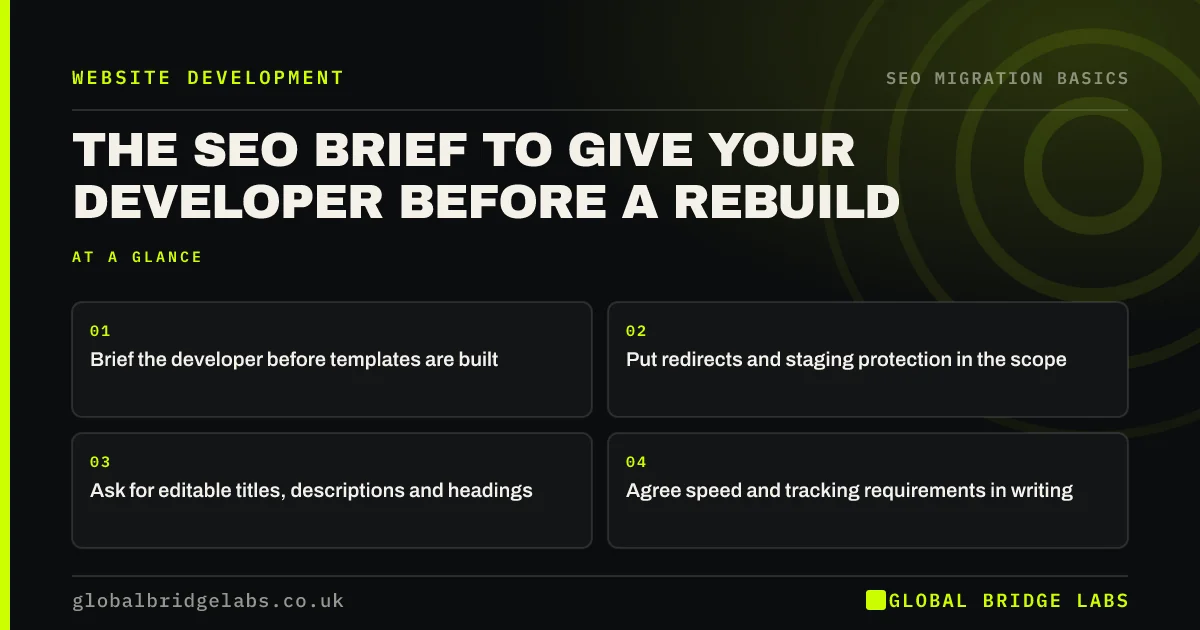
Give your developer a one-page SEO brief before any templates are built. It should cover which URLs stay, how redirects will be loaded and tested, how staging is kept out of Google, editable titles and descriptions, canonical tags, structured data, sitemap, speed targets and tracking. Agreeing these up front puts them in the quote, rather than in an argument at launch.
- Brief the developer before templates are built.
- Put redirects and staging protection in the scope.
- Ask for editable titles, descriptions and headings.
- Agree speed and tracking requirements in writing.
Want a brief template? Message us on WhatsApp.
Chat on WhatsApp →Why does the developer need an SEO brief?
Most SEO problems after a rebuild are not caused by bad developers but by missing requirements. If nobody asks for page titles to be editable, a template may generate them automatically. If nobody mentions redirects, they are not in the quote. If nobody says the staging site must be password protected, it may end up in Google alongside the live site.
A short brief, agreed at the start, avoids that. It also gives you something to check the finished site against.
What should the brief include?
Keep it to one page. Each line is a requirement the developer can quote for and test.
- URLs: keep existing addresses unless agreed otherwise.
- Redirects: load the redirect map as permanent 301 redirects, one hop each.
- Staging: password protected, never just blocked in robots.txt.
- Metadata: editable title, description and main heading on every page.
- Canonicals: self-referencing canonical tags on the new URLs.
- Sitemap: XML sitemap listing only live, indexable pages.
- Speed and tracking: Core Web Vitals targets and analytics on every page.
How do you check the brief was followed?
Crawl the staging site before launch and compare it with the brief. Check that titles and headings match what you agreed, that canonical tags point to the new URLs, that every old URL in the map returns a single redirect, and that the staging site asks for a password. Then check speed with PageSpeed Insights and confirm analytics events fire.
Anything that fails goes back to the developer before launch, not after.
Want us to check your staging site against the brief? Message us on WhatsApp.
Chat on WhatsApp →What does this look like in practice?
A pattern we see: a developer builds a fast, attractive site where every page title is the business name followed by the page name, generated by the theme. The old site had carefully written titles that ranked. A line in the brief asking for editable titles, filled in from the old site, would have taken minutes and protected those rankings.
Developer brief checklist
- Agree which URLs stay and which change.
- Put redirect loading and testing in the scope.
- Require password protection on staging.
- Require editable titles, descriptions and headings.
- Agree speed targets and tracking.
Next step
Write your one-page brief now and send it with your website brief or request for quotes. Ask each developer to confirm, line by line, what is included in their price.
Message us on WhatsApp for a developer brief review, or book a 30-minute consultation.
Chat on WhatsApp →Sources and further reading
- Site moves with URL changes · Google Search Central
- Redirects and Google Search · Google Search Central
- Block search indexing with noindex · Google Search Central
- How to specify a canonical URL with rel="canonical" and other methods · Google Search Central
Frequently asked questions
What SEO requirements should I give a web developer?
Ask for existing URLs to be kept unless agreed, redirects loaded as permanent 301s, a password-protected staging site, editable titles, descriptions and headings, self-referencing canonical tags, a clean XML sitemap, structured data where relevant, speed targets and analytics on every page. Put them in writing before the quote.
Should the developer build the redirect map?
The developer should load and test the redirects, but the map itself is best built by someone who knows which pages matter to the business, often the SEO lead or marketer. The developer can help by exporting the new URLs from staging so every old URL has a destination.
Can I add SEO requirements after the site is built?
Some, such as editing titles, can be done afterwards. Others, such as URL structure, template headings and how staging is protected, are much harder to change once the build is finished. That is why the brief belongs at the start, when changes cost little or nothing.
Written by

Global Bridge Labs (GBL) is a UK–Sri Lanka partner for social media, websites and BPO. Everything here comes from client delivery, not theory.