On this page
Key takeaways
Old URLs often carry parameters, the part after a question mark, such as tracking codes, filters, sort orders, session IDs or product IDs. Some change the content and need their own redirects; others do not and can be handled by the main page's redirect. Sort them by type, redirect the ones that matter, and check how your new platform treats query strings before launch.
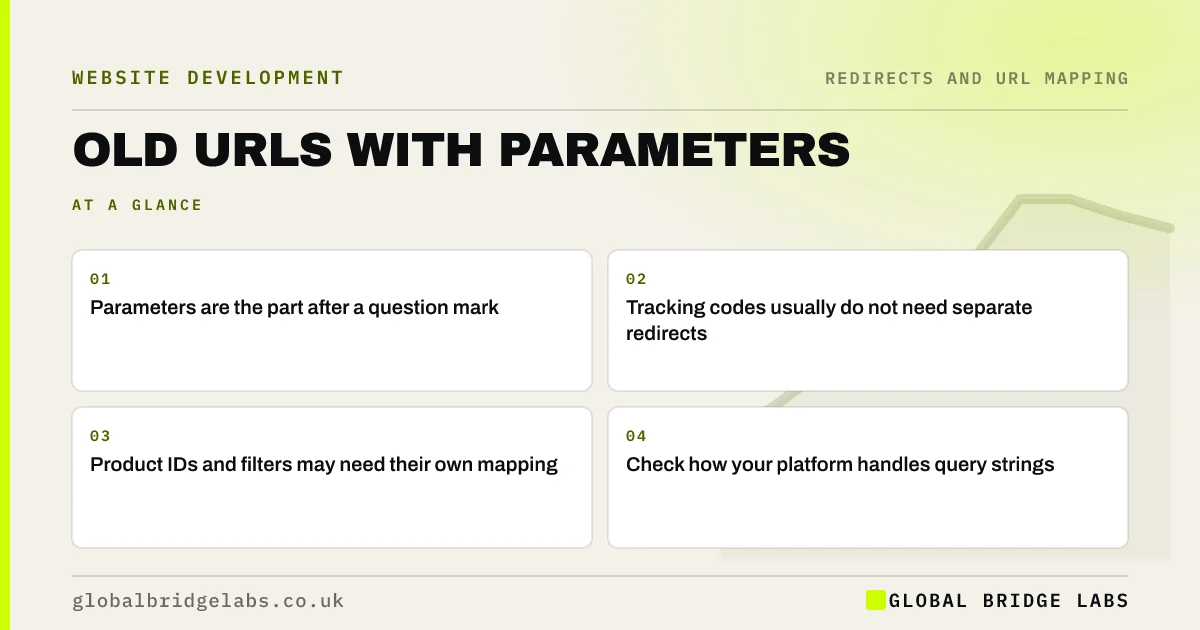
- Parameters are the part after a question mark.
- Tracking codes usually do not need separate redirects.
- Product IDs and filters may need their own mapping.
- Check how your platform handles query strings.
Old URLs full of question marks? Message us on WhatsApp.
Chat on WhatsApp →Which parameters matter?
Sort the parameter URLs from your inventory into groups. Each needs a different decision.
- Tracking codes, such as campaign tags: redirect with the main page.
- Session IDs: ignore; redirect to the clean URL.
- Sort orders: redirect to the clean category page.
- Filters that rank: map to equivalent filtered pages.
- Product or page IDs, such as ?id=123: map one to one.
How do you redirect them?
Server rules can match query strings and send each to the right page, so ID-based URLs from older platforms can be mapped individually. Decide whether the parameter should be dropped or passed through: tracking codes are often worth keeping on the new URL for analytics, while session IDs should be dropped. Hosted platforms may ignore or keep query strings automatically, so test samples of each type on staging.
How do you stop new parameter problems?
On the new site, use clean, readable URLs for pages you want to rank. Use canonical tags on filtered or sorted views to point to the main page, unless a filtered view deserves to rank on its own. Keep tracking parameters out of internal links, because they create duplicate URLs and muddle analytics. Google's URL structure guidance recommends keeping URLs simple.
- Canonical tags in a migration: point to the new URLs
- Trailing slashes, capitals and duplicate URL versions
Want us to sort your parameter URLs? Send us the list on WhatsApp.
Chat on WhatsApp →What does this look like in practice?
A pattern we see on older shops: product pages are addressed only by ID, such as product.php?id=482. The new platform uses readable product URLs, and a simple rule cannot know which ID matches which product. Exporting the IDs with product codes from the old database and mapping each one to its new URL keeps every product redirect accurate.
Parameter URL checklist
- List every parameter URL in the inventory.
- Group by type of parameter.
- Map ID and ranking filter URLs one to one.
- Decide which parameters to drop or keep.
- Test samples of each type on staging.
Next step
Filter your URL inventory for addresses containing a question mark and group them by parameter name. Each group usually needs one decision, not hundreds.
Message us on WhatsApp about parameter URLs, or book a 30-minute consultation.
Chat on WhatsApp →Sources and further reading
- Redirects and Google Search · Google Search Central
- How to specify a canonical URL with rel="canonical" and other methods · Google Search Central
- URL structure best practices for Google Search · Google Search Central
Frequently asked questions
Do I need to redirect URLs with tracking parameters?
Usually not separately. If the main page redirects, URLs with tracking codes added will normally follow the same redirect. Check how your server or platform handles query strings, and test a few tagged URLs, especially those used in emails, adverts or printed QR codes.
What are URL parameters?
They are the part of a URL after a question mark, made of names and values, such as ?colour=blue or ?utm_source=newsletter. Some change what the page shows, like filters and IDs. Others only track visits. Each type needs a different decision in a migration.
Should filtered pages be indexed after a migration?
Only filtered views that people search for and that offer genuinely useful content, such as a popular colour or size range, should be indexable. Most filtered and sorted views should use a canonical tag pointing to the main category page, to avoid many near-duplicate URLs.
Written by

Global Bridge Labs (GBL) is a UK–Sri Lanka partner for social media, websites and BPO. Everything here comes from client delivery, not theory.