On this page
- 01Key takeaways
- 02What is overhiring?
- 03What are the signs of overhiring?
- 04What does an unneeded role cost?
- 05Why do small businesses overhire?
- 06How do you correct overhiring fairly?
- 07How do you avoid overhiring next time?
- 08When is hiring ahead of demand justified?
- 09What does this look like in practice?
- 10Overhiring prevention checklist
- 11Next step
- 12Sources and further reading
- 13Frequently asked questions
Key takeaways
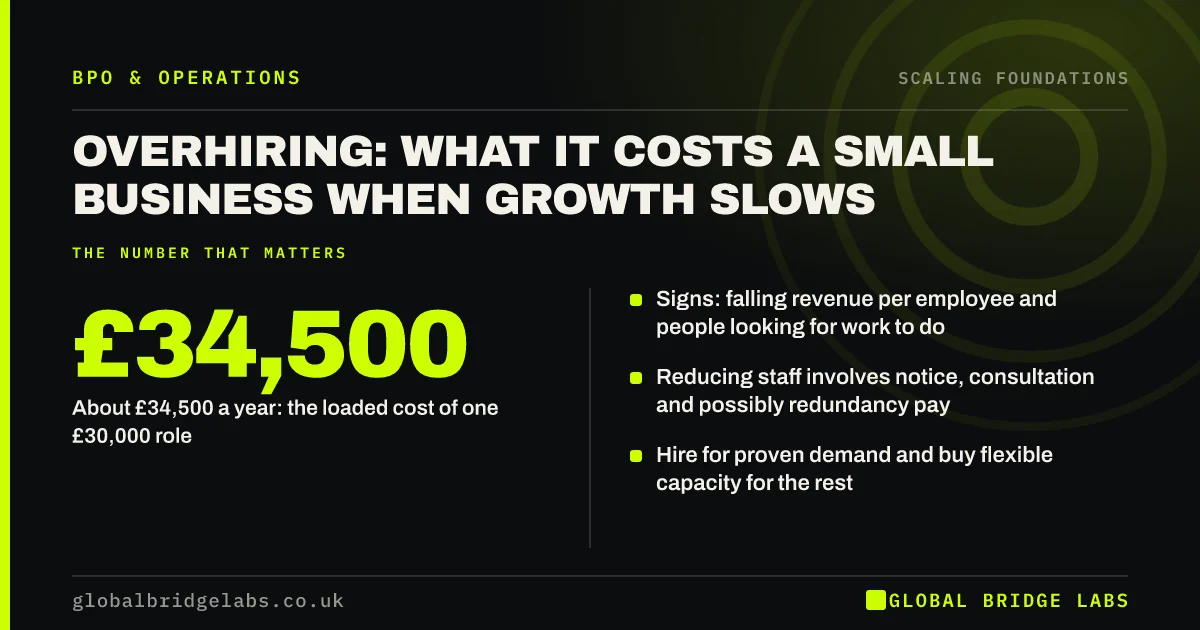
Overhiring is employing more people than the work needs, usually because roles were added ahead of demand. In a UK small business one unneeded £30,000 role costs about £34,500 a year at the loaded rate, and reversing it takes time, money and care. Flexible capacity for uncertain volume is the main defence.
- About £34,500 a year: the loaded cost of one £30,000 role.
- Signs: falling revenue per employee and people looking for work to do.
- Reducing staff involves notice, consultation and possibly redundancy pay.
- Hire for proven demand and buy flexible capacity for the rest.
Worried your team has outgrown the work? Message us on WhatsApp for a confidential capacity check.
Chat on WhatsApp →What is overhiring?
Overhiring is recruiting more employees than a business needs to deliver its current and near-term work. It usually follows a period of optimism: a strong quarter, a funding round or a large contract. The roles were reasonable on the forecast. The forecast was wrong, late or seasonal.
What are the signs of overhiring?
The clearest signs are in the numbers: revenue per employee falling, payroll rising as a share of revenue, and utilisation dropping. The softer signs appear first. People wait for work, meetings multiply, and tasks are invented to fill time.
- Revenue per employee down year on year.
- Payroll share of revenue up without a margin gain.
- Staff with regular idle time.
- Two people doing a job one used to manage.
- More coordination meetings, same output.
What does an unneeded role cost?
An unneeded role costs its full loaded cost for as long as it lasts. A £30,000 salary is about £34,500 a year once employer National Insurance at 15% above £5,000, the 3% minimum pension contribution and paid holiday are counted. Equipment, software licences and a manager's time come on top.
Removing the role has costs too. Employees are entitled to notice, and those with two years' service or more are normally entitled to statutory redundancy pay. A fair process takes weeks and affects the morale of everyone who stays.
Why do small businesses overhire?
Small businesses overhire because hiring feels like progress and because capacity can only be bought in whole people. A need for 15 hours a week becomes a full-time job. A busy season becomes a permanent role. Without a count of the work, the decision is made on how stretched the team feels in its worst week.
How do you correct overhiring fairly?
Correct it early and lawfully. First look for real work the person could do: a backlog, a delayed project or a role you were about to advertise. If roles must go, follow a fair redundancy process with proper consultation and notice, and take advice. Acas and GOV.UK set out the steps employers must follow.
- 1. Confirm the numbers over a full quarter.
- 2. Redeploy to real work where it exists.
- 3. Freeze replacement hiring.
- 4. If needed, run a fair, documented redundancy process.
Want to rebalance fixed and flexible capacity before it comes to that? Message us on WhatsApp.
Chat on WhatsApp →How do you avoid overhiring next time?
Avoid overhiring by hiring only for demand you have already seen and buying flexible capacity for demand you only expect. Size each need in hours. Where the volume is uncertain or seasonal, use a managed team on monthly terms, and convert it to a hire once the work has been steady for two or three quarters.
When is hiring ahead of demand justified?
Hiring ahead of demand is justified for roles that create the demand or take a long time to become productive: a salesperson, a senior specialist, a manager for a team you know is coming. The risk is deliberate and limited. It is support roles hired on hope that cause most of the damage.
What does this look like in practice?
A pattern we see after a strong year: a UK firm adds three office roles in a quarter, then a key contract ends. Six months later the roles are half used and nobody wants to raise it. Firms that had bought the same capacity as managed seats reduce hours the following month and keep their permanent team intact.
Overhiring prevention checklist
Apply these checks to every new role.
- The work is measured in hours per week.
- The volume has been steady for at least two quarters.
- The role would be used for most of its hours.
- The loaded annual cost is written into the plan.
- A flexible alternative has been priced.
- There is a review date after six months.
Next step
Send us your headcount by role and a rough idea of weekly workload. We will show you where fixed staffing is ahead of the work and how to hold future capacity flexibly.
Message us on WhatsApp for a staffing balance review, or book a 30-minute consultation.
Chat on WhatsApp →Sources and further reading
- Rates and thresholds for employers 2026 to 2027 · HM Revenue & Customs
- Workplace pensions: what you, your employer and the government pay · GOV.UK
- Redundancy: your rights · GOV.UK
- Making staff redundant · GOV.UK
Frequently asked questions
What happens if a business hires too many people?
If a business hires too many people, fixed costs rise faster than revenue, margin falls and cash tightens. Staff have too little to do, which damages morale and productivity. Correcting it means redeploying people or making roles redundant, which costs money and takes management time.
How do I know if my business is overstaffed?
Check whether revenue per employee is falling, whether payroll is taking a larger share of revenue, and whether staff have regular idle time. If two or more of those are true over a full quarter, and no growth is contracted to absorb the capacity, the business is likely overstaffed.
Is it better to be understaffed or overstaffed?
Neither is good, but they fail differently. Understaffing costs sales, service and wellbeing. Overstaffing costs cash and is slow to reverse. A small permanent team sized for steady demand, with flexible outside capacity for peaks and uncertain growth, avoids both.
How can a small business avoid redundancy when work drops?
Build flexibility in before work drops. Keep permanent staffing matched to steady demand and use managed outsourced hours, which can be reduced with a month's notice, for variable volume. When work falls, reduce the flexible hours first and protect the jobs of the permanent team.
Written by

Global Bridge Labs (GBL) is a UK–Sri Lanka partner for social media, websites and BPO. Everything here comes from client delivery, not theory.