On this page
- 01Key takeaways
- 02Why do scaling myths matter?
- 03Does growing always mean hiring?
- 04Are employees cheaper than outsourcing?
- 05Does outsourcing mean losing control?
- 06Is a small business too small to outsource?
- 07Which other myths are worth testing?
- 08When is the myth actually true?
- 09What does this look like in practice?
- 10Myth-testing checklist
- 11Next step
- 12Sources and further reading
- 13Frequently asked questions
Key takeaways
Most scaling a business myths share one assumption: that a bigger business needs a bigger payroll. It does not follow. Headcount is one way to buy capacity, and often the slowest and least flexible. Testing each belief against hours, costs and volume usually shows that fewer hires are needed than planned.
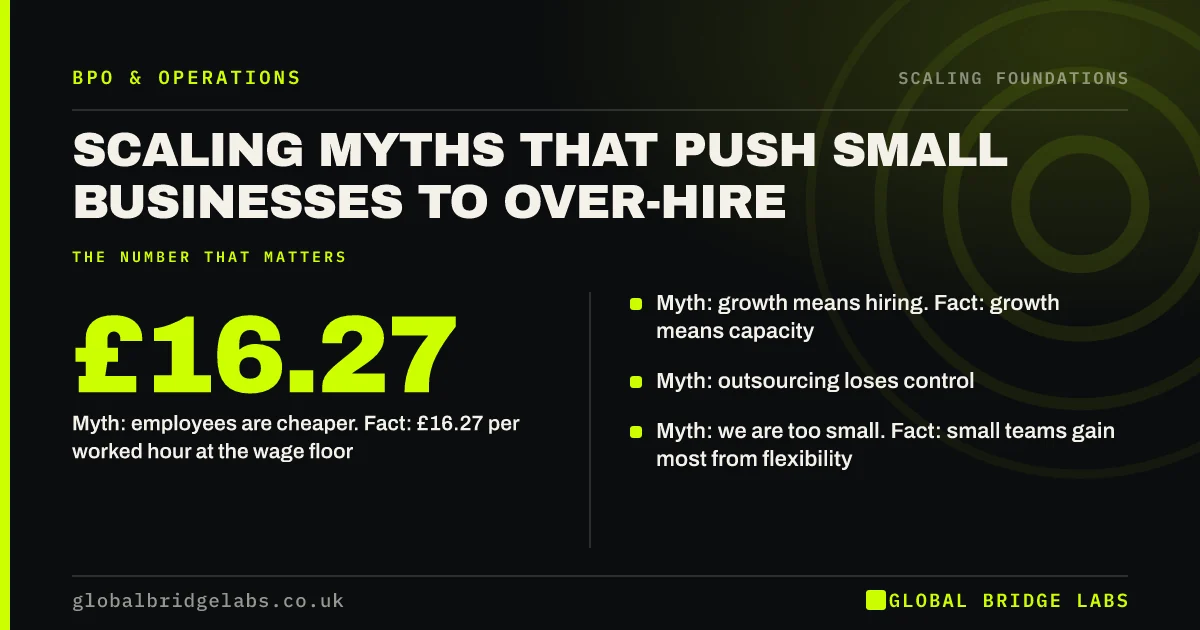
- Myth: growth means hiring. Fact: growth means capacity.
- Myth: employees are cheaper. Fact: £16.27 per worked hour at the wage floor.
- Myth: outsourcing loses control. Fact: it adds measurement.
- Myth: we are too small. Fact: small teams gain most from flexibility.
Hearing one of these in your planning meetings? Message us on WhatsApp and we will test it with your numbers.
Chat on WhatsApp →Why do scaling myths matter?
Scaling myths matter because they turn into fixed costs. A belief that every extra block of work needs another employee produces a payroll that is hard to reduce if sales dip. Each myth below is common in UK small businesses, and each has a simple test.
Does growing always mean hiring?
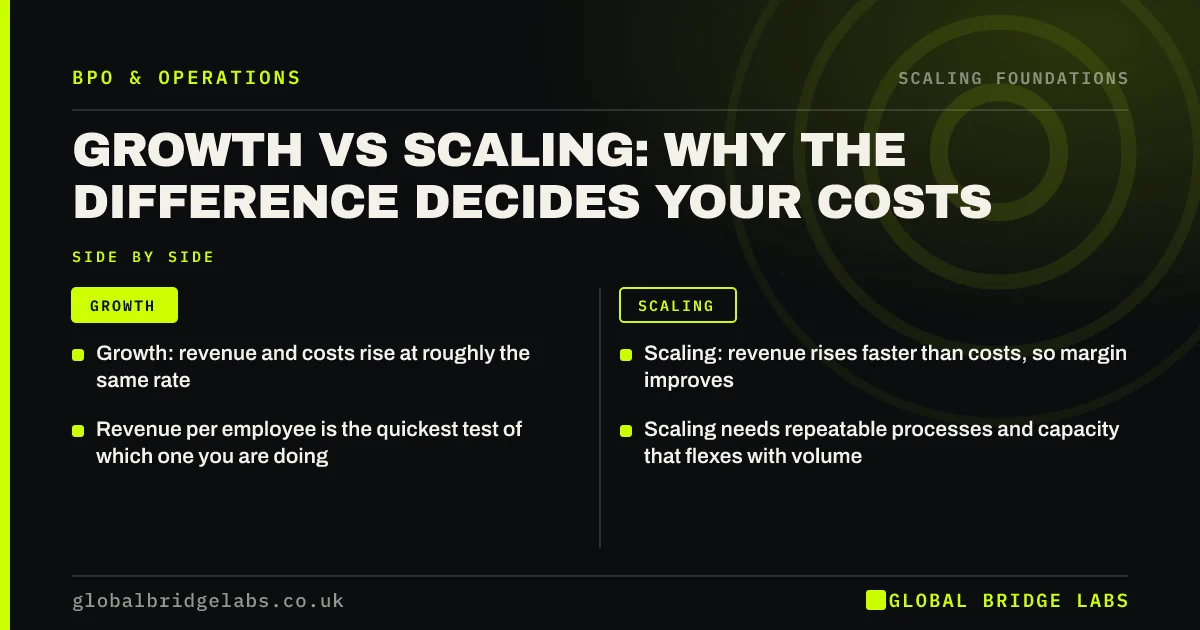
No. Growing means handling more work, and work can be handled by recovered hours, software, managed outside teams or new employees. Hiring is right for core roles that will be fully used. For variable, repeatable volume it is usually the most expensive option per productive hour and the hardest to reverse.
Are employees cheaper than outsourcing?
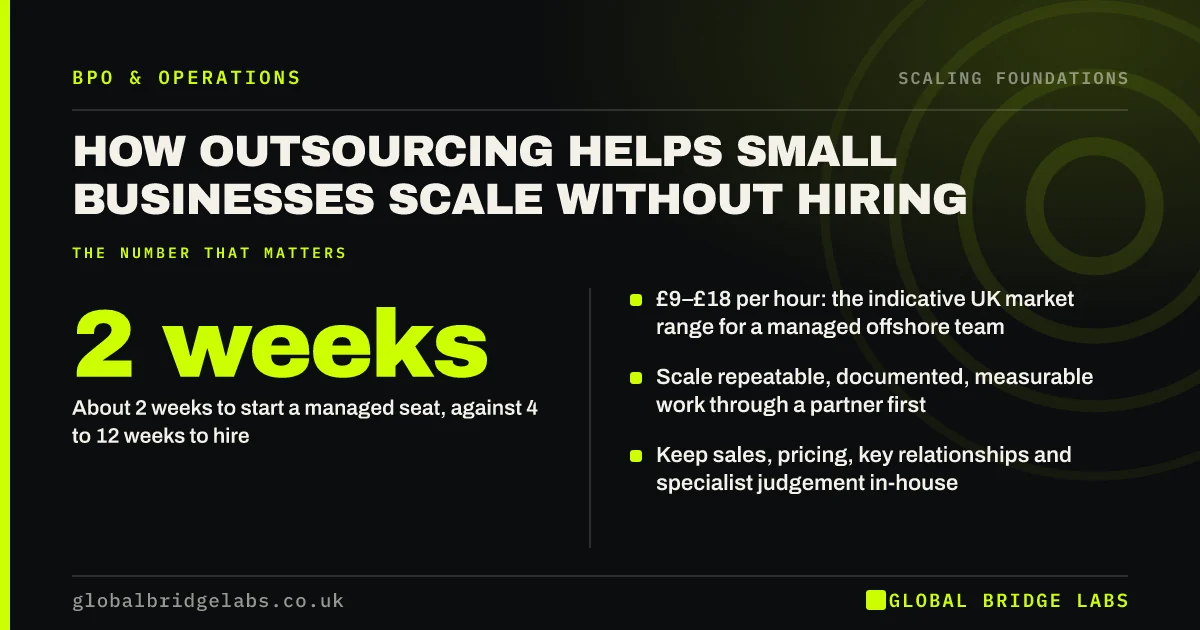
Not usually for routine work. At the 2026/27 National Living Wage of £12.71, an employee costs about £16.27 per worked hour once employer National Insurance, pension and paid holiday are included, before recruitment, equipment and management. Indicative market rates for a managed offshore team are £9–£18 per hour with supervision and cover included.
Does outsourcing mean losing control?
Outsourcing changes how control is exercised, from watching people to reviewing numbers. A well-run arrangement has a written process, service levels and a weekly scorecard, which is more control than most in-house admin has ever had. Control is lost when work is handed over undocumented and nobody inside owns the relationship.
Is a small business too small to outsource?
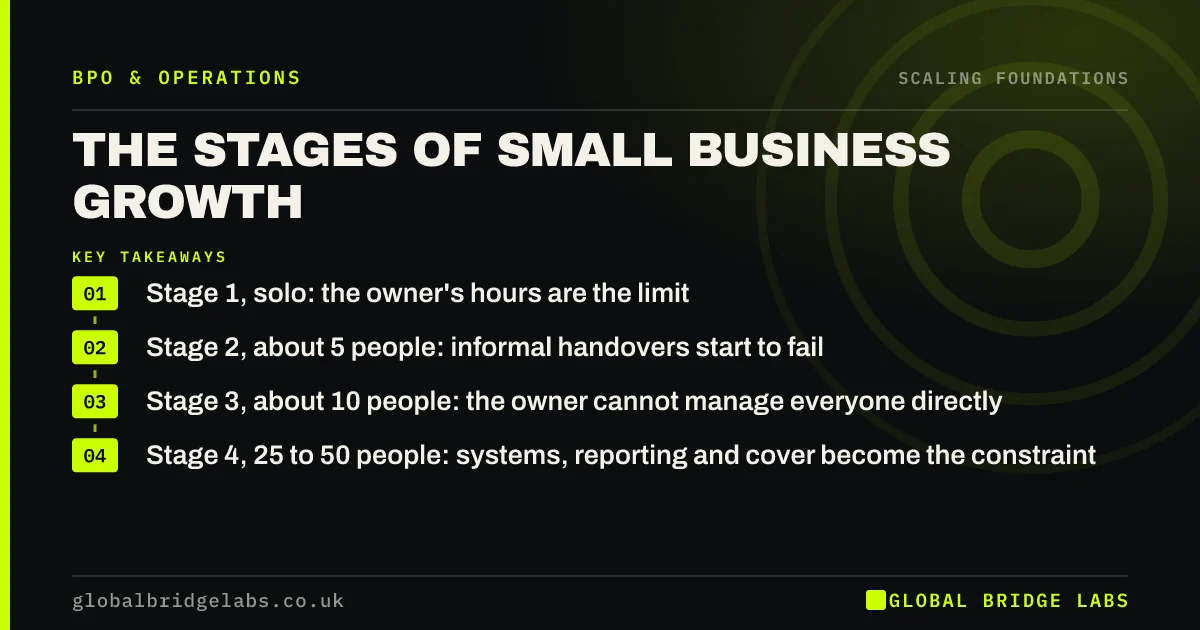
A small business is rarely too small, but a task can be. Providers that work with small firms offer part-time seats, so 15 to 20 hours a week is a workable starting point. Below about five hours a week, handover and review time can outweigh the gain, and a simpler fix such as automation is better.
Unsure whether your volume is enough to hand over? Send us the weekly hours on WhatsApp.
Chat on WhatsApp →Which other myths are worth testing?
Three more beliefs are worth a test. That quality always drops with an outside team: it depends on documentation and sampling, not location. That customers will mind: they notice speed and accuracy, not who employs the person. That scaling must be fast: adding capacity in small steps into a stable process is safer.
- Quality depends on the written process and checks.
- Customers judge response time and accuracy.
- Steady, staged scaling beats a rush.
When is the myth actually true?
Sometimes the old advice holds. If the role is core, full-time and needs presence or years of context, hire. If the work changes daily and cannot be written down, keep it close. The point is to decide case by case with numbers, not to replace one blanket rule with another.
What does this look like in practice?
A pattern we see in UK owner-managed firms: the growth plan is a list of job titles. When each title is tested against weekly hours, two are full roles and three are fragments of 10 to 15 hours. The fragments are where a managed team fits, and the two real roles get better candidates because the brief is clearer.
Myth-testing checklist
Put each planned hire through these questions.
- How many hours a week of work sit behind this role?
- What is the loaded hourly cost, not the salary?
- Is the volume steady all year?
- Could the process be written down in a day?
- What would the same scope cost from a provider?
- Who would manage the person, and with what time?
Next step
Send us your list of planned hires. We will test each one against hours and cost with you and say which are real roles.
Message us on WhatsApp to test your hiring plan, or book a 30-minute consultation.
Chat on WhatsApp →Sources and further reading
Frequently asked questions
Do you need more employees to grow a business?
Not always. You need more capacity, which can come from fixing wasted time, automating routine steps, using a managed outsourced team or hiring. New employees are the right choice for core roles that will be fully used. For variable or routine work, other sources of capacity are usually quicker and cheaper.
Is outsourcing only for big companies?
No. Many providers now serve small businesses with part-time seats and monthly terms, so a firm of five or ten people can outsource 15 to 20 hours a week. Small teams often benefit most, because one absence or one leaver has a much larger effect on them.
Does outsourcing reduce quality?
Quality depends on how the work is specified and checked, not on who employs the person doing it. With a written process, agreed service levels and regular sampling, outsourced work is often more consistent than informal in-house work. Without those, quality will suffer wherever the work is done.
What is the biggest mistake when scaling a small business?
The most common mistake is adding fixed cost ahead of proven demand, usually by hiring several people at once for work that has not been measured. If sales arrive later or lower than hoped, the business is left with payroll it cannot easily reduce and less cash to fix the real constraint.
Written by

Global Bridge Labs (GBL) is a UK–Sri Lanka partner for social media, websites and BPO. Everything here comes from client delivery, not theory.