On this page
- 01Key takeaways
- 02Which service metrics matter when deciding to outsource?
- 03What thresholds should trigger action?
- 04How do you collect these metrics without new systems?
- 05What is cost per contact and why track it?
- 06Which metrics measure quality, not just speed?
- 07How do these metrics feed the outsourcing decision?
- 08When do metrics mislead?
- 09How often should you review service metrics?
- 10What does this look like in practice?
- 11Metrics checklist
- 12Next step
- 13Sources and further reading
- 14Frequently asked questions
Key takeaways
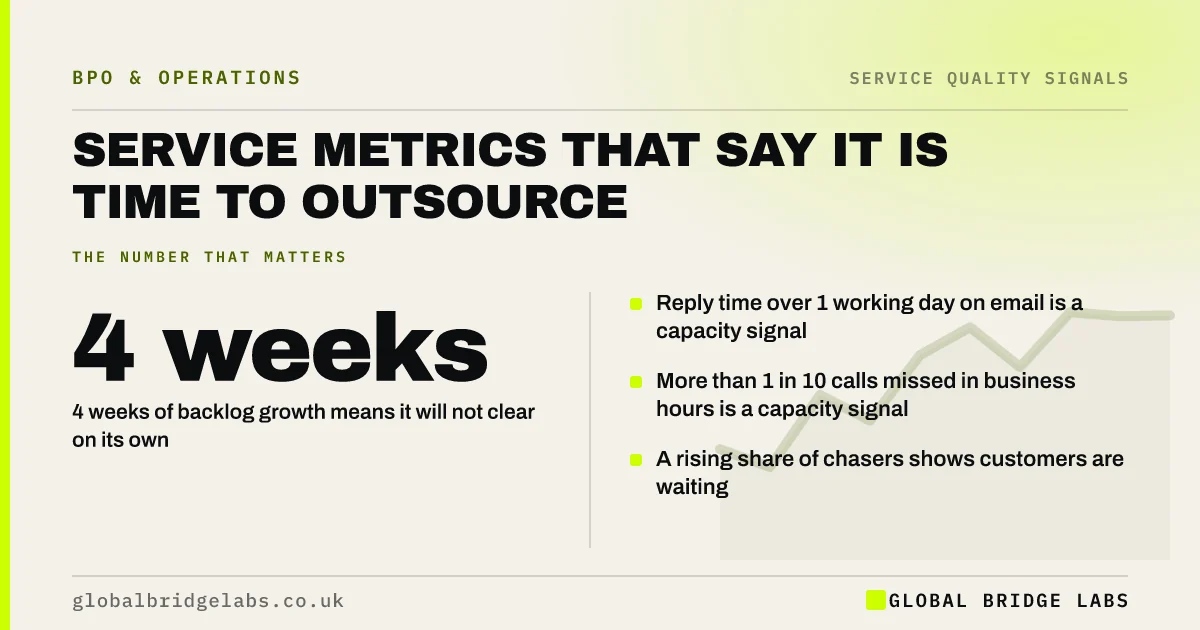
The customer service metrics that signal outsourcing are reply time, backlog, missed calls, chasers and cost per contact. When replies routinely exceed a working day, missed calls exceed about 1 in 10, chasers make up a growing share of contacts, or the backlog grows for four weeks, capacity is short and outsourcing the first line is worth testing.
- Reply time over 1 working day on email is a capacity signal.
- More than 1 in 10 calls missed in business hours is a capacity signal.
- A rising share of chasers shows customers are waiting.
- 4 weeks of backlog growth means it will not clear on its own.
Want to check your numbers against these thresholds? Message us on WhatsApp.
Chat on WhatsApp →Which service metrics matter when deciding to outsource?
The metrics that matter are the ones that show capacity: how long customers wait, how many contacts are missed, how much work is waiting and what each contact costs. Satisfaction scores matter too, but they lag. Customer service metrics that signal outsourcing are the early, operational ones.
What thresholds should trigger action?
Use these as working thresholds for a small business. They are not industry standards, but crossing them for a month or more usually means customers are being affected.
- Email: median first reply over one working day.
- Phone: more than 10% of calls missed in business hours.
- Chat and WhatsApp: first reply over 10 minutes in opening hours.
- Backlog: growing for four or more consecutive weeks.
- Chasers: more than 15% of contacts are customers following up.
Send us your five numbers on WhatsApp and we will tell you which one to act on first.
Chat on WhatsApp →How do you collect these metrics without new systems?
Most can be collected from tools you already have. Phone systems show missed calls. Email and helpdesk tools show reply times. A daily count of unanswered items gives the backlog. Tagging chasers for two weeks gives their share. A simple spreadsheet updated weekly is enough to see trends.
What is cost per contact and why track it?
Cost per contact is the total cost of handling customer contacts divided by the number handled. It shows whether service is efficient, and gives a fair comparison with an outsourced quote. Include the time of everyone who handles contacts, including the owner and salespeople, at their loaded hourly cost.
Which metrics measure quality, not just speed?
Speed without quality is not good service. Track first contact resolution, the share of contacts resolved in one go, and score a weekly sample of replies against your written guide. If speed improves but first contact resolution falls, customers are getting quick but incomplete answers.
How do these metrics feed the outsourcing decision?
They set the scope and the target. The channel that breaks its threshold is where to start, and its current figure becomes the baseline. If an outsourced team takes that channel, the same metrics then become its service levels, so the decision and the measurement use one set of numbers.
When do metrics mislead?
Metrics mislead when they are gamed, averaged over too long a period, or taken without context. A quick holding reply can make reply time look good while nothing is resolved. A monthly average can hide a terrible Monday. Look at medians, look by day of the week, and read a sample of real conversations.
How often should you review service metrics?
Weekly for the operational numbers and monthly for trends. A short weekly look at reply times, missed calls and backlog catches problems while they are small. A monthly review compares trends, cost per contact and quality samples, and decides whether any threshold has been crossed for long enough to act.
- Weekly: reply time, missed calls, backlog.
- Monthly: chasers, cost per contact, first contact resolution.
- Quarterly: rescore processes on the trigger scorecard.
What does this look like in practice?
A pattern we see in UK clinics: satisfaction seems fine, but the phone system shows 18% of calls missed between 8am and 10am, and a third of emails are patients chasing appointment changes. Those two numbers identify the scope: outsourced call answering for the morning peak and rebooking by email.
Metrics checklist
Set these up to know when to act.
- Median first reply by channel.
- Missed call rate in business hours.
- Weekly backlog count and oldest item.
- Share of contacts that are chasers.
- Cost per contact including all handlers.
- First contact resolution and a weekly quality sample.
Next step
Send us your service numbers. We will tell you which threshold you are closest to and whether outsourcing would bring it back in line.
Message us on WhatsApp with your metrics, or book a 30-minute consultation.
Chat on WhatsApp →Sources and further reading
- UK Customer Satisfaction Index · Institute of Customer Service
- National Minimum Wage and National Living Wage rates · GOV.UK
- Rates and thresholds for employers 2026 to 2027 · HM Revenue & Customs
Frequently asked questions
What customer service metrics should a small business track?
Median first reply by channel, missed call rate, backlog size, share of contacts that are chasers, cost per contact and first contact resolution. Track them weekly in a simple spreadsheet. Trends matter more than single weeks.
What is an acceptable missed call rate?
For a small business, aim to miss fewer than 1 in 10 calls in business hours, and lower still for sales lines. Missed calls often go straight to competitors. If you regularly miss more, extra cover at peak times is usually worth testing.
When should I outsource customer service?
When capacity metrics cross their thresholds for a month or more: replies over a working day, over 10% of calls missed, a backlog growing for four weeks, or a rising share of chasers. Start with the channel that breaks its threshold first.
Written by

Global Bridge Labs (GBL) is a UK–Sri Lanka partner for social media, websites and BPO. Everything here comes from client delivery, not theory.