On this page
Key takeaways
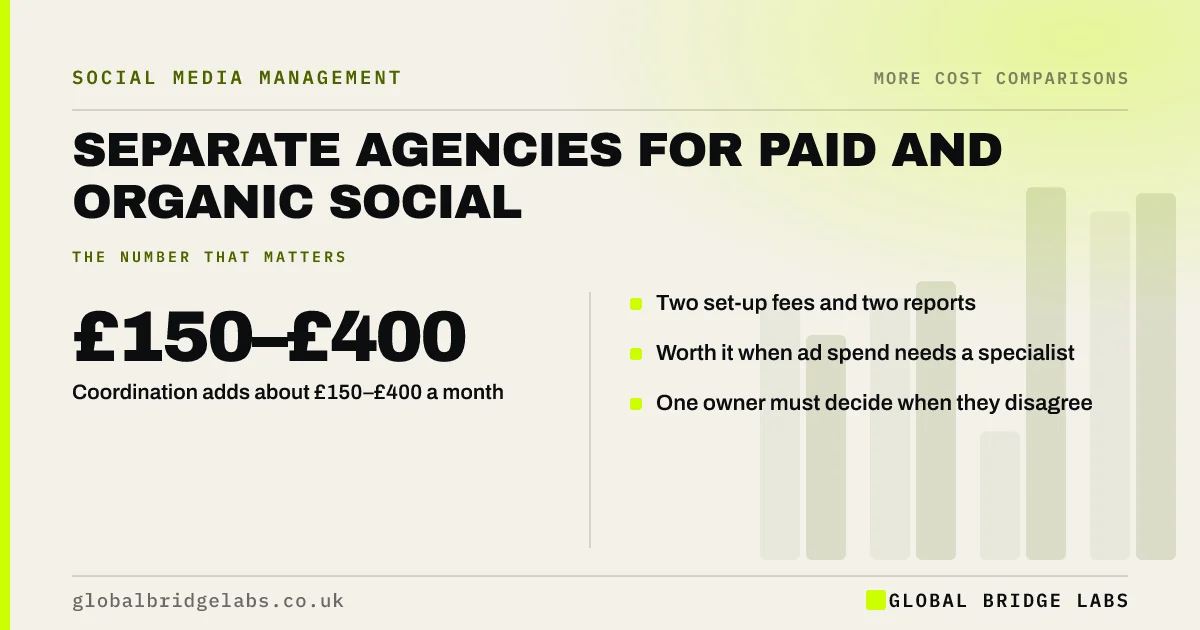
Using separate agencies for paid and organic social usually costs more than one agency doing both, because each needs its own onboarding, reporting and coordination time. Expect an extra 2 to 4 hours a month, about £150–£400, for the two to stay aligned. Splitting makes sense when ad spend is large enough to justify a paid specialist.
- Coordination adds about £150–£400 a month.
- Two set-up fees and two reports.
- Worth it when ad spend needs a specialist.
- One owner must decide when they disagree.
Running two agencies already? Message us on WhatsApp for a cost check.
Chat on WhatsApp →Why do businesses split paid and organic?
Some firms hire a paid social specialist for ads and a content agency for posts, believing each will be better at its part. It can work, especially at higher ad budgets. The risk is that ads and posts tell different stories and nobody owns the whole result.
What does splitting cost?
Each agency charges its own fee and often its own set-up. On top, someone must coordinate: sharing creative, aligning offers and dates, and reconciling reports. At £75–£100 an hour, 2 to 4 hours a month of coordination is an indicative £150–£400, often hidden in your own time.
- Paid social management: £300–£1,000 a month.
- Organic retainer: £950–£2,500 for most SMEs.
- Coordination: £150–£400 a month, indicative.
- Two set-ups: £600–£2,000 each.
Send us both quotes on WhatsApp and we will discuss your requirements.
Chat on WhatsApp →When does splitting make sense?
When ad spend is high enough that a specialist's testing skills clearly pay back, when your organic agency does not run ads well, or when ads must run across many platforms. Even then, agree one shared plan and one combined monthly report.
When is one agency better value?
For most small businesses with modest ad budgets, one agency doing both is cheaper and more joined up: the best organic posts become ads, and ad results shape content. You also have one contact and one report.
What does this look like in practice?
A pattern we see: two agencies each report success while enquiries stay flat, because nobody measures the whole funnel. Agreeing one shared goal and a joint monthly review usually exposes where the gap is.
Two-agency checklist
- Set one shared goal and measure it once.
- Share a single content and offer calendar.
- Hold a joint monthly review.
- Name who decides when they disagree.
- Compare the total with a single agency quote.
Next step
Add up both fees plus the hours you spend coordinating. Then ask one agency to quote for the whole job.
Message us on WhatsApp for a combined quote, or book a 30-minute consultation.
Chat on WhatsApp →Sources and further reading
- Meta Business Help Centre · Meta
- Meta Ad Library · Meta
Frequently asked questions
Should the same agency run my ads and organic social?
For most small businesses, yes: it is cheaper and more joined up. Splitting can make sense at higher ad budgets where a paid specialist's testing clearly pays back, as long as both work to one plan.
What goes wrong with two social media agencies?
Messages and offers drift apart, creative is not shared, reports measure different things and nobody owns the overall result. A shared calendar, one goal and joint reviews prevent most of it.
Who should own the ad account if I use two agencies?
You should. Keep the ad account and pages in your business's name and give each agency the access it needs. That way you can change either supplier without losing data.
Written by

Global Bridge Labs (GBL) is a UK–Sri Lanka partner for social media, websites and BPO. Everything here comes from client delivery, not theory.