On this page
- 01Key takeaways
- 02Is email better than social media for small businesses?
- 03What does owning an audience actually mean?
- 04When should social come first?
- 05What are the UK rules on marketing email?
- 06How should the hours be split?
- 07What does this look like in practice?
- 08What should a small business email actually say?
- 09Next step
- 10Sources and further reading
- 11Frequently asked questions
Key takeaways
Social media rents an audience and email owns one. New businesses need social to find people. Established businesses with a customer list are usually under-investing in email, which reaches everyone you send it to and cannot be switched off by an algorithm.
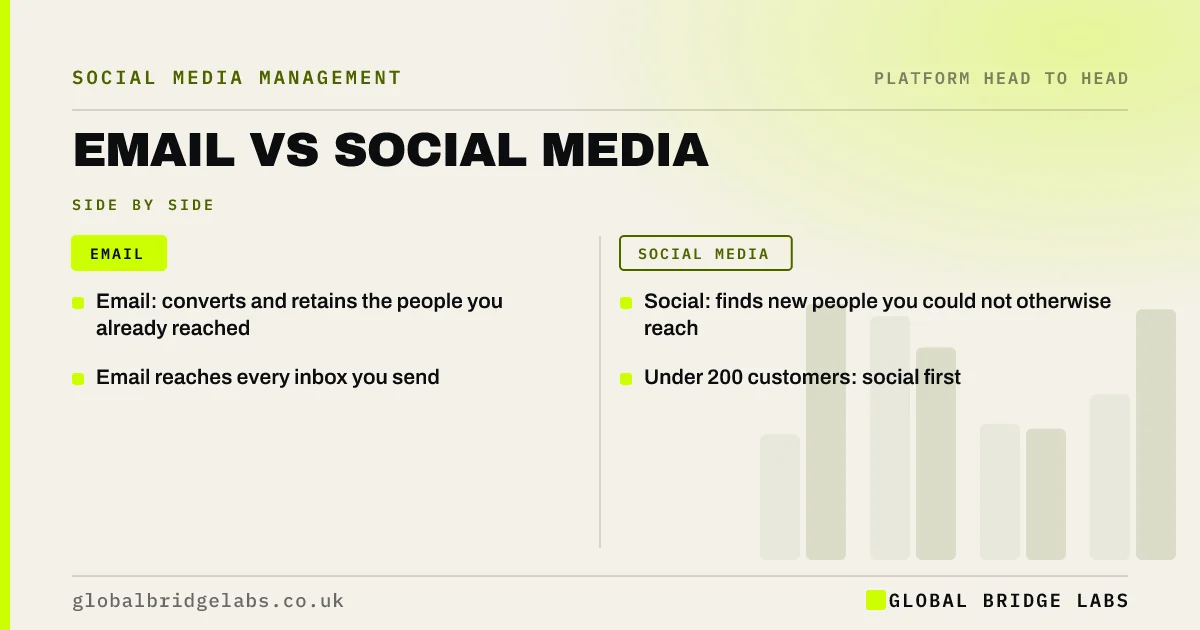
- Email: converts and retains the people you already reached. You own the list.
- Social: finds new people you could not otherwise reach. You rent that audience.
- Email reaches every inbox you send to. Organic social reaches a fraction.
- Under 200 customers: social first. Over 500: email is probably underused.
- UK email marketing needs consent under PECR. Get the permission properly.
Want your customer list turned into a working email channel? Ask us on WhatsApp.
Chat on WhatsApp →Is email better than social media for small businesses?
For reaching people who already know you, yes, and it is not close. An email reaches every inbox you send it to, while an organic social post reaches a small and shrinking fraction of the people who chose to follow you.
For reaching people who have never heard of you, no. Email cannot find anyone. That is the whole division of labour: social media is for discovery, email is for the relationship afterwards.
What does owning an audience actually mean?
That you can reach those people without a third party's permission. Four practical consequences that most businesses only appreciate once something goes wrong.
- An algorithm change cannot reduce your email reach. It can halve your social reach.
- A suspended account takes your social audience with it. Your list is unaffected.
- You can export, segment and analyse a list. You cannot export followers.
- Email works during a month when nobody has time to post.
- A list is an asset with value in a sale. Followers largely are not.
When should social come first?
When you do not yet have enough customers to email. A list of 40 addresses cannot carry a business, and the fastest way to grow it is to be visible somewhere people who have not met you are looking.
The practical sequence for a newer UK business is social for discovery, with every single interaction pushed toward something you own: an email signup, a WhatsApp conversation, or a booking. Treat social reach as raw material rather than as the outcome.
We will build the route from social post to owned contact. Message us on WhatsApp.
Chat on WhatsApp →What are the UK rules on marketing email?
Marketing email to individuals generally requires consent under the Privacy and Electronic Communications Regulations, with a limited exception for existing customers buying similar products, known as soft opt-in. Every message needs a clear unsubscribe route and must identify you.
In practice that means: ask properly at the point of purchase or enquiry, record when and how consent was given, never buy a list, and honour unsubscribes immediately. The ICO's direct marketing guidance is the authority here, and the rules are stricter than most small businesses assume.
How should the hours be split?
It depends on how many customers you already have, which is the variable most advice ignores.
- Under 200 customers: roughly 80% social, 20% email. You need discovery.
- 200-500 customers: 60/40. Start a monthly email and keep it simple.
- Over 500 customers: 50/50 at least. The list is probably your best channel.
- Seasonal businesses: shift to email before the season, social between them.
- Email takes 2-4 hours a month, not a week. It is the cheapest channel you have.
What does this look like in practice?
A UK garden centre had roughly 3,000 past customers with email addresses collected at the till and had never sent anything to them. Marketing effort went entirely into two social channels reaching a few hundred people a post.
One monthly email, plain text, written by the owner about what was in stock and what to plant that month, became the highest-returning marketing activity in the business within two sends. It took about two hours a month. The social channels kept doing the job they were good at, which was reaching people who had never visited.
What should a small business email actually say?
Something useful, written by a person, in plain text. The highest-returning small business emails we see are not designed at all: they are a few hundred words from the owner about what is in stock, what is worth doing this month, or what they learned on a job.
Elaborate templates take hours, look like advertising and frequently perform worse. Start with something you could write in thirty minutes and send it monthly. Consistency is what builds the habit of opening, and nothing about a designed header contributes to that.
Next step
Count how many customer email addresses you already hold and when you last used them. If the number is over 300 and the answer is never, that is the highest-return marketing job available to you this month, and it costs almost nothing.
Message us on WhatsApp and we will plan your first monthly email from your existing list.
Chat on WhatsApp →Sources and further reading
- Electronic and telephone marketing under PECR · Information Commissioner's Office
- Direct marketing and privacy and electronic communications · Information Commissioner's Office
Frequently asked questions
Is email marketing better than social media?
For reaching people who already know you, yes: email reaches every inbox you send to while organic social reaches a fraction of followers. For finding people who have never heard of you, social wins, because email cannot discover anyone.
Do I need consent to email my customers in the UK?
Generally yes, under the Privacy and Electronic Communications Regulations, with a limited soft opt-in exception for existing customers buying similar products. Record when and how consent was given, never buy a list, include a clear unsubscribe route, and honour opt-outs immediately.
How often should a small business send marketing emails?
Monthly is enough for most UK small businesses and is sustainable at two to four hours a month. Consistency matters far more than frequency or design: a plain, useful monthly email written by the owner outperforms an elaborate quarterly one nobody was expecting.
Should a new business focus on email or social media?
Social first, because a short list cannot carry a business. Use social for discovery and push every interaction toward something you own, such as an email signup or a WhatsApp conversation, so the audience becomes yours over time.
Written by
Global Bridge Labs (GBL) is a UK–Sri Lanka partner for social media, websites and BPO. Everything here comes from client delivery, not theory.