On this page
- 01Key takeaways
- 02Why do signs count as advertising?
- 03What does it cost?
- 04What should go on a van?
- 05What makes a shop sign work?
- 06Do you need permission for signs?
- 07How do you track a van or a sign?
- 08How does social media add to it?
- 09When is it not worth it?
- 10What does this look like in practice?
- 11Checklist for signs and vehicles
- 12Next step
- 13Sources and further reading
- 14Frequently asked questions
Key takeaways
Van signwriting and shop signs are advertising you pay for once and own for years. For a local business they are often the best-value traditional channel, because they are seen daily in exactly the area served. Social media then shows what the van and the shop cannot.
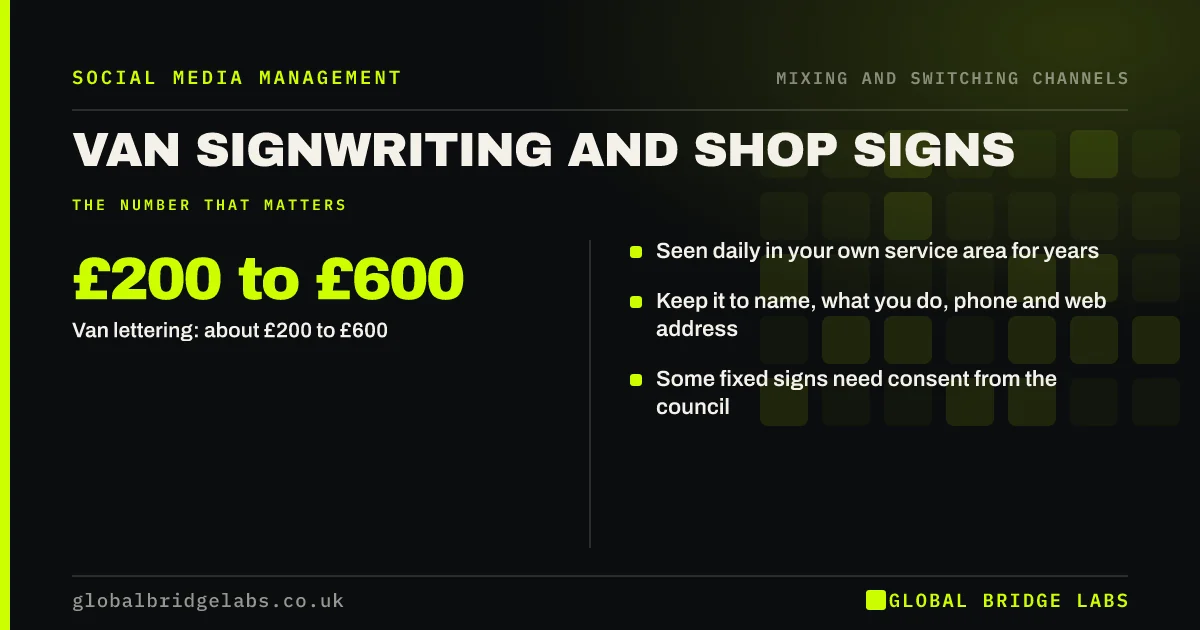
- Van lettering: about £200 to £600. Full wrap: £1,500 to £3,500.
- Seen daily in your own service area for years.
- Keep it to name, what you do, phone and web address.
- Some fixed signs need consent from the council.
Refreshing a van or shopfront? Message us on WhatsApp and we will check it matches everything else.
Chat on WhatsApp →Why do signs count as advertising?
Signs count as advertising because they put your name in front of local people repeatedly. They are owned media: there is no rental and no end date. A van parked outside a job tells the whole street who is trusted to do that kind of work.
What does it cost?
As indicative UK ranges, cut-vinyl lettering on a van costs about £200 to £600 and a full printed wrap £1,500 to £3,500, depending on vehicle size and design. Shop fascia signs vary more widely with size, materials and lighting. Spread over several years, the yearly cost is low.
Want the cost compared with a year of other local advertising? Message us on WhatsApp and we will discuss your requirements.
Chat on WhatsApp →What should go on a van?
A van is read in a few seconds from a distance, so less is more.
- Business name, large.
- What you do, in three or four words.
- One phone number.
- Web address or social handle.
- An accreditation logo, if it matters to buyers.
What makes a shop sign work?
A shop sign works when a passer-by can tell what you sell and whether you are open. Use a clear name, a short description and readable lettering. Keep the window uncluttered, and show opening hours that match your online listings.
Do you need permission for signs?
Sometimes. Outdoor advertisements in England are controlled by planning regulations. Many signs on business premises have deemed consent within limits on size, height and illumination, and others need express consent. Listed buildings and conservation areas have stricter rules, so check with the local planning authority.
How do you track a van or a sign?
Give the van its own tracking number or a short web address, and ask every enquirer how they heard of you. 'Saw your van' is one of the commonest answers for local trades once the question is asked.
How does social media add to it?
Social media gives the sighting somewhere to go. A neighbour who sees your van can look you up and find photos of the job in their own street. Post from each job with the area named, and put the same name and colours on your profile. A QR code suits a parked van or a job-site board, not a moving vehicle.
When is it not worth it?
It is not worth it on a vehicle that rarely leaves the yard, on one you will replace within a year, or where security is a concern and tools are kept inside. A full wrap is hard to justify when simple lettering does the same job.
What does this look like in practice?
A pattern we see with trades firms: the van carries a mobile number that changed two years ago and a web address that no longer works. The cheapest advertising the firm owns has been sending people nowhere. Checking the details takes five minutes.
Checklist for signs and vehicles
- Readable from 20 metres in three seconds.
- Details match the website and listings.
- Colours and logo match everything else.
- A tracking number or address in place.
- Consent checked for fixed signs.
Next step
Stand 20 metres from your van or shopfront and time how long it takes a friend to say what you do and how to reach you.
Message us on WhatsApp with a photo and we will give you our view, or book a 30-minute consultation.
Chat on WhatsApp →Sources and further reading
Frequently asked questions
Is van signwriting worth it?
For most local trades and service firms, yes. It is paid for once, lasts for years and is seen every day in the area you serve. Keep the design simple and make sure the phone number and web address are current.
How much does van signwriting cost in the UK?
As an indicative range, cut-vinyl lettering costs about £200 to £600 and a full printed wrap £1,500 to £3,500, depending on the size of the vehicle and the design. Get quotes from two or three signwriters.
Do I need planning permission for a shop sign?
Possibly. Many signs on business premises have deemed consent within limits on size and lighting, while others need express consent. Rules are stricter for listed buildings and conservation areas. Check with the local planning authority.
What should I put on my work van?
Your business name, what you do in a few words, one phone number and a web address or social handle. Add an accreditation logo if buyers look for it. Leave out long lists of services, which nobody can read in traffic.
Written by

Global Bridge Labs (GBL) is a UK–Sri Lanka partner for social media, websites and BPO. Everything here comes from client delivery, not theory.