On this page
- 01Key takeaways
- 02What is different about advertising a professional firm?
- 03Which channels work best?
- 04How should social media be used?
- 05What do the regulators restrict?
- 06Do traditional channels still have a role?
- 07What does it cost?
- 08How do you measure it?
- 09What should a professional firm avoid?
- 10What does this look like in practice?
- 11Next step
- 12Sources and further reading
- 13Frequently asked questions
Key takeaways
Advertising for professional services is about being trusted before being needed. Referrals, expertise shown on LinkedIn and a clear website do most of the work. Traditional channels such as local sponsorship and trade press support them, and sector rules shape what can be said.
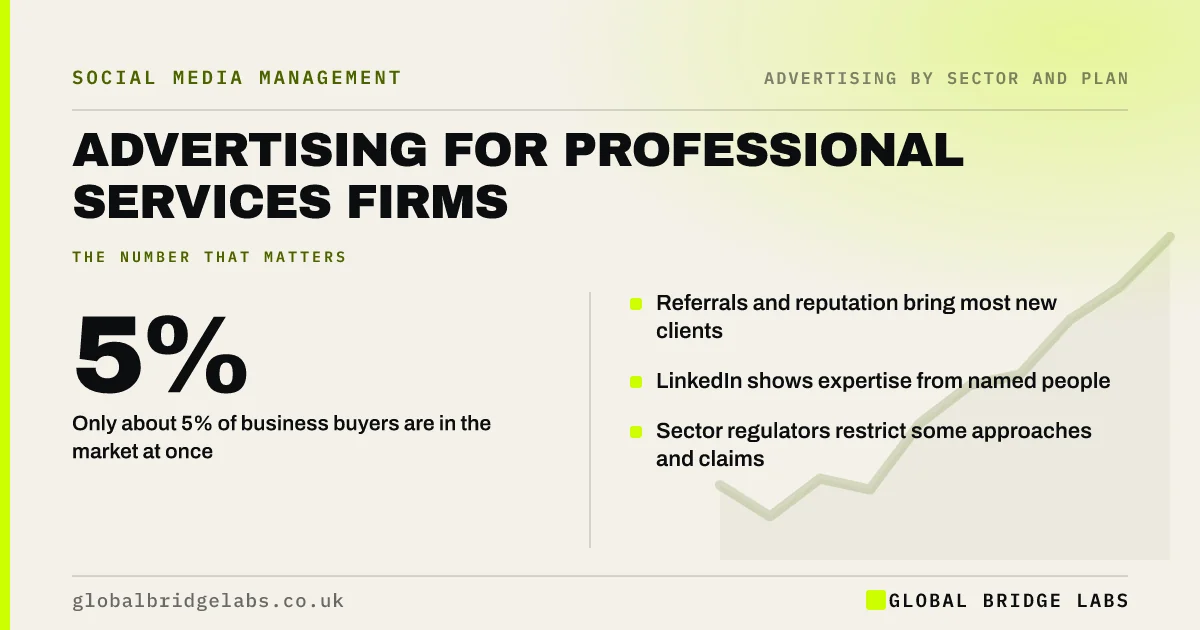
- Referrals and reputation bring most new clients.
- LinkedIn shows expertise from named people.
- Sector regulators restrict some approaches and claims.
- Only about 5% of business buyers are in the market at once.
Want your firm's channels reviewed? Message us on WhatsApp.
Chat on WhatsApp →What is different about advertising a professional firm?
Professional services, such as accountancy, law, financial advice and brokerage, are bought rarely, on trust, often after a recommendation. The client cannot judge quality in advance. Advertising therefore has to demonstrate competence and make the firm easy to check, not shout an offer.
Which channels work best?
These channels suit most professional firms, in roughly this order.
- 1. Referrals from clients and other professionals.
- 2. A website that states who you help and how.
- 3. LinkedIn posts from partners and senior staff.
- 4. A Google Business Profile with genuine reviews.
- 5. Seminars, networking and local sponsorship.
- 6. Trade or local press, used selectively.
How should social media be used?
Use social media to answer the questions clients ask before they instruct you. Explain a deadline, a rule change or a common mistake in plain English, under a named person. The LinkedIn B2B Institute estimates about 95% of business buyers are not in the market at any moment, so the aim is to be remembered.
What do the regulators restrict?
Rules vary by profession, and each firm should check its own regulator's current guidance. Solicitors regulated by the Solicitors Regulation Authority must not make unsolicited approaches to members of the public and must publish price information for certain services. Financial promotions must be fair, clear and not misleading under Financial Conduct Authority rules. All adverts fall under the CAP Code.
Do traditional channels still have a role?
Yes, in support. A local business magazine, sponsorship of a business awards evening or a seminar puts the firm in front of owners in person. Addressed mail to existing clients about a relevant change works well. Broad consumer advertising rarely suits a firm that wants a particular type of client.
What does it cost?
Posting on LinkedIn costs partner time. Most UK SMEs using an agency pay £950–£2,500 a month for managed social media. As indicative ranges, a trade or business magazine page costs £500 to £5,000 and addressed mail 60p to £1.20 an item.
- How much does advertising cost a UK small business?
- Social media costs for professional services firms
Want a channel plan costed for your practice? Message us on WhatsApp and we will discuss your requirements.
Chat on WhatsApp →How do you measure it?
Ask every new client how they first heard of the firm and who referred them. Record it at onboarding. Sales cycles are long, so judge channels over a year, and count the quality of clients won as well as the number.
What should a professional firm avoid?
Avoid claims you cannot evidence, such as 'the leading firm', comparisons with named competitors, and testimonials that breach confidentiality. Avoid outsourcing your voice entirely: clients buy the judgement of people, and posts should sound like them.
What does this look like in practice?
A pattern we see with established practices: growth has always come from referrals, the website describes the firm as it was ten years ago and no partner posts anything. Referrals still arrive, and the people referred look the firm up and find nothing that matches what they were told.
Next step
Ask each partner to list the five questions clients ask most. Those are your first 20 posts and the outline of a better website.
Message us on WhatsApp with the list and we will turn it into a plan, or book a 30-minute consultation.
Chat on WhatsApp →Sources and further reading
- Transparency rules · Solicitors Regulation Authority
- Financial promotions and adverts · Financial Conduct Authority
- The 95-5 rule: most B2B buyers are out of market · LinkedIn B2B Institute
- UK Code of Non-broadcast Advertising and Direct & Promotional Marketing (CAP Code) · ASA / CAP
Frequently asked questions
Can solicitors advertise in the UK?
Yes. Solicitors may advertise, subject to their regulator's rules and the advertising codes. SRA-regulated firms must not make unsolicited approaches to members of the public and must publish price information for certain services. Adverts must be accurate and not misleading.
What is the best marketing for an accountancy firm?
Referrals supported by a clear website, regular plain-English posts from named partners on LinkedIn and a Google Business Profile with genuine reviews. Seminars and local business sponsorship help firms that serve owner-managed businesses. Ask every new client who referred them, and thank the referrer personally.
Do professional services firms need social media?
Most benefit from it, particularly LinkedIn, because prospective clients check a firm and its people before making contact. It need not be frequent. One useful post a week from a named person is enough. Prospective clients are mainly looking for evidence that the firm understands problems like theirs.
Can financial advisers advertise on social media?
Yes, but posts that invite or induce investment activity are financial promotions and must meet FCA rules, including being fair, clear and not misleading and being communicated or approved by an authorised person. Keep a record of who approved each post, and check current FCA guidance before publishing.
Written by

Global Bridge Labs (GBL) is a UK–Sri Lanka partner for social media, websites and BPO. Everything here comes from client delivery, not theory.