On this page
- 01Key takeaways
- 02What does training a new employee cost?
- 03How do you calculate training cost?
- 04What does a worked example look like?
- 05How do you cut training cost?
- 06How does outsourcing change training cost?
- 07Is training cost ever worth paying in-house?
- 08What should an onboarding plan include?
- 09What does this look like in practice?
- 10Training cost checklist
- 11Next step
- 12Sources and further reading
- 13Frequently asked questions
Key takeaways
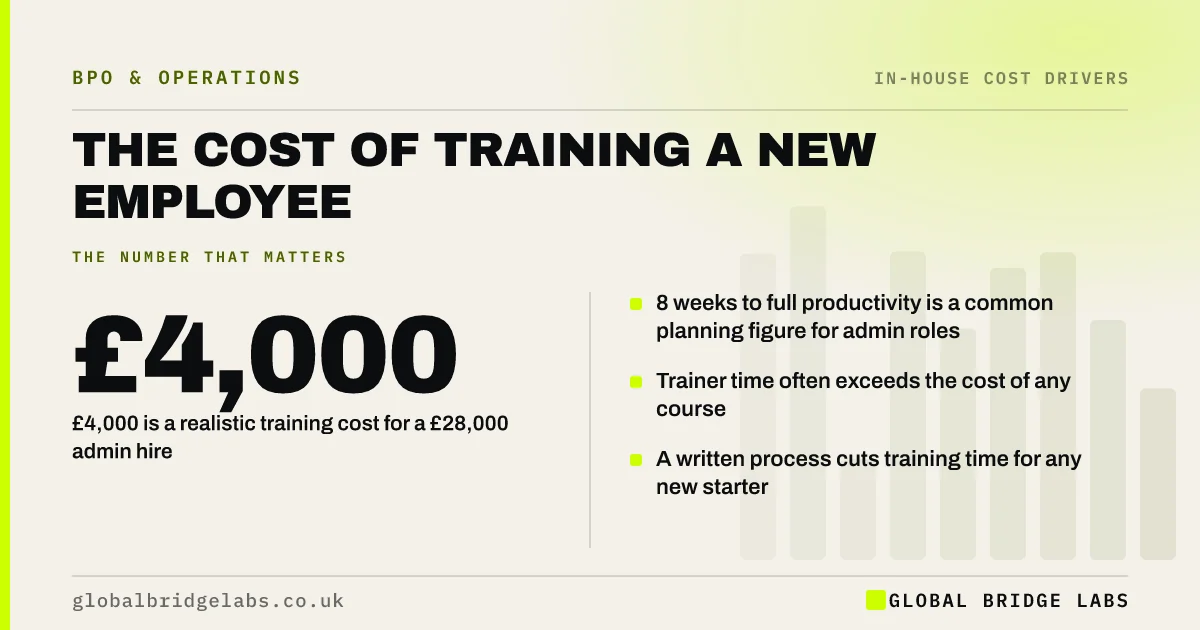
The cost of training a new employee is the output lost while they learn, plus the time of whoever trains them, plus the cost of early mistakes. For a £28,000 admin hire reaching full speed in 8 weeks, a realistic figure is about £4,000. It recurs with each new starter.
- £4,000 is a realistic training cost for a £28,000 admin hire.
- 8 weeks to full productivity is a common planning figure for admin roles.
- Trainer time often exceeds the cost of any course.
- A written process cuts training time for any new starter.
Want your onboarding cost worked out? Message us on WhatsApp with the role.
Chat on WhatsApp →What does training a new employee cost?
Training cost is the value of output lost between a new starter's first day and full productivity, plus the time others spend teaching them and fixing their early errors. External courses are usually the smallest part. The largest part is the gap between what you pay and what you get in the first weeks.
How do you calculate training cost?
Estimate how many weeks it takes to reach full speed and the average productivity over that time. Multiply the lost share by the weekly employment cost, then add trainer hours and any courses.
- Weeks to full productivity.
- Average productivity over that period (for example 50%).
- Lost output: weeks x weekly cost x lost share.
- Trainer time: hours x trainer's loaded rate.
- Rework: time spent correcting early mistakes.
What does a worked example look like?
A £28,000 hire costs about £32,103 a year, roughly £692 per worked week. If they average 50% productivity over 8 weeks, lost output is about £2,770. Add 30 hours of a colleague's time at £40 an hour, £1,200, and the training cost is about £4,000 before any course fees or mistakes.
Want training costs added to your staffing comparison? Send us the details on WhatsApp.
Chat on WhatsApp →How do you cut training cost?
Write the process down. A short procedure for the ten most common tasks, with screenshots and examples, halves the questions a new starter asks and lets them work independently sooner. The same document makes outsourcing easier if you choose that route later.
How does outsourcing change training cost?
With a managed provider, you invest once in a handover: documenting the process and answering questions during the first weeks. After that, the provider trains its own replacements and cover staff from the documentation and its team lead. You do not pay the training cost again each time someone leaves.
Is training cost ever worth paying in-house?
Yes, for roles where knowledge compounds over years, such as account management or specialist work. There, training is an investment that pays back through tenure. For high-turnover or seasonal roles, the cost recurs too often to pay back.
What should an onboarding plan include?
A simple onboarding plan cuts time to productivity for any new starter. Keep it to one page for routine roles, and review it after each hire so it improves over time.
- Week 1: systems access, the ten most common tasks, a named buddy.
- Weeks 2 to 4: supervised work with daily feedback.
- Weeks 5 to 8: independent work with weekly review.
- A written definition of full productivity for the role.
What does this look like in practice?
A pattern we see in UK e-commerce brands: each new customer service starter takes weeks to learn the returns rules, courier portals and product range, and the senior agent loses part of each day to questions. A written playbook cuts that, and moving routine tickets to a managed team removes most of it.
Training cost checklist
Use these steps for any new starter.
- Agree what full productivity means for the role.
- Estimate weeks to reach it and average output meanwhile.
- Log trainer hours for the first month.
- Write down the ten most common tasks.
- Review training time after each new starter.
Next step
Send us the role and how long new starters take to settle. We will cost training alongside the other in-house costs and compare with a managed team in a 30-minute call.
Message us on WhatsApp for a training cost estimate, or book a 30-minute consultation.
Chat on WhatsApp →Sources and further reading
- Rates and thresholds for employers 2026 to 2027 · HM Revenue & Customs
- Workplace pensions: what you, your employer and the government pay · GOV.UK
- Holiday entitlement · GOV.UK
Frequently asked questions
How much does it cost to train a new employee?
For a UK admin role, lost output while learning plus trainer time is often around £3,000–£5,000. A £28,000 hire at 50% productivity for 8 weeks loses about £2,770 of output, and 30 hours of a colleague's time at £40 an hour adds about £1,200, before any course fees.
How long does it take a new employee to become productive?
For routine admin and support roles, several weeks is common; for specialist or judgement-heavy roles, it can take months. A written process with examples, a named buddy and daily feedback in the first weeks shortens the time for any new starter, in-house or outsourced.
Who pays for training when you outsource?
With a managed provider, you pay once for the initial handover, mainly your time documenting the process and answering questions in the first weeks. After that, the provider trains its own replacements and cover staff within its rate, so a departure does not restart the cost for you.
Is formal training or on-the-job learning cheaper?
For routine roles, structured on-the-job learning with a written process is usually cheapest, because the new starter produces real work from the first week. Formal courses add value for specialist skills or regulated tasks. The biggest saving in either case comes from good documentation.
Written by

Global Bridge Labs (GBL) is a UK–Sri Lanka partner for social media, websites and BPO. Everything here comes from client delivery, not theory.