
On this page
- 01Key takeaways
- 02Why do new customers call more?
- 03How do you find their questions?
- 04What should welcome messages say?
- 05Should new customers get a different phone route?
- 06What does this look like in practice?
- 07New customer call checklist
- 08Next step
- 09Sources and further reading
- 10Frequently asked questions
Key takeaways
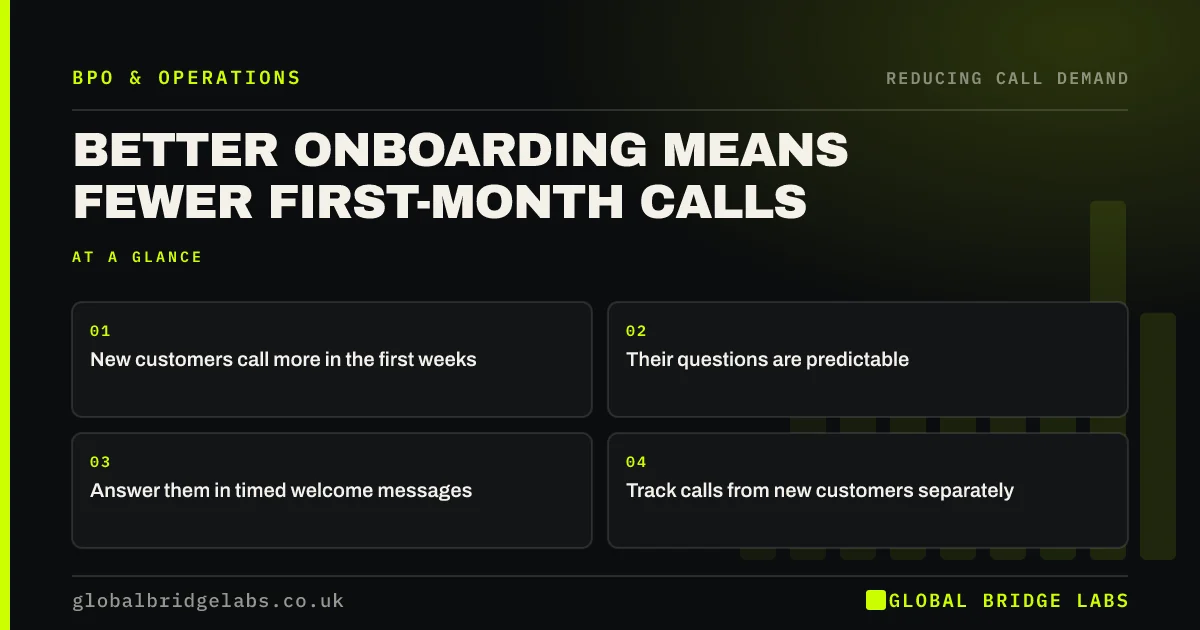
New customers often call more in their first weeks than at any other time, because they do not yet know how things work. Many questions are predictable: how to log in, when the first bill arrives, what happens next. A short, well-timed set of welcome messages answering these questions reduces early calls and gives customers a better start.
- New customers call more in the first weeks.
- Their questions are predictable.
- Answer them in timed welcome messages.
- Track calls from new customers separately.
Want to reduce calls from new customers? Message us on WhatsApp.
Chat on WhatsApp →Why do new customers call more?
They are learning your process, systems and terms. They want reassurance that everything is set up, and they may be unsure about the first bill or delivery. These questions are reasonable, but most can be answered before they arise.
How do you find their questions?
Tag calls from customers in their first 30 or 60 days, then look at the reasons. You will usually see a handful of repeated questions about setup, first payments, access and next steps.
- Tag early-life calls.
- Rank their reasons.
- Note when in the first month they call.
What should welcome messages say?
Send a short welcome confirming what they bought and what happens next, then timed messages just before common questions arise: before the first bill, before the first delivery or visit and after the first use. Keep each one short and specific.
Want a welcome message sequence drafted? Send us your top early-life questions on WhatsApp.
Chat on WhatsApp →Should new customers get a different phone route?
For some businesses, a short menu option for new customers, answered by staff who know the onboarding process, shortens calls and improves first impressions. It works best when early-life volume is significant and questions are distinct.
What does this look like in practice?
A pattern we see: a subscription business finds that new customers make a large share of calls about the first payment date. A message three days before the first payment, explaining the amount and date, removes most of those calls.
New customers who receive the message also cancel less often in their first month, because the payment no longer comes as a surprise.
New customer call checklist
- Tag calls from new customers.
- Rank their call reasons.
- Write a welcome message sequence.
- Time messages before common questions.
- Measure early-life calls monthly.
Next step
Tag calls from customers in their first 30 days, find the top three questions and write one short message to answer each before it is asked.
Message us on WhatsApp to improve new customer onboarding, or book a 30-minute consultation.
Chat on WhatsApp →Sources and further reading
- Stop trying to delight your customers (Dixon, Freeman and Toman, 2010) · Harvard Business Review
- Consumer Contracts (Information, Cancellation and Additional Charges) Regulations 2013 · legislation.gov.uk
Frequently asked questions
Why do new customers call so often?
Because they are unfamiliar with your process and want reassurance. They often ask how to access services, when they will be charged and what happens next. These questions are predictable, so a short sequence of welcome messages can answer most of them before customers need to call.
How many welcome messages should I send?
Usually three to five over the first month, each timed before a predictable question. Too many messages get ignored. Keep each one short, focused on one topic and with a clear way to get help if they still need it.
Should new customers be able to call easily?
Yes. Reducing avoidable calls does not mean making it hard to call. New customers who have a real problem should reach someone quickly, because first impressions affect whether they stay. Welcome messages handle the routine questions so the phones are freer for those who need help.
Written by

Global Bridge Labs (GBL) is a UK–Sri Lanka partner for social media, websites and BPO. Everything here comes from client delivery, not theory.


