On this page
Key takeaways
Many calls are customers asking for information you already have: where their order is, when the engineer will arrive, whether a payment went through. Sending that information before they ask removes the call entirely. Start with the call reasons that are really requests for an update, send short, timely messages and measure how calls change.
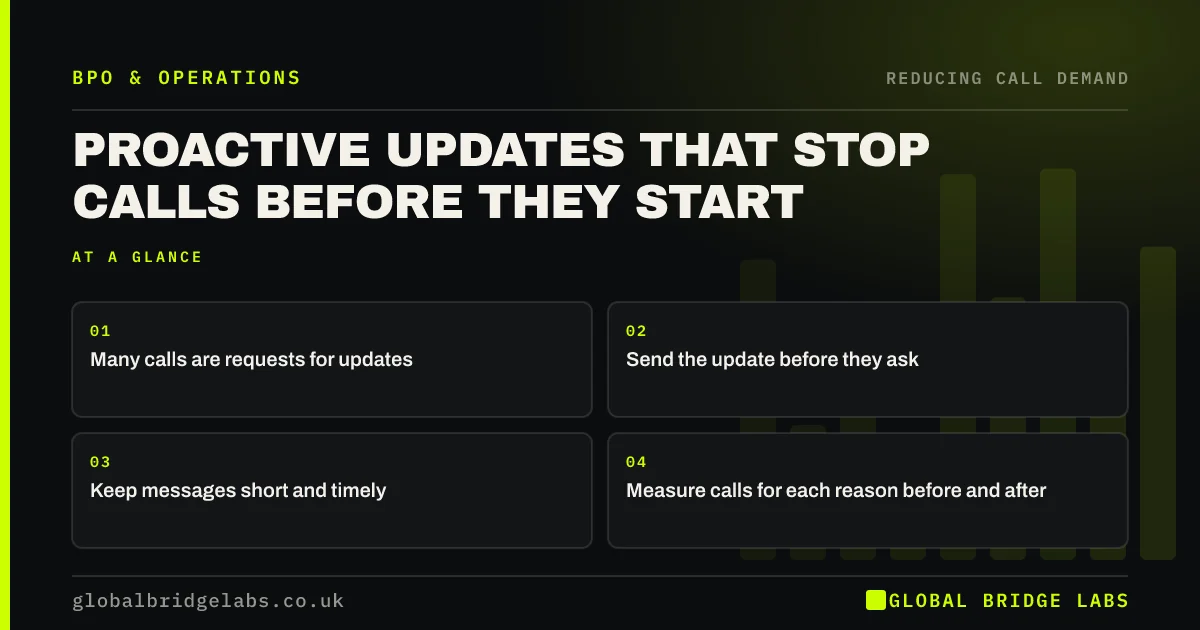
- Many calls are requests for updates.
- Send the update before they ask.
- Keep messages short and timely.
- Measure calls for each reason before and after.
Want to cut update calls? Message us on WhatsApp.
Chat on WhatsApp →Which calls can proactive updates prevent?
Calls that ask "where is it", "when is it" or "did it work": order status, appointment times, engineer arrival, refund progress, payment confirmation and service outages. Your call reason codes will show which of these are common.
When should updates be sent?
At the moments customers usually start to wonder: just after ordering or booking, when something is dispatched or scheduled, the day before an appointment, when a delay happens and when the job is done. A delay message sent early prevents far more calls than one sent after customers start ringing.
Which channel should you use?
Use the channel customers read quickly: text for time-sensitive updates, email for detail, and in-app messages where customers use an app. Service messages about an order or booking are generally treated differently from marketing, but check the rules on electronic communications before adding any promotion.
- Text for urgent updates.
- Email for detail.
- No marketing in service messages without care.
Want your update messages drafted? Send us your top call reasons on WhatsApp.
Chat on WhatsApp →How do you measure the effect?
Count calls for each update-related reason for four weeks before and after starting the messages. Watch for new calls caused by unclear messages, and adjust wording quickly if they appear.
What does this look like in practice?
A pattern we see: refund status calls are a top reason for an online business. Sending a short text when a refund is approved and another when it is paid reduces those calls sharply, and the customers who still call are usually those with genuine problems.
The team also adds a delay message when refunds take longer than usual, which prevents a spike of calls during busy return periods.
Proactive update checklist
- List call reasons that are update requests.
- Map the moments customers wonder.
- Choose the channel for each update.
- Keep service and marketing separate.
- Measure calls before and after.
Next step
Pick the top update-related call reason, write one short proactive message for the moment customers usually call and measure calls for four weeks.
Message us on WhatsApp to set up proactive updates, or book a 30-minute consultation.
Chat on WhatsApp →Sources and further reading
- Electronic and telephone marketing under PECR · Information Commissioner's Office
- Stop trying to delight your customers (Dixon, Freeman and Toman, 2010) · Harvard Business Review
Frequently asked questions
What is proactive customer service?
It means contacting customers with information or help before they need to ask, such as delivery updates, appointment reminders or delay warnings. It reduces calls and frustration, because customers know what is happening. It works best for predictable questions where you already hold the answer.
Can I send service texts without marketing consent?
Messages purely about an existing order, booking or account are generally service messages rather than direct marketing. Adding promotions can change that. Check ICO guidance on electronic marketing and keep service updates free of marketing content unless you have the right basis to include it.
Will proactive messages create more calls?
Unclear messages can. A text saying "your order is delayed" with no new date may prompt calls. Include the key detail, the next step and a link for more information. Test messages on a small group first and watch for any new call reasons appearing.
Written by

Global Bridge Labs (GBL) is a UK–Sri Lanka partner for social media, websites and BPO. Everything here comes from client delivery, not theory.