On this page
- 01Key takeaways
- 02How does navigation affect conversion rate?
- 03How do you measure navigation's effect on conversions?
- 04Which navigation changes usually help conversions?
- 05What does the evidence say?
- 06When is navigation not the cause?
- 07What does this look like in practice?
- 08Navigation conversion checklist
- 09Next step
- 10Sources and further reading
- 11Frequently asked questions
Key takeaways
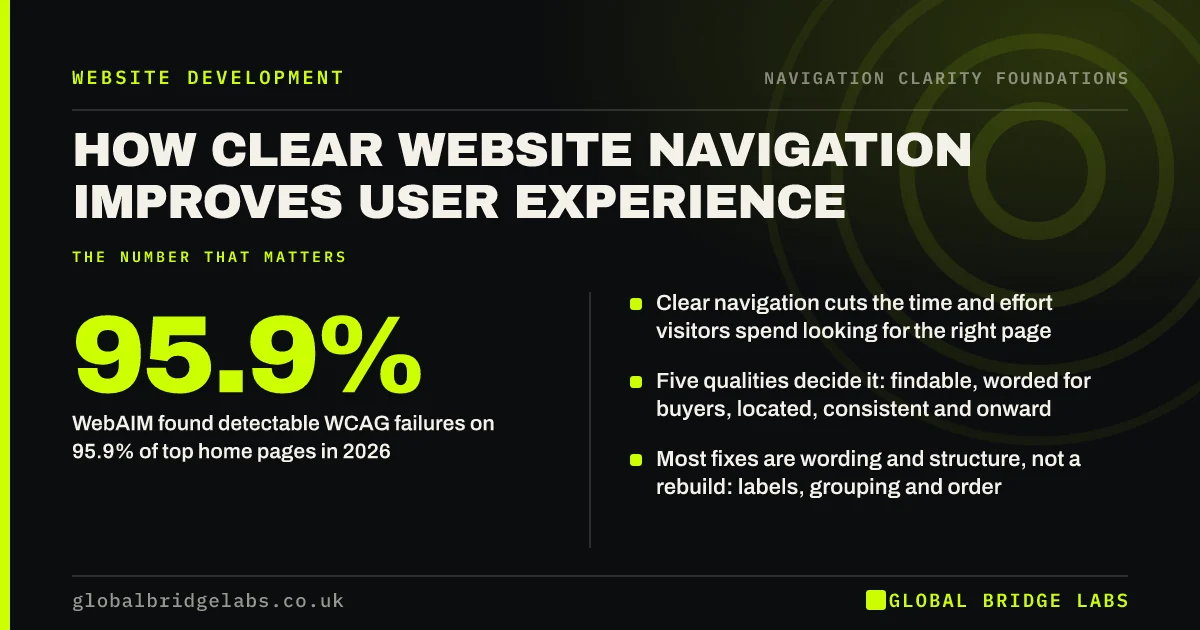
Yes, website navigation affects conversion rate, but indirectly. Clear navigation gets more visitors to the pages that persuade them, such as services, prices, proof and contact, and keeps the enquiry action visible. It cannot rescue a weak offer or a broken form. Measure how many sessions reach a key page before you change the menu.
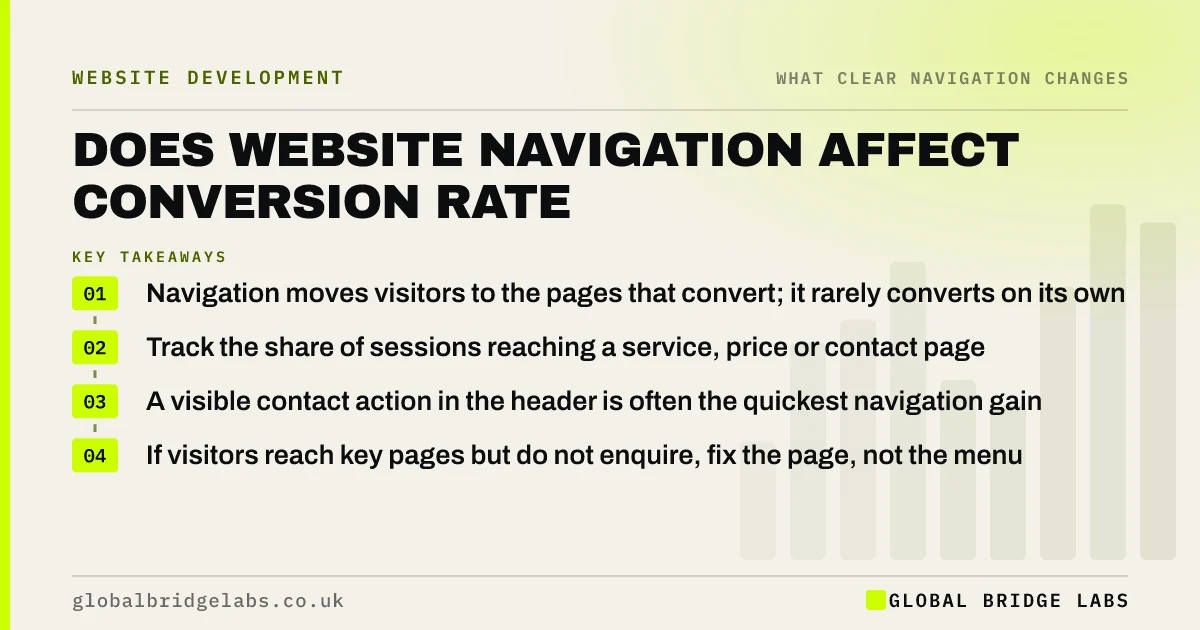
- Navigation moves visitors to the pages that convert; it rarely converts on its own.
- Track the share of sessions reaching a service, price or contact page.
- A visible contact action in the header is often the quickest navigation gain.
- If visitors reach key pages but do not enquire, fix the page, not the menu.
Want to see how many of your visitors reach a service page? Message us on WhatsApp.
Chat on WhatsApp →How does navigation affect conversion rate?
Conversion depends on visitors reaching the content that answers their questions and then finding the action. Navigation controls both. Vague labels send visitors to the wrong page or nowhere; a hidden contact action means even convinced visitors have to hunt. Each lost step is a lost enquiry, even though the menu never appears in a conversion report.
How do you measure navigation's effect on conversions?
Measure the route, not only the result. In Google Analytics 4, track the share of sessions that reach a service, price or contact page, the share that leave from the homepage, and enquiries per session. Record four weeks before a change and four weeks after, allowing for seasonality.
- Sessions reaching a key page, as a share of all sessions.
- Exits from the homepage and from blog posts.
- Clicks on the header contact or booking action.
- Site searches for items already in the menu.
- Enquiries, calls and WhatsApp chats per session.
Which navigation changes usually help conversions?
The changes that help most are the ones that put persuasive pages and the action in view. In our experience these are usually wording and placement changes rather than structural ones.
- A distinct contact or booking button in the header.
- Services named in customer words instead of 'Solutions'.
- A visible link to prices or fees where buyers expect one.
- Case studies or reviews linked from service pages.
- A visible menu on desktop instead of a hamburger icon.
Want these changes mapped to your site? Message us on WhatsApp and we will discuss your requirements.
Chat on WhatsApp →What does the evidence say?
Usability research consistently links findability to task completion. Nielsen Norman Group's work on information scent shows visitors abandon routes when labels do not signal their goal, and its research on hidden navigation found menus behind icons are used less. Across our client work, websites rebuilt around clarity and an obvious next step have reached a 2.4× enquiry rate, with navigation one part of that work.
When is navigation not the cause?
If analytics show visitors reach your service pages and then leave, the problem is the page: the offer, the proof, the price, the form or the speed. Navigation also cannot fix traffic from the wrong audience. Find where visitors leave first, and only redesign the menu if they leave before reaching the pages that matter.
What does this look like in practice?
A pattern we see: a service site gets steady search traffic to blog posts, but few of those readers ever see a service page. The menu says 'What we do' and the contact link is in the footer. Naming the services in the menu and adding a header button gives every reader a route to the offer.
Navigation conversion checklist
- Record four weeks of baseline data.
- Check the share of sessions reaching a key page.
- Add a distinct header action.
- Name services in buyer words.
- Link proof and prices from service pages.
- Compare four weeks after the change.
Next step
Check what share of your sessions reach a service page today. That is your navigation baseline.
Message us on WhatsApp for a navigation and conversion review, or book a 30-minute consultation.
Chat on WhatsApp →Sources and further reading
- Information scent: how users decide where to go next · Nielsen Norman Group
- Hamburger menus and hidden navigation hurt UX metrics · Nielsen Norman Group
- About key events · Google Analytics Help
Frequently asked questions
Can changing the menu increase sales?
It can, when visitors currently struggle to reach the pages that persuade them or to find the contact action. Renaming vague labels, showing the menu on desktop and adding a header button are common gains. If visitors already reach those pages, a menu change will make little difference.
How long before navigation changes affect conversions?
Behaviour changes immediately, but you need enough data to see it. On most small business sites, compare four weeks before with four weeks after, and allow for seasonal patterns. Very low-traffic sites may need longer or user testing instead.
Should I A/B test my navigation?
Only if you have enough traffic for a reliable result, which many small sites do not. Otherwise, test with five users before and after, and compare analytics over equal periods. Navigation changes affect every page, so test carefully.
Written by

Global Bridge Labs (GBL) is a UK–Sri Lanka partner for social media, websites and BPO. Everything here comes from client delivery, not theory.