
On this page
Key takeaways
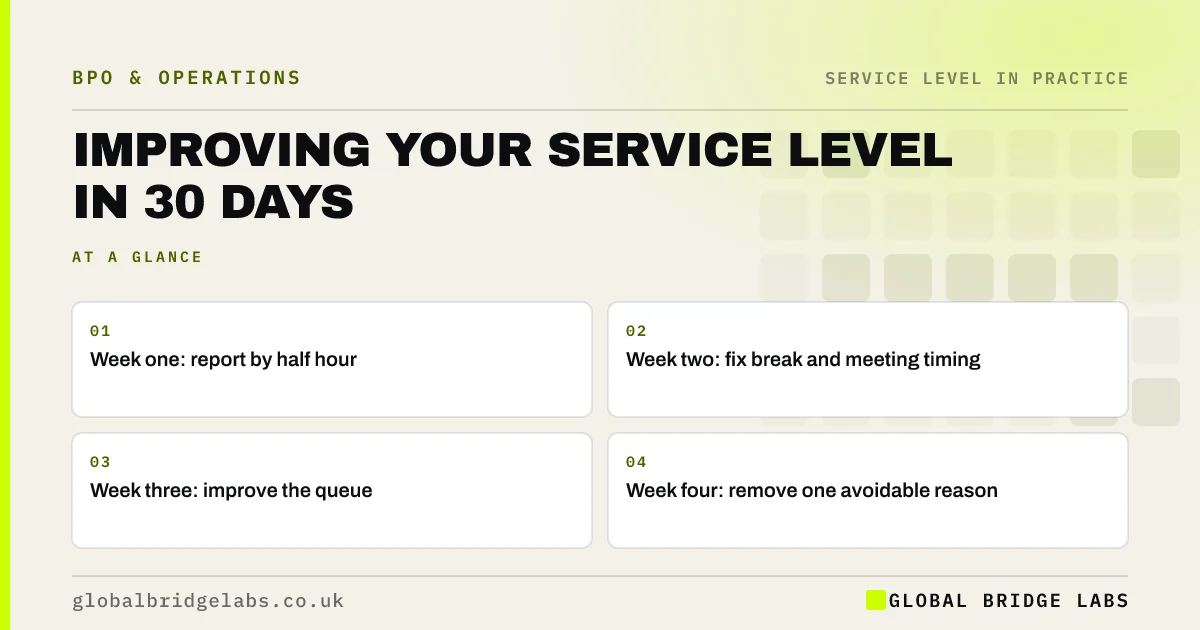
You can make a noticeable improvement to service level in 30 days without hiring, by focusing on quick wins. Week one fixes reporting, week two fixes timing, week three improves the queue and week four removes one avoidable call reason. Each step is small, and together they often close the worst gaps.
- Week one: report by half hour.
- Week two: fix break and meeting timing.
- Week three: improve the queue.
- Week four: remove one avoidable reason.
Want a 30-day plan for your phones? Message us on WhatsApp.
Chat on WhatsApp →Week one: fix reporting
Set up half-hourly reports of service level, abandonment and longest wait. Write down your formula. Start coding calls with reasons if you do not already. By the end of the week you should see your weakest half hours.
Week two: fix timing
Move breaks, meetings and training out of your weakest half hours. Stagger lunches. Adjust one or two start times if a gap appears at opening. These changes cost nothing and often have the biggest effect.
- Stagger lunches.
- Move meetings and training.
- Adjust start times.
Week three: improve the queue
Cut the queue message to under 20 seconds, reduce the menu to four options or fewer and add a callback offer before callers usually give up. Callers wait less and give up less.
Want help with week three? Send us your queue message and menu on WhatsApp.
Chat on WhatsApp →Week four: remove one reason
From two weeks of coded calls, pick one avoidable reason, such as status questions, and make one change: a text update, a clearer email or a web answer. Measure that reason over the next month.
What does this look like in practice?
A pattern we see: a team follows this plan and, by the end of the month, its weakest half hours have moved closer to target, abandonment is lower and one call reason is falling. The improvements give the team confidence to run a fuller review.
The owner also has, for the first time, reliable half-hourly data to decide whether any extra cover is really needed.
The plan works because each week builds on the last: reporting shows where to act, timing fixes are free, queue changes reduce hang-ups and the demand fix starts the habit of removing calls.
30-day plan checklist
- Week one: half-hourly reports and codes.
- Week two: move breaks and meetings.
- Week three: shorten messages, add callbacks.
- Week four: fix one avoidable reason.
- Measure and plan the next month.
Next step
Start week one today: set up half-hourly reporting and begin coding calls, so you can see your weakest half hours by the end of the week.
Message us on WhatsApp to improve your service level in 30 days, or book a 30-minute consultation.
Chat on WhatsApp →Sources and further reading
- Measuring success · GOV.UK Service Manual
- Stop trying to delight your customers (Dixon, Freeman and Toman, 2010) · Harvard Business Review
Frequently asked questions
Can service level really improve in 30 days?
Often noticeably, because many quick wins are about timing and queue design, which can change immediately. Demand fixes take longer to show fully. A 30-day plan usually closes the worst gaps and builds the data you need for a longer-term review.
What is the quickest service level win?
For many teams, moving breaks and meetings out of the busiest half hours. It costs nothing and can lift weak intervals within days. Shortening the queue message and adding a callback are also quick, and they reduce abandonment while you work on staffing and demand.
What should I do after the 30 days?
Run the full 80/20 service review: split, tail, reasons, remove and cover. Start a monthly call reason review, score yourself on the 20-check scorecard and plan staffing with the worksheet. Keep reporting by half hour so improvements are sustained. Repeat the cycle each quarter.
Written by

Global Bridge Labs (GBL) is a UK–Sri Lanka partner for social media, websites and BPO. Everything here comes from client delivery, not theory.


