On this page
- 01Key takeaways
- 02Step 1: confirm the top reason
- 03Step 2: find the root cause
- 04Step 3: design the simplest fix
- 05Step 4: launch and measure
- 06Step 5: move to the next reason
- 07What does this look like in practice?
- 08Fixing a call reason checklist
- 09Next step
- 10Sources and further reading
- 11Frequently asked questions
Key takeaways
Fixing your top call reason follows five steps: confirm it is the biggest, find the root cause, design the simplest fix, launch it and measure the result. This worked example follows a small online retailer through each step. Figures are illustrative, not client data, but the method works for any business with a clear top reason.
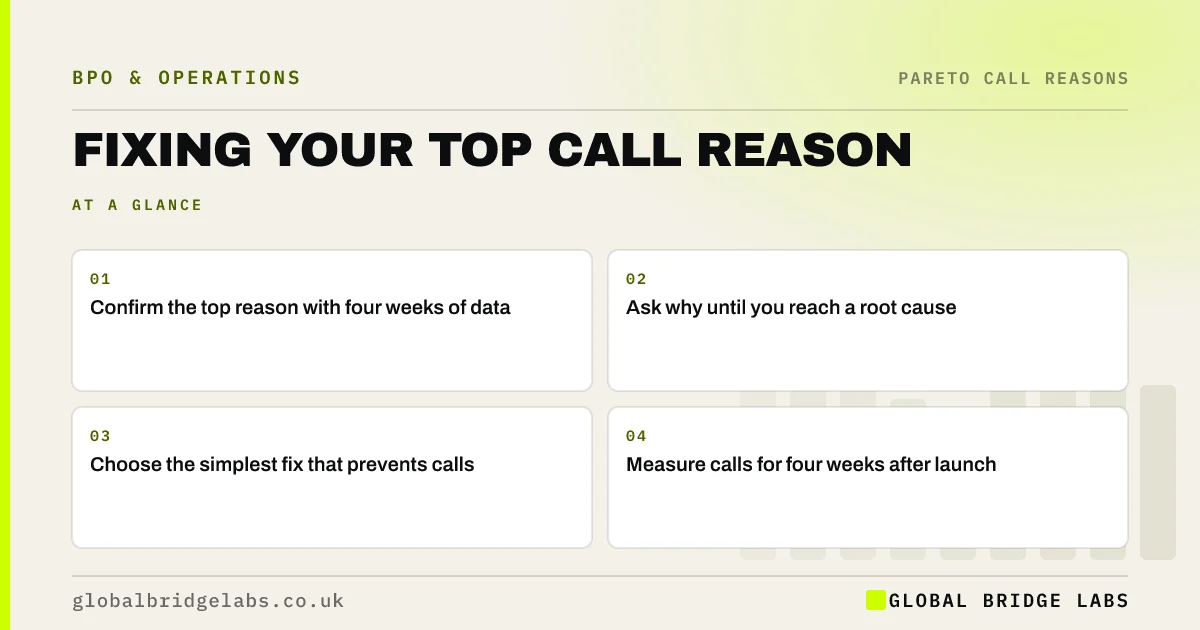
- Confirm the top reason with four weeks of data.
- Ask why until you reach a root cause.
- Choose the simplest fix that prevents calls.
- Measure calls for four weeks after launch.
Want help fixing your top call reason? Message us on WhatsApp.
Chat on WhatsApp →Step 1: confirm the top reason
In our illustrative example, a retailer codes 2,000 calls over four weeks. "Where is my order" is 600 calls, 30% of the total, and the largest bar on the Pareto chart. Handling time is about four minutes, so this reason uses around 40 staff hours a month.
Step 2: find the root cause
Listening to 30 calls shows most customers have a dispatch email but cannot see where the parcel is. The email has no tracking link, and orders take a day longer to dispatch than the website suggests. Asking why twice moves from "customers ask about orders" to two clear causes.
Step 3: design the simplest fix
Each fix below is small, and together they address both causes.
- Add a tracking link to the dispatch email.
- Correct the dispatch time on the website.
- Send a short text when the parcel is out for delivery.
Want your top reason taken through these steps? Send us your data on WhatsApp.
Chat on WhatsApp →Step 4: launch and measure
Launch the changes together and compare four weeks before and after. In our illustrative example, order calls fall from 600 to about 350, freeing around 17 staff hours a month and improving the mid-morning service level. Example only.
Step 5: move to the next reason
Once the top reason shrinks, the next one becomes the priority. Repeat the steps each month.
What does this look like in practice?
A pattern we see: teams who fix one reason at a time, fully, get better results than those who start five changes at once. Small, measured fixes build confidence and show clearly what worked.
Fixing a call reason checklist
- Confirm the top reason with data.
- Listen to 30 calls for the root cause.
- Choose the simplest fix.
- Launch and measure for four weeks.
- Move to the next reason.
Next step
Pick your top call reason, listen to 30 calls about it, and write down the two or three causes you hear most often.
Message us on WhatsApp to fix your top call reason, or book a 30-minute consultation.
Chat on WhatsApp →Sources and further reading
- Value Stream Mapping Overview · Lean Enterprise Institute
- Stop trying to delight your customers (Dixon, Freeman and Toman, 2010) · Harvard Business Review
Frequently asked questions
How do I find the root cause of a call reason?
Listen to a sample of calls and ask why the customer needed to call, then why that happened, until you reach something you can change. Usually two or three rounds of asking why are enough. Check your answer with the people who handle those calls every day.
What if the fix needs another team?
Most do. Bring the evidence, such as call counts, cost per month and customer quotes, to the team that owns the process. Agree a small first step and a date. Showing the hours it would free often persuades other teams to make the change.
How quickly should calls fall after a fix?
For simple fixes, such as adding a link to an email, you should see a drop within a few weeks. Bigger changes may take a full billing or delivery cycle. If calls have not fallen after four weeks, check whether customers saw the change and whether the cause was right.
Written by

Global Bridge Labs (GBL) is a UK–Sri Lanka partner for social media, websites and BPO. Everything here comes from client delivery, not theory.