On this page
- 01Key takeaways
- 02What is a first-line help desk?
- 03What does an in-house help desk cost?
- 04What does an outsourced help desk cost?
- 05How do you split tier 1 and tier 2?
- 06When should the help desk stay in-house?
- 07When is an outsourced help desk better?
- 08What about access and security?
- 09Which help desk measures should you track?
- 10What does this look like in practice?
- 11Help desk checklist
- 12Next step
- 13Sources and further reading
- 14Frequently asked questions
Key takeaways
In-house vs outsourced help desk usually splits by tier. First-line (tier 1) questions such as log-ins, how-to and account changes suit outsourcing; second-line (tier 2) technical issues stay with your product team. Staffing 50 hours a week of tier 1 in-house costs about £47,000 a year in employment costs; outsourced, about £31,000–£39,000.
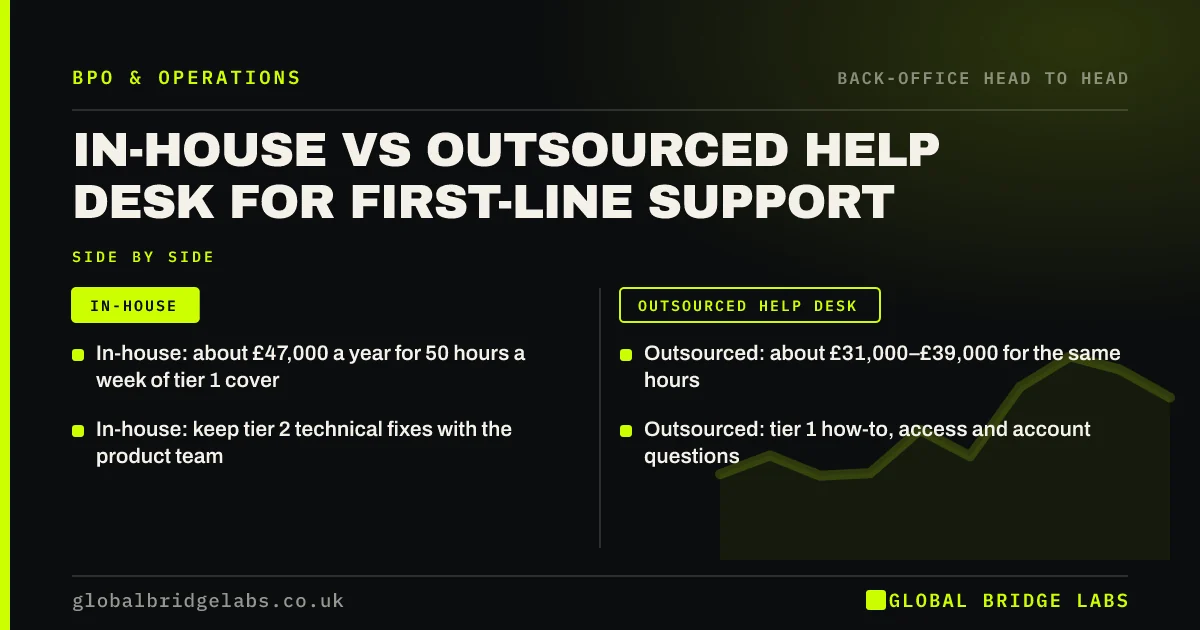
- In-house: about £47,000 a year for 50 hours a week of tier 1 cover.
- Outsourced: about £31,000–£39,000 for the same hours.
- In-house: keep tier 2 technical fixes with the product team.
- Outsourced: tier 1 how-to, access and account questions.
Want your help desk split and costed? Message us on WhatsApp with your ticket volumes.
Chat on WhatsApp →What is a first-line help desk?
A first-line help desk is the first point of contact for customers who need help with a product or service. It logs every request, answers common questions, resolves simple issues from written guides and escalates the rest to specialists. Tier 1 handles the volume; tier 2 handles the depth.
What does an in-house help desk cost?
Covering 8:00 to 18:00 on weekdays is 50 hours a week, about 2,600 hours a year. That needs one full-time and one part-time agent. At £27,000 for the full-time role and the same rate pro rata for 20 hours, employment costs are about £47,000 a year, before tools, overheads and management.
What does an outsourced help desk cost?
The same 2,600 hours at an indicative £12–£15 per hour for a managed offshore team cost about £31,200–£39,000 a year, with cover and supervision included. Technical or multilingual support sits higher in the range. Per-ticket pricing is an option when volume is predictable.
Want per-hour and per-ticket options compared? Send us your ticket data on WhatsApp.
Chat on WhatsApp →How do you split tier 1 and tier 2?
Sort a month of tickets by type and note which were solved from existing knowledge. Those are tier 1 candidates. Anything needing code, configuration or judgement stays tier 2. Write a knowledge base article for each tier 1 type before handover.
- Tier 1: log-in and access, how-to questions, account changes, billing queries.
- Tier 2: bugs, data fixes, integrations, configuration.
- Escalation: a clear form with what tier 2 needs to act.
When should the help desk stay in-house?
When most tickets need product engineering knowledge, when the product changes weekly and documentation cannot keep up, or when ticket volume is low enough for a developer to handle between tasks. Early-stage products often fall here.
When is an outsourced help desk better?
When a large share of tickets are repeat how-to questions, when you need longer hours or UK-hours cover from a different time zone, or when engineers are losing hours to first-line queries. Outsourcing tier 1 protects engineering time, which is usually the most expensive time in the business.
What about access and security?
First-line agents should have only the access needed: read access to accounts, the ability to reset passwords through your admin tools, and no direct database access. Use individual logins, multi-factor authentication and a processor contract under UK GDPR.
Which help desk measures should you track?
Track a handful of measures for tier 1 whether it is in-house or outsourced. They show whether the desk is resolving problems or just passing them on, and whether the knowledge base needs work.
- First response time against target.
- Share of tickets resolved at tier 1.
- Escalations that tier 2 sends back as solvable.
- Customer satisfaction after resolution.
What does this look like in practice?
A pattern we see in UK software SMEs: developers answer support tickets between sprints, and releases slip. An outsourced tier 1 desk working from a knowledge base resolves the routine tickets, and developers only see well-described escalations.
Help desk checklist
Use these steps to prepare.
- Categorise a month of tickets.
- Mark which were solvable from existing knowledge.
- Write knowledge base articles for tier 1 types.
- Define the escalation form and response times.
- Set access levels and security controls.
- Cost in-house and outsourced tier 1 cover.
Next step
Send us a month of ticket categories. We will estimate the tier 1 share and cost the help desk both ways in a 30-minute call.
Message us on WhatsApp for a help desk cost comparison, or book a 30-minute consultation.
Chat on WhatsApp →Sources and further reading
- Rates and thresholds for employers 2026 to 2027 · HM Revenue & Customs
- Workplace pensions: what you, your employer and the government pay · GOV.UK
- Contracts and liabilities between controllers and processors · Information Commissioner's Office
- Small Business Guide: cyber security · National Cyber Security Centre
Frequently asked questions
What is tier 1 support?
Tier 1 is first-line support: logging every request, answering common questions, resolving simple issues such as log-ins, how-to questions and account changes from written guides, and escalating the rest to specialists with the details they need to act quickly. It handles most volume.
Should I outsource my help desk?
Outsource tier 1 when most tickets are repeat questions, when you need longer hours or cover across time zones, or when engineers are losing time to routine support. Keep tier 2 technical fixes in-house with the people who build and understand the product.
How much does an outsourced help desk cost?
At an indicative £12–£15 per hour for a managed offshore team, 50 hours a week costs about £31,200–£39,000 a year with holiday and sickness cover included. Technical, multilingual or 24/7 support costs more, and per-ticket pricing is an option when volumes are predictable.
What does an outsourced help desk need from me?
A knowledge base article for each common ticket type, access to your helpdesk and admin tools at the right level, a clear escalation form, and a named tier 2 contact. The better the knowledge base, the more tickets tier 1 can resolve without passing them on.
Written by

Global Bridge Labs (GBL) is a UK–Sri Lanka partner for social media, websites and BPO. Everything here comes from client delivery, not theory.