On this page
- 01Key takeaways
- 02What is a homepage message hierarchy?
- 03How do you choose the main point?
- 04What makes a good supporting point?
- 05How does the hierarchy shape the page?
- 06When does one main point not fit?
- 07What does this look like in practice?
- 08Message hierarchy checklist
- 09Next step
- 10Sources and further reading
- 11Frequently asked questions
Key takeaways
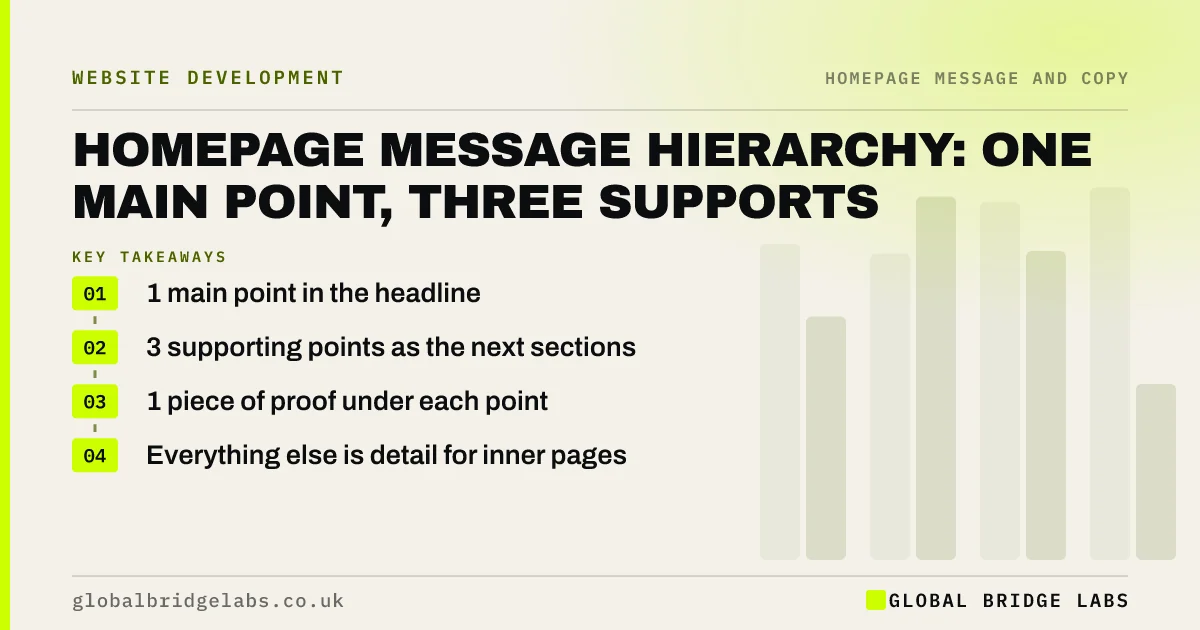
A homepage message hierarchy is one main point, three supporting points and the proof for each, ranked before any writing or design starts. The main point goes in the headline, the supporting points become the next sections, and everything else is detail for inner pages. Without the hierarchy, every message competes and none lands.
- 1 main point in the headline.
- 3 supporting points as the next sections.
- 1 piece of proof under each point.
- Everything else is detail for inner pages.
Want help ranking your homepage messages? Message us on WhatsApp.
Chat on WhatsApp →What is a homepage message hierarchy?
A homepage message hierarchy is a ranked list of what you want visitors to understand: the one point that matters most, the few that support it and the proof behind each. It is decided before the copy and design, and it tells the designer what should be largest and the writer what to cut.
How do you choose the main point?
The main point is the reason your best customers buy, put in their words. It usually combines what you do and the most valued result, such as 'commercial cleaning that never misses a night'. If you cannot pick one, ask which point would lose you the most customers if a competitor claimed it first.
What makes a good supporting point?
A good supporting point answers a likely doubt about the main point. If the main point is speed, supports might be quality ('every job inspected'), price ('fixed quote') and coverage ('across Greater Manchester'). Each supporting point needs one piece of proof: a number, a review, an accreditation or a project.
How does the hierarchy shape the page?
The main point becomes the headline and subheadline. The three supports become the first sections after the hero, in order of how often buyers raise them. Proof sits inside each. Services, process and fuller proof follow, and the call to action repeats after the supports and at the end.
When does one main point not fit?
When a business genuinely serves two unrelated markets, one point cannot cover both. Then the main point becomes a short description that covers both, and the page routes quickly to two clear paths. Do not stretch one slogan over two audiences.
What does this look like in practice?
A pattern we see: a homepage with eight boxes of equal size, each a different message. Ranking them into one main point, three supports and proof turns the same content into a page a visitor can scan in seconds, often without new copy.
Message hierarchy checklist
- Write one main point in the customer's words.
- List three supporting points that answer doubts.
- Attach one proof to each point.
- Order sections by how often buyers raise each doubt.
- Move everything else to inner pages.
Next step
Write your main point, three supports and their proof on a single card before changing a word on the site. Share the card with whoever designs or writes the page.
Message us on WhatsApp to review your card, or book a 30-minute consultation.
Chat on WhatsApp →Sources and further reading
- Visual hierarchy in UX: definition · Nielsen Norman Group
- How users read on the web · Nielsen Norman Group
Frequently asked questions
What is messaging hierarchy on a website?
It is the order of importance of what you want visitors to understand: one main message, a few supporting messages and the proof for each. It decides what goes in the headline, which sections come first and what moves to inner pages.
How many key messages should a homepage have?
One main message and about three supporting ones. More than that and visitors cannot remember any of them. Each supporting message should answer a common doubt and have one piece of proof.
What comes first, copy or design?
The message hierarchy comes first, then copy, then design. If design comes first, writers fill boxes to fit the layout and the most important point may end up in a small tile. Ranking messages first tells designers what should be most prominent.
Written by

Global Bridge Labs (GBL) is a UK–Sri Lanka partner for social media, websites and BPO. Everything here comes from client delivery, not theory.