On this page
- 01Short answer
- 02What is a social media content calendar?
- 03Why do content calendars fail in small businesses?
- 04What does a working weekly grid look like?
- 05How far ahead should you plan?
- 06What happens when a busy month hits?
- 07Which tool should you use?
- 08What does this look like in practice?
- 09How do you plan around your commercial calendar?
- 10Next step
- 11Sources and further reading
- 12Frequently asked questions
Short answer
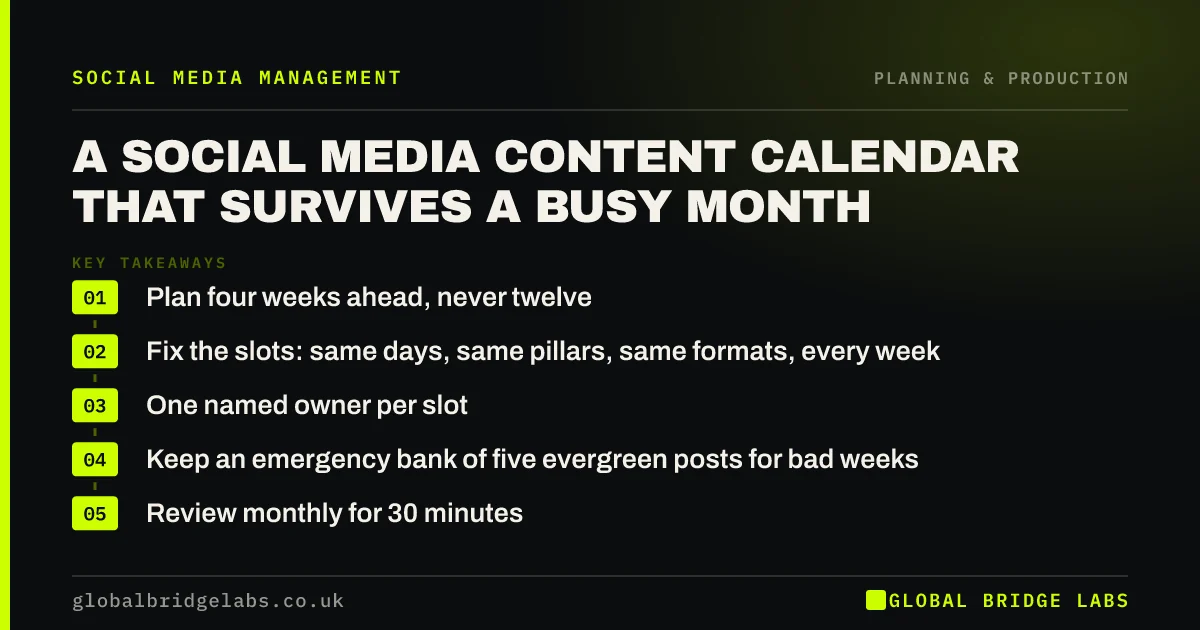
Build the calendar around repeating weekly slots rather than individual post ideas. Fix the slot, the pillar and the owner; let the specific content change. A calendar built from slots survives a busy month because refilling a known slot takes minutes, while inventing a post takes an hour.
- Plan four weeks ahead, never twelve. Beyond a month, plans get rewritten anyway.
- Fix the slots: same days, same pillars, same formats, every week.
- One named owner per slot. Shared ownership is why calendars slip.
- Keep an emergency bank of five evergreen posts for bad weeks.
- Review monthly for 30 minutes. Refill, do not redesign.
Want a four-week calendar built around your pillars? Message us on WhatsApp.
Chat on WhatsApp →What is a social media content calendar?
A social media content calendar is a schedule that states what will be published, on which channel, on which day, by whom, and which content pillar it belongs to.
The last two columns are the ones small businesses leave out and the ones that make it work. Without an owner, nothing is anyone's responsibility. Without a pillar, every slot is a blank page.
Why do content calendars fail in small businesses?
They fail in week three of a busy month, and always for the same reason: the calendar contains ideas rather than structure. When an idea does not survive contact with a hectic week, there is nothing behind it.
The second cause is over-planning. A quarter of individually designed posts takes a day to build and is obsolete within a fortnight, which teaches the team that planning is wasted effort.
- Ideas instead of repeating slots.
- Planned too far ahead to stay accurate.
- No owner per slot, so it defaults to the busiest person.
- No fallback content, so a bad week becomes a visible gap.
What does a working weekly grid look like?
For two channels at three posts a week, six fixed slots. Here is a grid that holds for most UK service businesses.
- Monday, channel A, teaching pillar, carousel or text. Owner: marketing lead.
- Wednesday, channel A, proof pillar, photo set from last week's jobs. Owner: delivery team supplies, marketing publishes.
- Friday, channel A, people pillar, short video. Owner: marketing lead.
- Tuesday, channel B, proof pillar, repurposed from Wednesday. Owner: marketing lead.
- Thursday, channel B, teaching pillar, repurposed from Monday. Owner: marketing lead.
- One slot per fortnight, either channel, offer pillar. Owner: business owner approves.
How far ahead should you plan?
Four weeks of specifics, twelve weeks of themes. The four weeks are scheduled; the twelve weeks are a list of what is coming that would be worth content, such as a trade show, a seasonal peak, a new service or a hiring round.
Seasonality matters more than most UK small businesses plan for. A garden business knows February is the month that determines the summer, and a hospitality business knows November bookings are won in September. Mark those on the twelve-week view and work backwards.
What happens when a busy month hits?
Have the downgrade decided in advance, so it is a plan rather than a failure. Drop from six slots to three: one proof, one teaching, one reply-and-community day. Publish from the emergency bank if the week gets away entirely.
The emergency bank is five evergreen posts produced when things are calm, held in reserve and refreshed quarterly. It costs half a day once and prevents the visible gaps that undo months of consistency.
Send us your busiest month and we will build a downgrade plan you can actually hold. Message us on WhatsApp.
Chat on WhatsApp →Which tool should you use?
A spreadsheet is enough below about 30 posts a month, and it has the advantage that everyone already knows how to use it. Move to a scheduling tool when you need approval workflows, multiple people publishing, or channel-native previews.
Do not buy a tool to fix a discipline problem. A calendar nobody updates in a spreadsheet becomes a calendar nobody updates in software, plus a subscription.
What does this look like in practice?
A pattern in professional services: a beautifully designed quarterly calendar, abandoned by week five, for three consecutive quarters. What replaces it is four repeating slots and a shared folder where the team drops photos and questions from client work.
Nothing about the content gets more sophisticated. What changes is the publishing rate, which is usually the only variable that was blocking the results in the first place.
How do you plan around your commercial calendar?
Map your revenue year first, then build content backwards from each buying window rather than from the event itself.
Most UK small businesses have three or four predictable peaks and one genuinely quiet period. The content that supports a peak needs to publish four to six weeks before it, which in practice means planning it during the previous busy month, when nobody has time. Marking it on the twelve-week view is what makes that possible.
Also mark the quiet period deliberately. It is the right time for the content that never gets made otherwise: the evergreen bank, the pricing explainers, the process videos and the case studies that will carry you through the next peak.
- Map revenue peaks before planning content.
- Publish peak content four to six weeks ahead of the window.
- Plan peak content during the previous busy month.
- Use quiet periods to build the evergreen bank.
Next step
If your calendar keeps collapsing in busy months, the problem is structural and it is fixable in one session.
Message us on WhatsApp for a four-week content calendar built around your pillars and your team.
Chat on WhatsApp →Sources and further reading
Frequently asked questions
How far in advance should I plan social media content?
Four weeks of specific posts and twelve weeks of themes. Beyond a month, plans are rewritten before they are used. The twelve-week view exists to catch seasonal peaks and events early enough to prepare content for them.
What should a content calendar include?
Date, channel, content pillar, format, owner and status. Owner and pillar are the two columns small businesses usually omit, and they are the ones that determine whether the calendar survives a busy week.
Do I need scheduling software for a content calendar?
Not below about 30 posts a month. A shared spreadsheet works and everyone can use it. Move to a tool when you need approval steps, several publishers, or previews of how posts will render natively on each channel.
What do I do if I miss a week of posting?
Publish from your emergency bank of evergreen posts and carry on without commentary. Do not apologise publicly or try to catch up by double-posting, which suppresses reach. Consistency from here matters more than the gap behind you.
Written by

Global Bridge Labs (GBL) is a UK–Sri Lanka partner for social media, websites and BPO. Everything here comes from client delivery, not theory.