On this page
- 01Key takeaways
- 02Do newsletter sign-ups help homepage conversion?
- 03When does email capture earn homepage space?
- 04Where should a sign-up form go?
- 05What are the rules on collecting emails?
- 06What is a better alternative for service firms?
- 07What does this look like in practice?
- 08Newsletter sign-up checklist
- 09Next step
- 10Sources and further reading
- 11Frequently asked questions
Key takeaways
A newsletter signup on a homepage rarely helps a small service business, because it competes with the main action and few people want another email. It earns a place when you sell repeat purchases, run seasonal offers or have genuinely useful content, and even then it belongs low on the page or in the footer, never as an arrival pop-up.
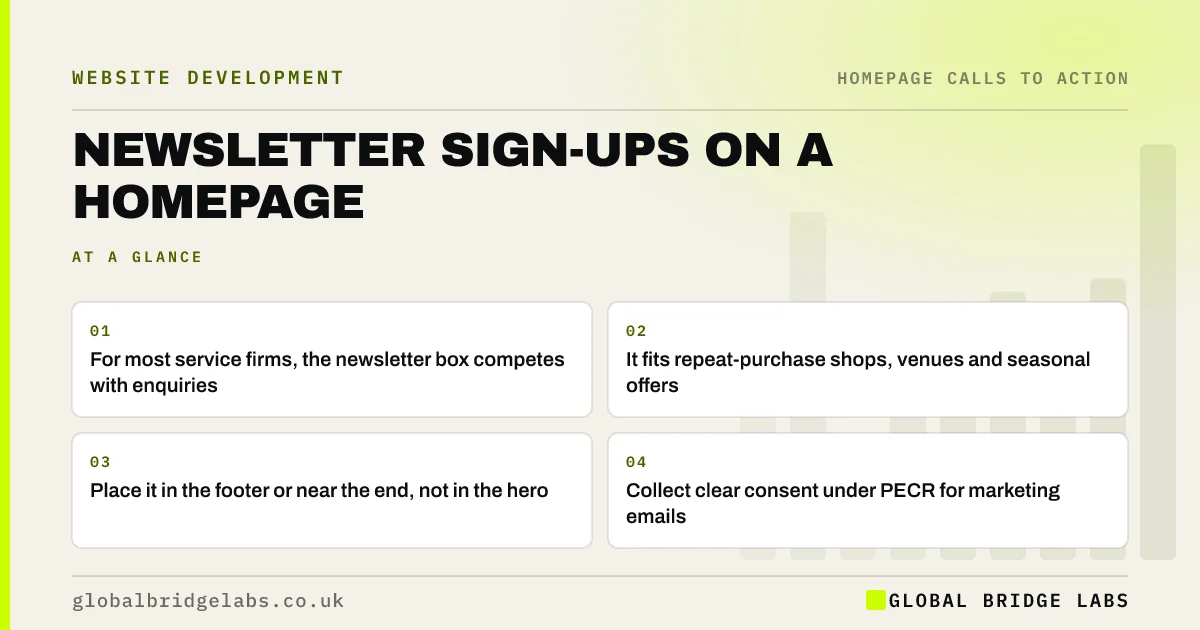
- For most service firms, the newsletter box competes with enquiries.
- It fits repeat-purchase shops, venues and seasonal offers.
- Place it in the footer or near the end, not in the hero.
- Collect clear consent under PECR for marketing emails.
Not sure whether a newsletter box belongs on your homepage? Message us on WhatsApp.
Chat on WhatsApp →Do newsletter sign-ups help homepage conversion?
For most service businesses, no. A homepage newsletter box asks visitors to commit to something they rarely want, and it competes with the action that actually produces work. Many sign-up forms on small business sites collect a handful of addresses a year and are never emailed.
When does email capture earn homepage space?
It earns space when customers buy repeatedly and react to news, such as online shops, restaurants, venues, garden centres and events. It also works for B2B firms with a genuinely useful regular briefing. The offer must be specific: 'Monthly menu and events, one email' beats 'Subscribe to our newsletter'.
Where should a sign-up form go?
Put it in the footer or as the last section before it, after the main action has had its chance. Avoid arrival pop-ups: Google warns that intrusive interstitials on mobile make content less accessible, and visitors who have not read anything yet have no reason to subscribe.
What are the rules on collecting emails?
Under PECR, you generally need clear consent to send marketing emails to individuals, with a soft opt-in exception for existing customers in some cases. Say what you will send and how often, do not pre-tick boxes and make unsubscribing easy. Link to your privacy notice next to the form.
What is a better alternative for service firms?
Offer something useful with a reason to talk: a price guide, a checklist or a short call. If you do send emails, follow up enquiries and past customers, who are far more likely to buy again than anonymous subscribers.
What does this look like in practice?
A pattern we see: a large 'Join our newsletter' block directly under the hero of a building firm's homepage. Moving it to the footer and putting a trust bar in its place usually costs nothing in sign-ups that matter and gives the main action more attention.
Newsletter sign-up checklist
- Check how many sign-ups you got last year and whether you emailed them.
- Keep a homepage form only for repeat-purchase businesses.
- Make the offer specific: what and how often.
- Place it in the footer or near the end.
- No arrival pop-ups on mobile.
- Collect PECR-compliant consent and link the privacy notice.
Next step
Look up how many people joined your newsletter last year and how many emails you sent them. If either is close to zero, move the form to the footer.
Message us on WhatsApp to decide what replaces it, or book a 30-minute consultation.
Chat on WhatsApp →Sources and further reading
- Electronic and telephone marketing under PECR · Information Commissioner's Office
- Direct marketing and privacy and electronic communications · Information Commissioner's Office
- Avoid intrusive interstitials and dialogs · Google Search Central
Frequently asked questions
Should I put a newsletter signup on my homepage?
Only if you sell repeat purchases or send genuinely useful regular updates, such as an online shop or restaurant. For most service businesses it competes with the main enquiry action. Place it in the footer or near the end rather than in the hero.
Are email pop-ups bad for small business websites?
Pop-ups that appear on arrival, especially on mobile, interrupt visitors before they have seen anything and Google treats intrusive interstitials as a poor experience. If you use one, show it later or on exit and make it easy to close.
Do I need consent to send a newsletter in the UK?
Generally yes. Under PECR you need clear consent to send marketing emails to individuals, with a limited soft opt-in for existing customers. Explain what you will send, do not pre-tick boxes and make unsubscribing easy.
Written by

Global Bridge Labs (GBL) is a UK–Sri Lanka partner for social media, websites and BPO. Everything here comes from client delivery, not theory.