On this page
- 01Key takeaways
- 02Why does the homepage need one owner?
- 03What does the homepage owner do?
- 04Who should it be?
- 05How do others give input?
- 06When should ownership be shared?
- 07What does this look like in practice?
- 08Homepage ownership checklist
- 09Next step
- 10Sources and further reading
- 11Frequently asked questions
Key takeaways
Who is responsible for the homepage should have one answer: a named person who decides what changes, keeps facts current and reads the numbers. In a small business that is often the owner or a marketing lead. Others give input through a simple request route. Without an owner, homepages drift into clutter and go out of date.
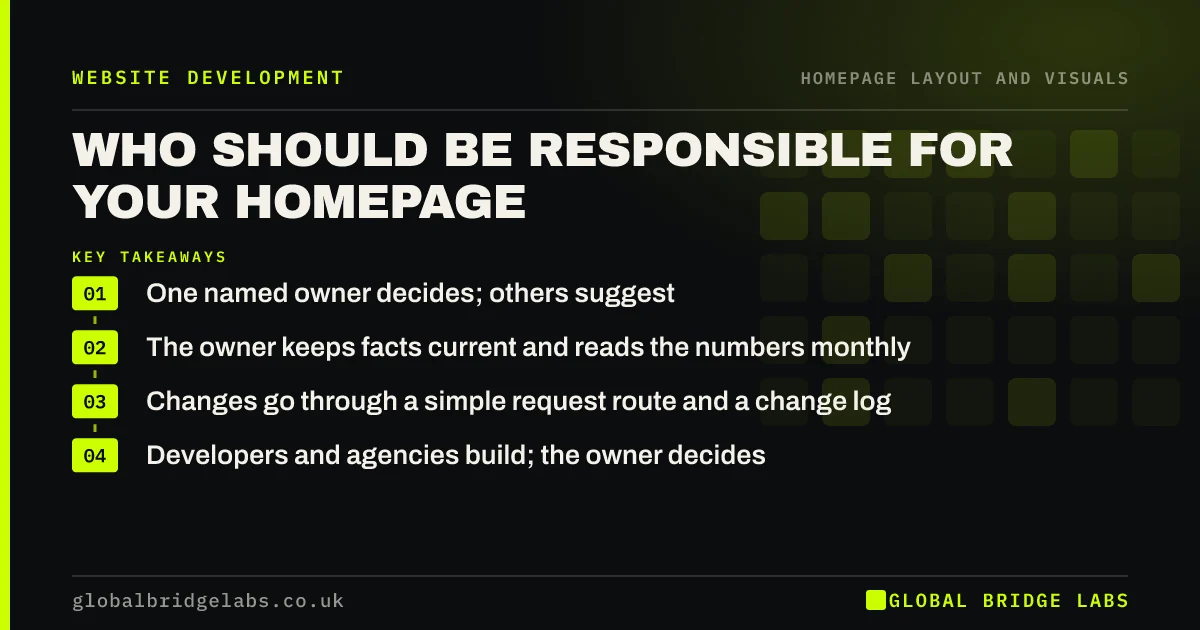
- One named owner decides; others suggest.
- The owner keeps facts current and reads the numbers monthly.
- Changes go through a simple request route and a change log.
- Developers and agencies build; the owner decides.
Want help setting up homepage ownership? Message us on WhatsApp.
Chat on WhatsApp →Why does the homepage need one owner?
The homepage needs one owner because everyone in a business has a reason to want space on it: a new service, an award, a vacancy, a partner logo. Without someone who can say no, each request is added and the page slowly fills with competing messages. One owner keeps it focused on the main action.
What does the homepage owner do?
The role is small but specific.
- Decides what goes on the homepage and what does not.
- Runs the monthly check of facts, offers and routes.
- Reads the homepage numbers monthly.
- Keeps the change log and approves changes.
- Briefs designers, writers and developers.
Who should it be?
In most small businesses, the owner or a marketing or operations lead who understands what brings in work. It should not be the web developer by default; developers build well, but deciding what customers need to see is a business decision. Agencies can advise but should not be the only people who can change the page.
How do others give input?
Give colleagues a simple route, such as a shared note or form, to suggest changes with a reason. The owner reviews requests monthly against the homepage goal. This keeps good ideas from sales and front-line staff flowing without turning every idea into a homepage change.
When should ownership be shared?
In businesses with several distinct divisions, each may own its service pages, but the homepage still needs one final decision-maker. Sharing the homepage itself between equals usually recreates the committee problem.
What does this look like in practice?
A pattern we see: an agency built the site, the owner cannot log in, and three staff each email the agency with changes. Naming one owner, getting admin access back and running a monthly check usually tidies the homepage within a quarter.
Homepage ownership checklist
- Name one homepage owner.
- Make sure they have admin access.
- Set up a simple suggestion route for colleagues.
- Schedule a monthly check and numbers review.
- Keep a change log the owner approves.
Next step
Write down who currently decides what goes on your homepage. If the honest answer is 'nobody' or 'whoever asks the developer', name an owner this week.
Message us on WhatsApp to set up the routine, or book a 30-minute consultation.
Chat on WhatsApp →Sources and further reading
- Government design principles · GOV.UK
- Updating WordPress · WordPress.org
Frequently asked questions
Who should manage website content in a small business?
One named person, often the owner or a marketing or operations lead, who decides what goes on key pages, keeps facts current and reviews the numbers. Others can suggest changes, but one person should make the final call.
Should my web developer decide what goes on my homepage?
Usually not. Developers build and advise, but what customers need to see is a business decision. Keep the decision with someone who understands your customers and sales, and make sure you have admin access to your own site.
How do I stop my homepage getting cluttered?
Give it one owner, a written conversion goal and a rule that every new item must help that goal or replace something. Review requests monthly rather than adding things as they come in, and log every change.
Written by

Global Bridge Labs (GBL) is a UK–Sri Lanka partner for social media, websites and BPO. Everything here comes from client delivery, not theory.