On this page
- 01Key takeaways
- 02Why keep a homepage change log?
- 03What should the log record?
- 04What counts as a change?
- 05How do you use the log?
- 06When can you change several things at once?
- 07What does this look like in practice?
- 08Change log checklist
- 09Next step
- 10Sources and further reading
- 11Frequently asked questions
Key takeaways
A website change log is a simple record of every homepage change: the date, what changed, why and who made it. With low traffic, it is the most reliable way to link results to changes, explain sudden jumps in the numbers and undo mistakes. Change one thing at a time where you can, and log plugin and tracking updates too.
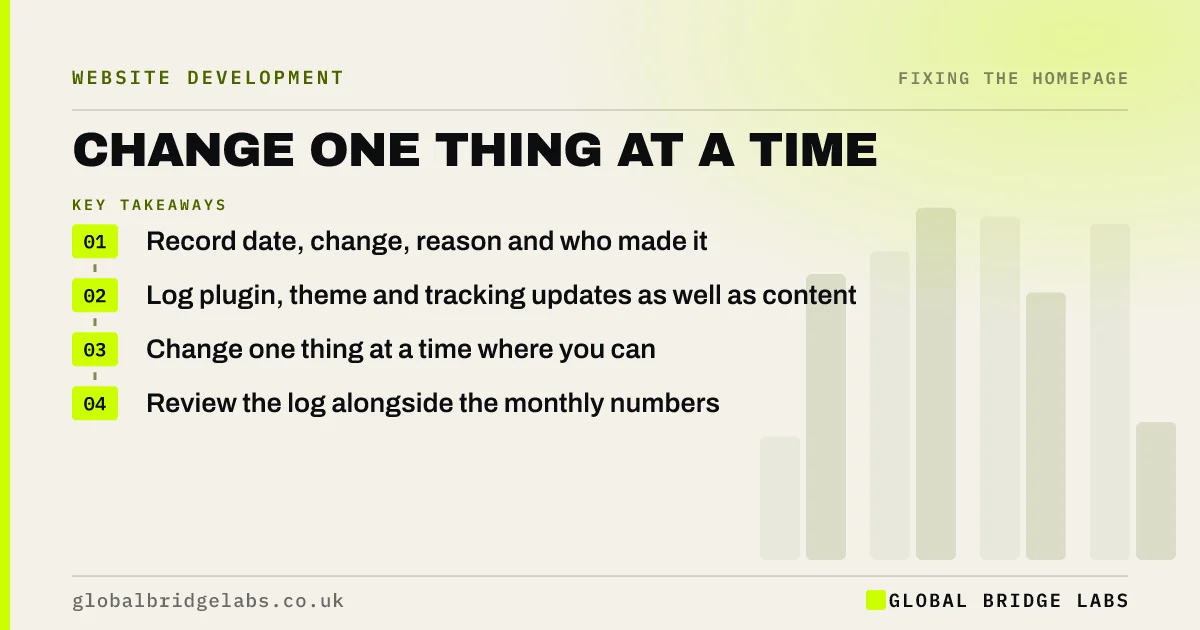
- Record date, change, reason and who made it.
- Log plugin, theme and tracking updates as well as content.
- Change one thing at a time where you can.
- Review the log alongside the monthly numbers.
Want a homepage change log template? Message us on WhatsApp.
Chat on WhatsApp →Why keep a homepage change log?
Small business sites rarely have enough traffic for A/B tests, so the best evidence of what works is a before-and-after comparison. That only works if you know exactly what changed and when. Without a log, a jump or drop in enquiries can be blamed on the wrong thing.
What should the log record?
Keep it simple enough that people actually use it.
- Date and time of the change.
- What changed, with before and after screenshots.
- Why it changed: the problem or hypothesis.
- Who made it.
- What you expect to move, such as button clicks.
What counts as a change?
Content edits, and also plugin and theme updates, new scripts, tracking changes, cookie banner changes, hosting moves and booking tool updates. Many homepage drops come from technical changes nobody thought of as a 'homepage change'.
How do you use the log?
Review it alongside the monthly numbers. When a number moves, check the log for changes in the previous weeks. When you plan a change, check nothing else changed at the same time. GA4 annotations can mirror key entries on charts.
When can you change several things at once?
When the page is clearly broken or a rewrite touches several connected parts, such as the hero, trust line and button together. Then log it as one change and judge the whole. Avoid bundling unrelated changes, such as a new headline and a new chat widget.
What does this look like in practice?
A pattern we see: enquiries rise one month and nobody knows why, so nothing is learned. With a log, the rise lines up with a new trust line two weeks earlier, and the same idea can be applied to service pages.
Change log checklist
- Create a shared spreadsheet with five columns.
- Log content, plugin, tracking and tool changes.
- Take before and after screenshots.
- Change one thing at a time where possible.
- Review the log with the monthly numbers.
Next step
Create the log today and add the last three changes you remember making to the homepage, with approximate dates.
Message us on WhatsApp for a template, or book a 30-minute consultation.
Chat on WhatsApp →Sources and further reading
- About key events · Google Analytics Help
- Updating WordPress · WordPress.org
Frequently asked questions
What is a website change log?
It is a simple record of changes made to a website, with the date, what changed, why and who made it. It helps you link changes in results to specific edits and undo changes that cause problems.
How do I track changes to my website?
Keep a shared spreadsheet or document listing every change with date, description, reason and screenshots. Include technical changes such as plugin updates and new scripts. Some platforms also keep version history you can refer to.
Why should I change one thing at a time?
Because with several simultaneous changes you cannot tell which one caused a rise or fall in enquiries. On low-traffic sites, before-and-after comparisons are the main evidence, so isolating changes makes that evidence useful.
Written by

Global Bridge Labs (GBL) is a UK–Sri Lanka partner for social media, websites and BPO. Everything here comes from client delivery, not theory.