On this page
- 01Key takeaways
- 02Why does homepage freshness matter?
- 03What should you check every month?
- 04What should change with the seasons?
- 05What should you leave alone?
- 06Does updating the homepage help SEO?
- 07What does this look like in practice?
- 08Homepage update checklist
- 09Next step
- 10Sources and further reading
- 11Frequently asked questions
Key takeaways
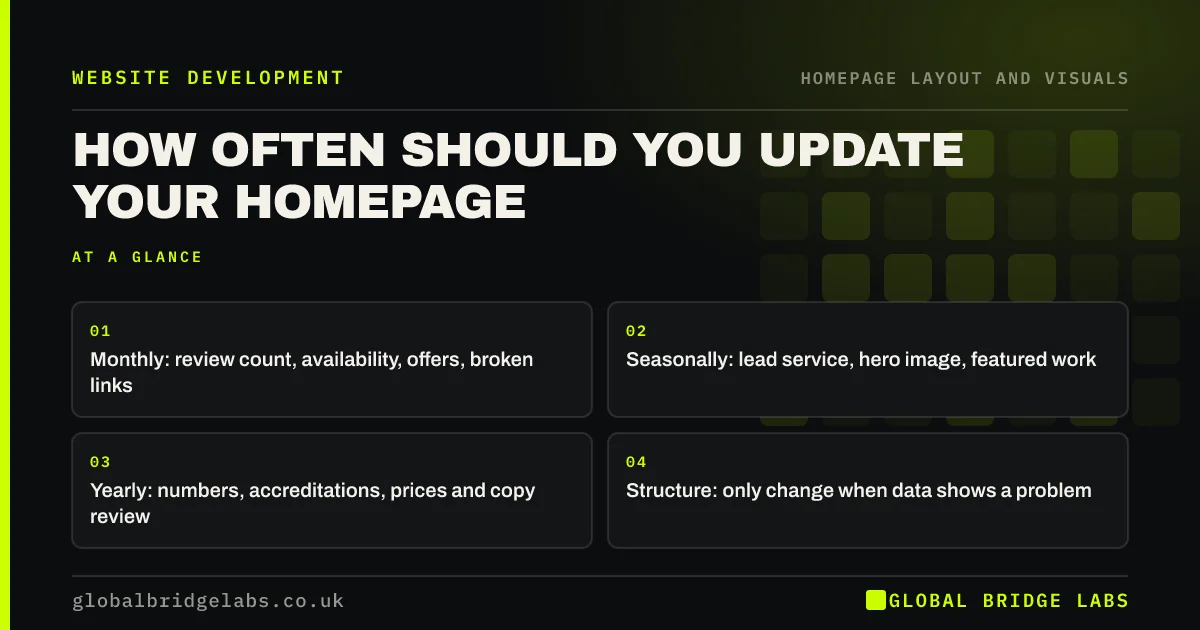
How often to update a homepage depends on the part: check facts like reviews, availability and offers monthly; change seasonal messages and proof a few times a year; and leave the structure alone unless data shows a problem. Constant tinkering makes results impossible to read, but a homepage untouched for years quietly goes stale.
- Monthly: review count, availability, offers, broken links.
- Seasonally: lead service, hero image, featured work.
- Yearly: numbers, accreditations, prices and copy review.
- Structure: only change when data shows a problem.
Want a homepage update calendar set up? Message us on WhatsApp.
Chat on WhatsApp →Why does homepage freshness matter?
Freshness matters because visitors notice signs of neglect: an offer that ended in March, a review count from two years ago, a copyright year that never changes. They read these as a sign the business may be slow or struggling. Fresh, specific details signal that someone is paying attention.
What should you check every month?
Spend 15 minutes a month checking things that change often: review score and count, availability or lead time, any offers, opening hours, the phone and form routes, and links from the homepage. Fix anything wrong the same day.
What should change with the seasons?
Change what you lead with when your buyers' needs change: the featured service, the hero image, the case study and any seasonal offer. Plan these changes in your calendar so they happen on time and get reversed when the season ends.
What should you leave alone?
Leave the structure, the main message and the primary action alone unless data shows a problem. Changing them every month makes it impossible to know what works, especially with low traffic. When you do change them, change one thing and log it.
Does updating the homepage help SEO?
Changing words for the sake of it does not help rankings. Keeping information accurate, useful and current does help visitors, which is what Google's guidance on helpful content focuses on. Update for people, not for an imagined freshness score.
What does this look like in practice?
A pattern we see: a homepage still advertising last year's Christmas opening hours in February, alongside 'Over 50 five-star reviews' when the real figure is 240. A monthly 15-minute check with one named owner fixes both kinds of drift.
Homepage update checklist
- Name one person responsible for homepage checks.
- Check facts and routes monthly in 15 minutes.
- Plan seasonal changes in the calendar.
- Review numbers, badges and copy once a year.
- Change structure only when data shows a problem.
- Log every change with a date.
Next step
Put a recurring 15-minute 'homepage check' in someone's diary for the first working day of each month.
Message us on WhatsApp for a monthly check list, or book a 30-minute consultation.
Chat on WhatsApp →Sources and further reading
- Creating helpful, reliable, people-first content · Google Search Central
- Add a byline date to Google Search results · Google Search Central
Frequently asked questions
How often should I update my homepage?
Check facts such as reviews, availability, offers and contact routes monthly, change seasonal content a few times a year and review numbers and copy annually. Change the structure and main message only when data shows a problem.
Does updating my homepage help SEO?
Not by itself. Changing words for the sake of freshness does not improve rankings. Keeping information accurate, helpful and current is what matters, because it serves visitors, which is what Google's guidance focuses on.
How do I know if my homepage is out of date?
Look for old offers, past dates, review counts or numbers that no longer match reality, staff who have left, lapsed accreditations and a copyright year that is several years old. Any of these signals neglect to visitors.
Written by

Global Bridge Labs (GBL) is a UK–Sri Lanka partner for social media, websites and BPO. Everything here comes from client delivery, not theory.