On this page
- 01Key takeaways
- 02What are the common causes of a website traffic drop?
- 03How do you tell a real drop from a tracking problem?
- 04What does Search Console tell you about the drop?
- 05Which technical faults cause sudden drops?
- 06When does a traffic drop point to a redesign?
- 07When is the drop not about your website?
- 08How do you check for seasonality?
- 09What does this look like in practice?
- 10Traffic drop diagnosis checklist
- 11Next step
- 12Sources and further reading
- 13Frequently asked questions
Key takeaways
Website traffic usually drops for one of five reasons: seasonality, a tracking change, a technical fault, a search ranking change, or fewer people searching. Only one of those, a site that has fallen behind on quality or speed, is fixed by a redesign. Diagnose first; it takes about an hour.
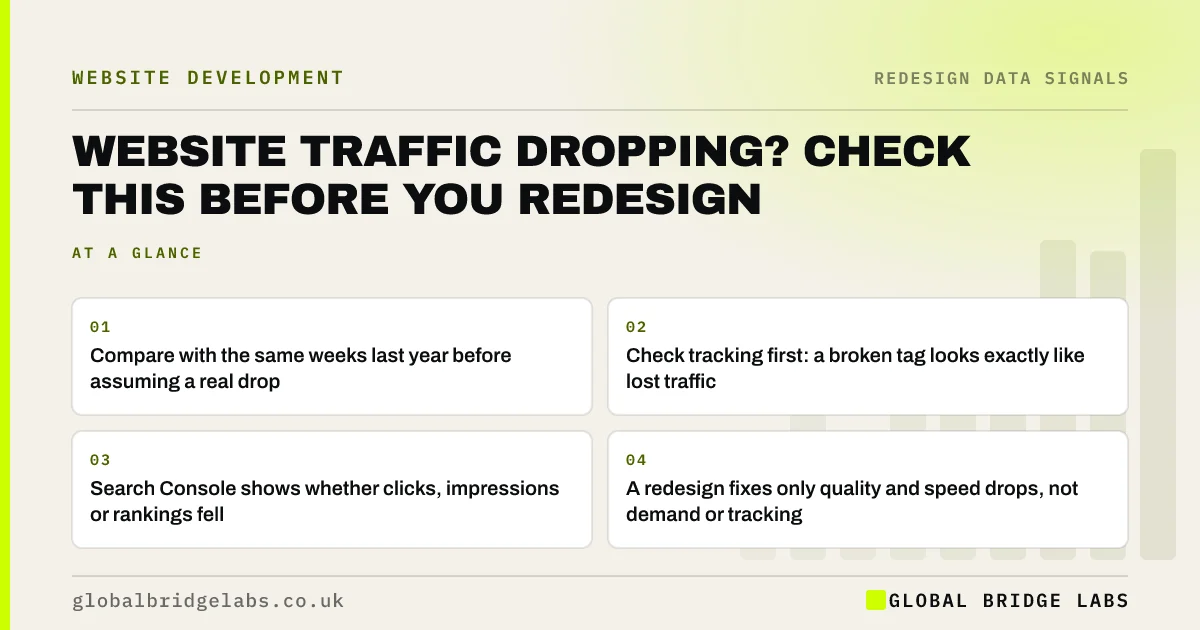
- Compare with the same weeks last year before assuming a real drop.
- Check tracking first: a broken tag looks exactly like lost traffic.
- Search Console shows whether clicks, impressions or rankings fell.
- A redesign fixes only quality and speed drops, not demand or tracking.
Traffic falling and not sure why? Send us the numbers on WhatsApp.
Chat on WhatsApp →What are the common causes of a website traffic drop?
Website traffic drops are usually caused by seasonal demand, broken analytics tracking, technical faults such as pages blocked from indexing, lost search rankings after algorithm or competitor changes, or a fall in how many people search for your services. Each has a different fix, and only some need website changes.
How do you tell a real drop from a tracking problem?
Compare analytics with Search Console. Search Console counts clicks from Google independently of your analytics tag, so if Search Console clicks are steady while GA4 sessions fell, the problem is almost certainly tracking: a removed tag, a cookie banner change or a new site section without the code.
What does Search Console tell you about the drop?
The Performance report splits search traffic into clicks, impressions, click-through rate and average position. Which of them fell tells you the cause.
- Impressions and position fell: rankings dropped. Check which pages and queries.
- Impressions steady, clicks fell: your listing is less attractive, or AI answers are taking clicks.
- Impressions fell, position steady: fewer people are searching. Demand has changed.
- Everything fell on a specific date: look for a technical change on that date.
Want us to read your Search Console with you? Ask on WhatsApp.
Chat on WhatsApp →Which technical faults cause sudden drops?
Sudden drops on a specific date usually trace back to a change on the site. Check the date against any updates, plugin changes or hosting moves.
- A noindex tag left on after a staging site went live.
- Changed URLs without 301 redirects.
- A robots.txt rule blocking important sections.
- Server errors or slow responses after a hosting change.
- A hacked site serving spam pages or warnings.
When does a traffic drop point to a redesign?
When rankings have slipped gradually across many pages over six months or more, competitors with faster, clearer and more useful pages are overtaking you, and the platform makes it hard to fix speed or add content. That pattern suggests the site has fallen behind, and a redesign or rebuild may be justified.
When is the drop not about your website?
When impressions fell because demand fell. Search volumes for many services are seasonal, and some decline as markets change. AI answers in search can also reduce clicks on informational queries without any change in your rankings. A redesign will not change either; your content strategy and marketing mix might.
How do you check for seasonality?
Compare the same weeks with last year, not with last month. Many UK services have strong seasonal patterns: heating engineers peak in autumn, garden businesses in spring, accountants around January. A fall from August to September can be entirely normal for one business and a warning sign for another.
In Search Console, set the date comparison to the same period year on year and look at impressions for your core service queries. If impressions fell by a similar amount last year at the same time, the drop is seasonal. Google Trends gives a second view of demand for your main service terms in the UK.
- Compare year on year, not month on month.
- Check impressions for core service queries.
- Look at last year's pattern for the same weeks.
- Note any change in your own marketing spend.
What does this look like in practice?
A pattern we see: an owner sees GA4 sessions halve and asks for a new website. Search Console shows clicks almost unchanged. The cause is a cookie banner update that stopped analytics loading until consent, which is lawful but changes what GA4 records.
No redesign was needed. The fix was understanding the tracking, and the budget went into service pages instead.
Traffic drop diagnosis checklist
Work through these in order before deciding anything.
- Compare the drop with the same weeks last year.
- Compare GA4 sessions with Search Console clicks.
- Check clicks, impressions, CTR and position by page.
- Note the date of the drop and any site changes that day.
- Check for noindex tags, robots.txt blocks and missing redirects.
- Only then consider whether the site has fallen behind competitors.
Next step
If your traffic has dropped, we will diagnose the cause with you in 30 minutes using Search Console and GA4, and tell you whether it needs a fix, a redesign or nothing at all.
Message us on WhatsApp for a traffic drop diagnosis, or book a 30-minute consultation.
Chat on WhatsApp →Sources and further reading
- Performance report (Search results) · Search Console Help
- Engagement rate and bounce rate · Google Analytics Help
- Site moves with URL changes · Google Search Central
Frequently asked questions
Why has my website traffic suddenly dropped?
Sudden drops are usually technical: broken tracking, a noindex tag, changed URLs without redirects, server errors or a hack. Check the date of the drop against site changes, and compare analytics with Search Console clicks to see whether visitors really fell or only the measurement did.
How do I check if my Google rankings have dropped?
Open the Performance report in Google Search Console and compare average position and impressions for your key pages and queries against the previous period and the same period last year. A fall in position with steady search demand confirms a ranking drop.
Will a new website fix falling traffic?
Only if the cause is that your site has fallen behind competitors on speed, clarity or content and the platform prevents fixing that. It will not fix tracking faults, seasonal demand or falling search volumes, and a badly handled relaunch can make traffic worse.
Is a drop in website traffic always bad?
No. If irrelevant traffic falls while qualified enquiries hold or rise, the site may be doing better. Judge the site on qualified enquiries and enquiry rate, and use traffic as a diagnostic that explains changes rather than as the goal.
Written by

Global Bridge Labs (GBL) is a UK–Sri Lanka partner for social media, websites and BPO. Everything here comes from client delivery, not theory.