On this page
- 01Key takeaways
- 02What do high impressions and low clicks mean?
- 03What causes a low click-through rate?
- 04How do you find the pages to fix?
- 05What fixes work fastest?
- 06When does low CTR point to a redesign?
- 07When should you accept low CTR?
- 08How do you move pages from page two to page one?
- 09What does this look like in practice?
- 10CTR checklist
- 11Next step
- 12Sources and further reading
- 13Frequently asked questions
Key takeaways
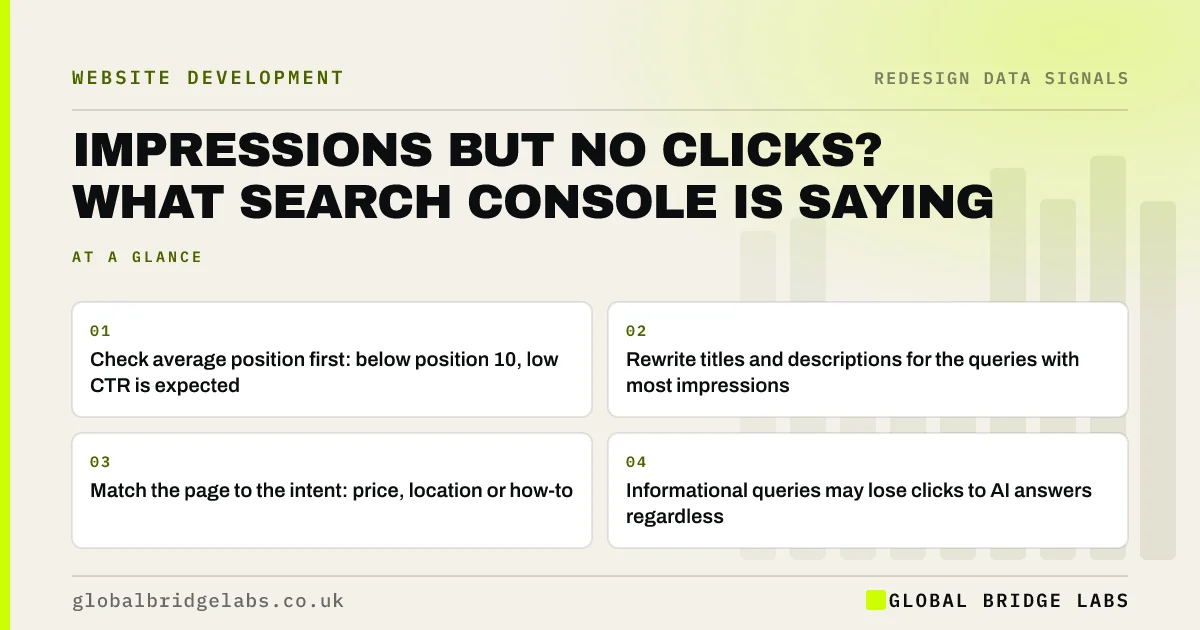
High impressions with low clicks means Google shows your pages but searchers choose other results. The cause is usually a low average position, weak titles and descriptions, a mismatch with search intent, or an AI answer satisfying the query. Rewriting titles and descriptions is the fastest fix; a redesign rarely is.
- Check average position first: below position 10, low CTR is expected.
- Rewrite titles and descriptions for the queries with most impressions.
- Match the page to the intent: price, location or how-to.
- Informational queries may lose clicks to AI answers regardless.
Want your low-CTR pages identified? Message us on WhatsApp.
Chat on WhatsApp →What do high impressions and low clicks mean?
In Google Search Console, an impression is counted when your page appears in results a searcher sees, and click-through rate is clicks divided by impressions. High impressions with low clicks means your pages are being shown, but searchers are choosing other results or finding their answer without clicking.
What causes a low click-through rate?
Position explains most of it. Pages on page two of results collect impressions and almost no clicks. For pages on page one, the listing itself is usually the cause.
- Average position below 10: impressions without visibility.
- Generic title links that do not match the query.
- Meta descriptions that are missing, so Google picks a random snippet.
- Intent mismatch: a sales page ranking for a how-to query.
- AI Overviews or other features answering the query on the results page.
Want your titles and descriptions rewritten for clicks? Ask us on WhatsApp.
Chat on WhatsApp →How do you find the pages to fix?
In the Performance report, filter to the last three months, show impressions, clicks, CTR and position, and sort pages by impressions. Pages on page one with many impressions and a CTR well below your other pages at similar positions are the best candidates.
What fixes work fastest?
Title and description rewrites. Google's documentation explains how title links are generated and how to influence them. Put the main query near the front, add a specific benefit or detail such as a location or price guide, and make each page's title unique.
When does low CTR point to a redesign?
Rarely. Low CTR is a search listing problem, not a design problem. It points to deeper site work only when many pages rank for queries they do not answer well, which is a content structure issue that a redesign can address if the site is being restructured anyway.
When should you accept low CTR?
When the query is informational and the answer fits in a result. If someone searches your opening hours or a simple definition, Google may answer on the results page. That still builds visibility for your name; focus your effort on commercial queries where the click leads to an enquiry.
How do you move pages from page two to page one?
Pages ranking in positions 11 to 20 already have Google's attention, so they are often the fastest search gains. Improve the content so it answers the query more fully than the pages above it, and add internal links from your strongest pages using descriptive anchor text.
Check what the top results include that your page does not: prices, a comparison table, a process, a local detail or FAQs. Add those where they genuinely help the reader. Then request indexing in Search Console and review the page's position after four to eight weeks.
- Filter to pages in positions 11 to 20.
- Compare them with the top three results.
- Add the missing answers, not extra words.
- Add internal links from strong pages.
What does this look like in practice?
A pattern in UK trades: a service page ranks in the top five for a valuable local search, but its title is just the company name and 'Home'. Rewriting the title to name the service and town, and adding a description with the area covered and response time, often lifts clicks within weeks with no other change.
CTR checklist
Run this every quarter.
- Export three months of page and query data from Search Console.
- Filter to pages with average position 1 to 10.
- Sort by impressions and flag low CTR pages.
- Rewrite titles and descriptions for those pages.
- Check each page matches the query's intent.
- Compare CTR after 4 to 6 weeks.
Next step
If Google is showing your site but nobody is clicking, we will find the pages to fix with you in 30 minutes and draft better titles on the call.
Message us on WhatsApp for a Search Console CTR review, or book a 30-minute consultation.
Chat on WhatsApp →Sources and further reading
- Performance report (Search results) · Search Console Help
- Influencing your title links in search results · Google Search Central
- Control your snippets in search results · Google Search Central
Frequently asked questions
Why do I have lots of impressions but no clicks?
Usually because your pages rank below the first page, the title and description do not match what searchers want, or the answer appears on the results page itself. Check average position first, then rewrite titles and descriptions for the pages with the most impressions.
What is a good click-through rate in Google?
It varies widely by position, query type and result features, so there is no single benchmark. Compare pages on your own site at similar positions, and prioritise pages on page one whose CTR is well below the rest. Track the change over several months to see a trend.
How do I improve my click-through rate?
Write unique titles that put the main query near the front and add a specific detail such as a location, price guide or timescale. Write descriptions that answer the query and give a reason to click. Make sure the page matches the intent behind the search.
Do AI Overviews reduce clicks to my website?
They can for informational queries, where the answer is shown on the results page. Commercial queries, where buyers want to compare providers and enquire, are less affected. Clear, well-structured pages also give you a chance to be cited in those AI answers.
Written by

Global Bridge Labs (GBL) is a UK–Sri Lanka partner for social media, websites and BPO. Everything here comes from client delivery, not theory.