On this page
- 01Key takeaways
- 02Why does e-commerce cost more?
- 03What do e-commerce brands pay?
- 04How should you judge the spend?
- 05Is a percentage of ad spend fair for a shop?
- 06What extras should you expect?
- 07When should a shop not pay an agency?
- 08How much creative does a shop need each month?
- 09What does this look like in practice?
- 10E-commerce cost checklist
- 11Next step
- 12Sources and further reading
- 13Frequently asked questions
Key takeaways
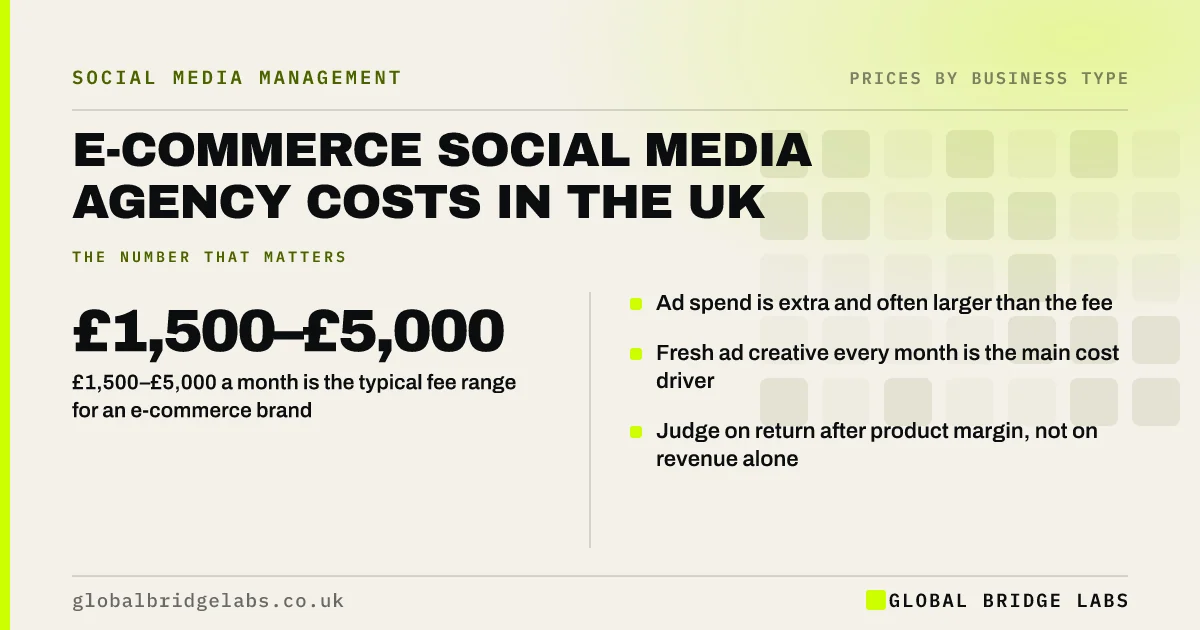
E-commerce social media agency cost in the UK is typically £1,500–£5,000 a month in fees, plus ad spend. Online shops need more creative and more paid media than service firms, so they sit in the higher bands. The spend is judged on sales and margin, which makes it the easiest sector to measure.
- £1,500–£5,000 a month is the typical fee range for an e-commerce brand.
- Ad spend is extra and often larger than the fee.
- Fresh ad creative every month is the main cost driver.
- Judge on return after product margin, not on revenue alone.
Want social media judged on sales, not likes? Message us on WhatsApp.
Chat on WhatsApp →Why does e-commerce cost more?
E-commerce needs a steady supply of new creative, active paid campaigns and fast answers to order questions. Ads fade as people see them repeatedly, so images and video must be refreshed. That volume of production and optimisation is what lifts the fee.
What do e-commerce brands pay?
As market bands, £1,500–£2,500 a month covers organic content, replies and light paid management for a small shop. £2,500–£5,000 covers regular video, multiple campaigns and deeper reporting. Above £5,000 covers multi-market or high-volume brands. These are market indications, not a GBL price list.
- Small shop, two channels, light paid: £1,500–£2,500.
- Growing brand, video and several campaigns: £2,500–£5,000.
- Paid management: flat fee or 10% to 20% of spend.
- Creator content and usage rights: separate.
Want fees and ad spend planned against your margin? Send us your average order value on WhatsApp and we will discuss your requirements.
Chat on WhatsApp →How should you judge the spend?
Judge it on profit after product cost, fees and ad spend. A campaign that returns £3 of revenue for each £1 of ads may still lose money on a 30% margin once the fee is added. Work out your break-even return before agreeing targets.
Is a percentage of ad spend fair for a shop?
It can be on larger budgets, where more spend means more campaigns and testing. On small budgets a flat fee is fairer. Either way, set a target return so the agency is not rewarded simply for spending more of your money.
What extras should you expect?
Expect extras for product photography, creator content and usage rights, catalogue and shop set-up, and customer service beyond simple replies. Creator content run as adverts must be labelled and you need the right to use it. Reviews shown in ads must be genuine.
- Product photography and video.
- Creator content and usage rights.
- Catalogue and shop set-up.
- Order and returns enquiries at volume.
When should a shop not pay an agency?
Do not pay an agency when margins are too thin to carry ad costs, when the site converts poorly, or when stock cannot meet demand. Fix the product page and checkout first. Sending paid traffic to a weak page wastes the fee and the spend.
How much creative does a shop need each month?
Enough to keep adverts fresh. As a rough guide, plan for a handful of new ad creatives a month for each main product, mixing product video, customer content and simple offers. Results fade as the same people see the same advert, so creative volume is the cost to budget for first.
- Product in use, filmed on a phone.
- Customer reviews and unboxing clips, used with permission.
- Offer and bundle adverts.
- The weakest creative retired each month.
What does this look like in practice?
A pattern we see with UK online shops: one or two products carry most sales, and creative for those is refreshed monthly while the rest of the range gets organic posts. Concentrating budget on proven products makes both the fee and the ad spend work harder.
E-commerce cost checklist
Prepare these before asking for quotes.
- Average order value and margin.
- Break-even return on ad spend.
- Ad account, pixel and catalogue in your name.
- Creative volume per month.
- Who answers order questions.
- Monthly report on sales and profit.
Next step
Tell us your average order value, margin and current ad spend. We will tell you what return you need and what level of service fits.
Message us on WhatsApp for an e-commerce social media plan, or book a 30-minute consultation.
Chat on WhatsApp →Sources and further reading
- Meta Business Help Centre · Meta
- Influencers' guide to making clear that ads are ads · ASA / CAP
- Publishing consumer reviews and complying with consumer protection law · Competition and Markets Authority
Frequently asked questions
How much does a social media agency cost for an e-commerce business?
Typically £1,500–£5,000 a month in fees for UK online shops, depending on creative volume and the number of campaigns. Ad spend is on top and is often larger than the fee. Ask for fees and ad spend as separate lines.
How much should an online shop spend on social ads?
Enough to learn from, and no more than your margin supports. Work out the return you need to break even after product cost and fees, start small on your best products and raise spend only while the return holds.
Do e-commerce agencies charge a percentage of sales?
Some do, or a percentage of ad spend. Agree exactly which sales count and for how long after a click, and keep your ad account, pixel and analytics in your own name. Agree a cap on the monthly total as well.
What is a good return on ad spend for a small shop?
It depends on margin. A shop with a 30% margin needs more than £3.33 of revenue per £1 of ads just to cover the ads, before fees. Calculate your own break-even figure instead of using a general benchmark.
Written by

Global Bridge Labs (GBL) is a UK–Sri Lanka partner for social media, websites and BPO. Everything here comes from client delivery, not theory.