On this page
- 01Short answer
- 02Why do published best-time charts mislead?
- 03How do you find your own best times?
- 04Does UK timing differ from US advice?
- 05How much does timing actually matter?
- 06When should you ignore optimal timing entirely?
- 07How do you run a timing test properly?
- 08What about UK bank holidays and school terms?
- 09Next step
- 10Sources and further reading
- 11Frequently asked questions
Short answer
For UK audiences, sensible starting windows are 07:30-09:00 and 17:00-19:30 on weekdays, and mid-morning at weekends for consumer brands. But your own analytics will beat any published chart within three weeks, and timing is worth perhaps 10-20% of reach, far less than content and consistency.
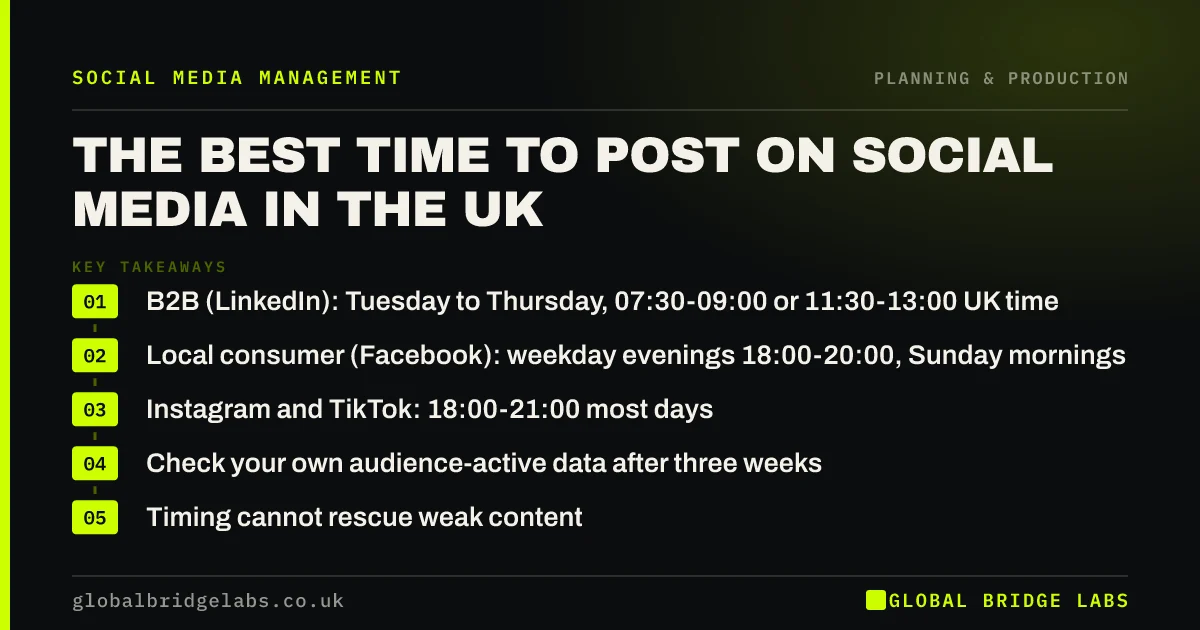
- B2B (LinkedIn): Tuesday to Thursday, 07:30-09:00 or 11:30-13:00 UK time.
- Local consumer (Facebook): weekday evenings 18:00-20:00, Sunday mornings.
- Instagram and TikTok: 18:00-21:00 most days; lunchtime is a weaker second window.
- Check your own audience-active data after three weeks and override all of the above.
- Timing cannot rescue weak content. It amplifies content that already works.
Want your actual windows read from your analytics? Message us on WhatsApp.
Chat on WhatsApp →Why do published best-time charts mislead?
Because they average across time zones, industries, account sizes and follower behaviours that have nothing in common with yours. A chart built mostly from large US consumer accounts is not evidence about facilities managers in the West Midlands.
There is also a circularity problem. Published charts influence when people post, which changes when competition is highest, which changes the optimal time. Use them as a starting hypothesis and nothing more.
How do you find your own best times?
Twenty minutes of work, then three weeks of patience.
First, open the audience insight view in your platform tools and note the hours your followers are most active. Second, list your ten best-performing posts from the last quarter and record when each was published. Third, look for overlap between the two. Where they agree, you have a window. Where they disagree, trust your own post performance over the platform's aggregate activity chart.
- Native audience-active data for the shape of the day.
- Your ten best posts for what actually performed.
- Three weeks of consistent testing at two windows, not five.
- Hold everything else constant while testing or the result means nothing.
Does UK timing differ from US advice?
Yes, in two practical ways. UK working patterns produce a sharper commute-time peak in the morning than much US advice assumes, and a distinct post-school-run mid-morning window for consumer audiences.
The second difference matters for B2B: if a meaningful share of your audience sits in Ireland or continental Europe, a 08:00 UK post lands at 09:00 for a large part of them, which is usually beneficial. If your audience includes the US east coast, afternoon UK posts do double duty.
How much does timing actually matter?
Less than most small businesses assume. On modern recommendation-led feeds, content is distributed over hours or days rather than minutes, so publishing time sets the starting conditions rather than the ceiling.
A reasonable expectation is that good timing adds perhaps 10-20% to early reach. Content quality, format and consistency each move the number far more, which is why optimising timing before fixing those is the wrong order of work.
If timing is the only thing left to optimise, you are in good shape. Message us on WhatsApp and we will check the rest.
Chat on WhatsApp →When should you ignore optimal timing entirely?
When nobody is available to respond. A post that lands at 20:00 and generates six questions answered at 09:30 the next morning converts worse than a post at 11:00 answered in twenty minutes.
Publish when you can reply. For most small UK businesses that single rule outperforms any timing chart, because the conversation, not the impression, is where enquiries are actually won.
How do you run a timing test properly?
Test two windows, not five, and change nothing else while you do it. Pick the two candidate slots, alternate between them for three weeks, and hold format, pillar and length constant so the only variable is publication time.
Compare reach in the first two hours rather than total reach after a week. Total reach is contaminated by content quality and later distribution; early reach is the part that timing actually controls.
Three weeks is the minimum because weekly cycles matter. A Tuesday and a Saturday are different audiences, not just different times, and one week of data will usually mislead you about both.
- Two candidate windows only.
- Hold format, pillar and length constant.
- Compare reach in the first two hours, not total reach.
- Run for three weeks so weekly cycles are covered.
- Re-test annually. Audience habits shift with seasons and working patterns.
What about UK bank holidays and school terms?
Both move audience behaviour more than time of day does, and both are predictable a year in advance, which makes them the easier win.
B2B engagement drops sharply over UK bank holidays and through mid-August, and recovers in the first full week of September. Consumer audiences move the opposite way, with more daytime activity during school holidays. Plan your important posts around those rather than fighting them.
Mark the UK bank holidays and school term dates on your twelve-week planning view. It costs ten minutes once a year and prevents the recurring waste of publishing your best content of the quarter on the Friday before a long weekend.
- B2B dips over bank holidays and mid-August.
- Consumer daytime activity rises during school holidays.
- Mark UK holiday and term dates on the twelve-week view.
- Never publish your strongest B2B content before a long weekend.
Next step
Timing is a 20-minute optimisation. If you have not yet fixed cadence, pillars and the destination page, those are worth far more.
Message us on WhatsApp for a read of your posting windows and what to fix before them.
Chat on WhatsApp →Sources and further reading
Frequently asked questions
What is the best time to post on Instagram in the UK?
Evenings between 18:00 and 21:00 work for most UK consumer audiences, with a weaker lunchtime window. Treat that as a starting hypothesis and replace it after three weeks with the pattern from your own ten best-performing posts.
What is the best day to post on LinkedIn?
Tuesday to Thursday for UK B2B audiences, published between 07:30 and 09:00 to catch the commute and the first hour of the working day. Monday mornings and Friday afternoons consistently underperform for professional audiences.
Does posting time still matter with algorithmic feeds?
It matters less than it did. Recommendation-led feeds distribute content over hours or days, so timing sets the starting conditions rather than the ceiling. Expect roughly 10-20% of reach from timing, against much larger effects from format and consistency.
Should I schedule posts or publish manually?
Schedule the routine slots so consistency never depends on someone being free, and publish manually when a post is topical or when the comments need an immediate reply. The failure mode of scheduling is publishing into a moment you have not checked.
Written by

Global Bridge Labs (GBL) is a UK–Sri Lanka partner for social media, websites and BPO. Everything here comes from client delivery, not theory.