On this page
- 01Key takeaways
- 02Why should a website brief include the customer journey?
- 03What journey information belongs in the brief?
- 04What if you have not mapped the journey yet?
- 05How do you define success in journey terms?
- 06How should agencies respond to a journey-led brief?
- 07When can the brief stay simple?
- 08What does this look like in practice?
- 09Journey brief checklist
- 10Next step
- 11Sources and further reading
- 12Frequently asked questions
Key takeaways
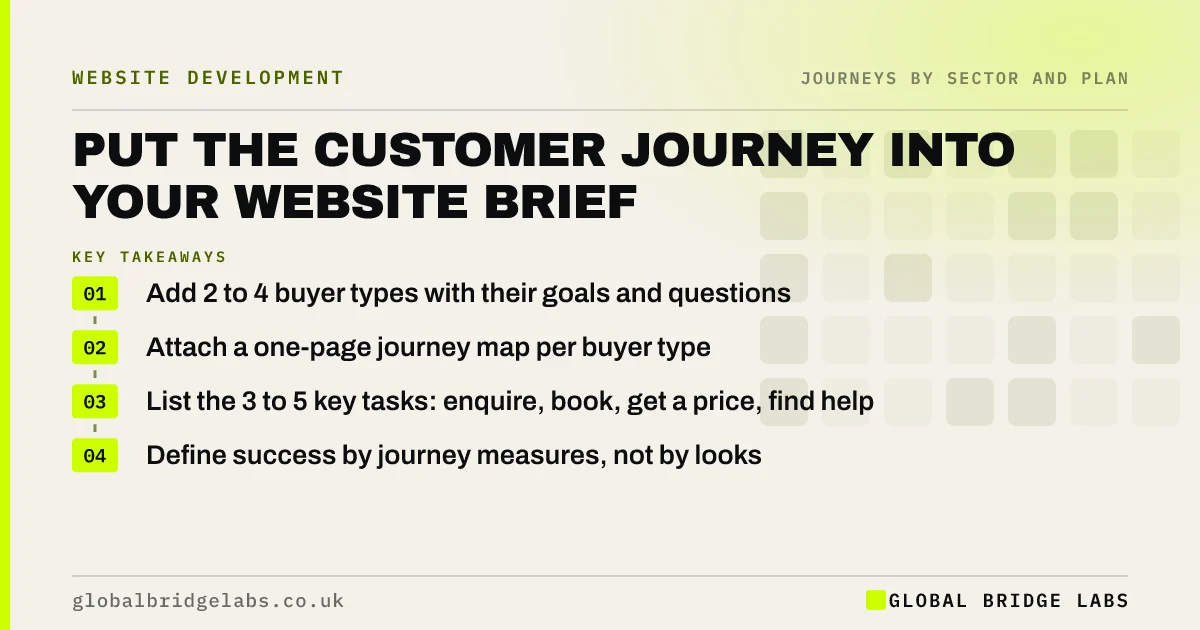
A website brief that includes the customer journey gets a site designed for buyers, not for the brief-writer's taste. Add four things: your main buyer types and what each is trying to get done, a one-page journey map for each, the three to five key tasks the site must make easy, and journey measures that will define success. Agencies can then quote, design and test against real needs.
- Add 2 to 4 buyer types with their goals and questions.
- Attach a one-page journey map per buyer type.
- List the 3 to 5 key tasks: enquire, book, get a price, find help.
- Define success by journey measures, not by looks.
Want your website brief reviewed for the customer journey? Send it to us on WhatsApp.
Chat on WhatsApp →Why should a website brief include the customer journey?
A brief should include the customer journey because it is the clearest statement of what the website must do. Without it, agencies design from your preferences, competitors' sites and their own templates. With it, they can see which pages matter, which answers are missing and which tasks must be quick, and they can quote for research, structure and content rather than just design.
What journey information belongs in the brief?
Include enough to guide design without overwhelming it. Buyer types, journey maps, key tasks, top questions and current problems with evidence are the core. Add your analytics baseline so the agency can measure improvement.
- Buyer types: 2 to 4, with goals, triggers and decision factors.
- Journey maps: one page each, with the main breaks marked.
- Key tasks: 3 to 5, with where they start.
- Top questions: the ten most-asked, by journey stage.
- Current problems: with evidence from analytics or customers.
- Baseline: landing pages, enquiry rate, key drop-offs.
What if you have not mapped the journey yet?
If you have not mapped the journey, say so and ask agencies to include a short research and mapping phase in their quote. Give them what you have: customer types, common questions and analytics access. A good agency will propose interviews and a mapping session before design. One that skips straight to visuals is designing on assumptions.
How do you define success in journey terms?
Define success with measures tied to the journey stages: more visitors moving from entry pages to service pages, more viewing pricing and proof, a higher enquiry rate, faster form completion, fewer repetitive questions, and a better Journey Fit Scorecard score. Set a baseline before the project and agree when you will measure after launch.
- Customer journey metrics: the numbers that show it working
- Setting website redesign goals that you can measure
Want journey success measures written into your brief? Message us on WhatsApp.
Chat on WhatsApp →How should agencies respond to a journey-led brief?
A good response shows how the agency will use the journey: how it will validate the map, how structure and content will follow it, which tasks it will test and how it will measure the result. Ask to see the information architecture and user flows before visual design. Proposals that only show mood boards have not engaged with the journey.
When can the brief stay simple?
The brief can stay simple for small sites with one buyer type and a short journey. A paragraph describing the customer, their top five questions and the main action you want is enough. The principle is the same: tell the designer who the site is for and what it must help them do.
What does this look like in practice?
A pattern we see in website briefs: pages of brand guidance, a list of competitor sites the owner likes, and one line about customers. Proposals come back with attractive designs and no plan for the questions buyers ask, so the new site repeats the old one's gaps.
Adding two buyer types, their questions and the three key tasks changes what agencies propose and what they test. Across our client work we have seen a 2.4x enquiry rate from conversion changes of this kind. Global Bridge Labs (GBL) asks for the journey before the mood board.
Journey brief checklist
- Describe 2 to 4 buyer types and their goals.
- Attach journey maps or ask for a mapping phase.
- List 3 to 5 key tasks and where they start.
- Add the top questions by journey stage.
- Include an analytics baseline.
- Define success in journey measures.
Next step
A journey-led brief gets better proposals and a better site. We will help you write one, or review the one you have.
Message us on WhatsApp to put your customer journey into your website brief, or book a 30-minute consultation.
Chat on WhatsApp →Sources and further reading
- User research · GOV.UK Service Manual
- Journey mapping 101 · Nielsen Norman Group
- About key events · Google Analytics Help
Frequently asked questions
What customer information should go in a website brief?
Your main buyer types and what each is trying to get done, a one-page journey map for each, the three to five key tasks the site must make easy, the most common customer questions by stage, current problems with evidence, and an analytics baseline.
Should I map my customer journey before briefing an agency?
It helps, but it is not essential. If you have not mapped it, ask agencies to include a short research and mapping phase in their quote, and give them customer types, common questions and analytics access. Be wary of proposals that go straight to visual design.
How do I measure whether a new website improved the customer journey?
Set a baseline before the project and compare after launch: onward clicks from entry pages, pricing and proof views, enquiry rate, form completion, repetitive questions and a journey scorecard. Agree when you will measure, usually one and three months after launch.
Written by

Global Bridge Labs (GBL) is a UK–Sri Lanka partner for social media, websites and BPO. Everything here comes from client delivery, not theory.