On this page
- 01Key takeaways
- 02Why is inconsistent social media expensive?
- 03What are the four costs?
- 04How much time does stop-start waste?
- 05How do lost enquiries add up?
- 06Why does inconsistency lead to viral chasing?
- 07How do you fix it cheaply?
- 08What does this look like in practice?
- 09What does a worked annual comparison look like?
- 10When is inconsistency acceptable?
- 11Next step
- 12Sources and further reading
- 13Frequently asked questions
Key takeaways
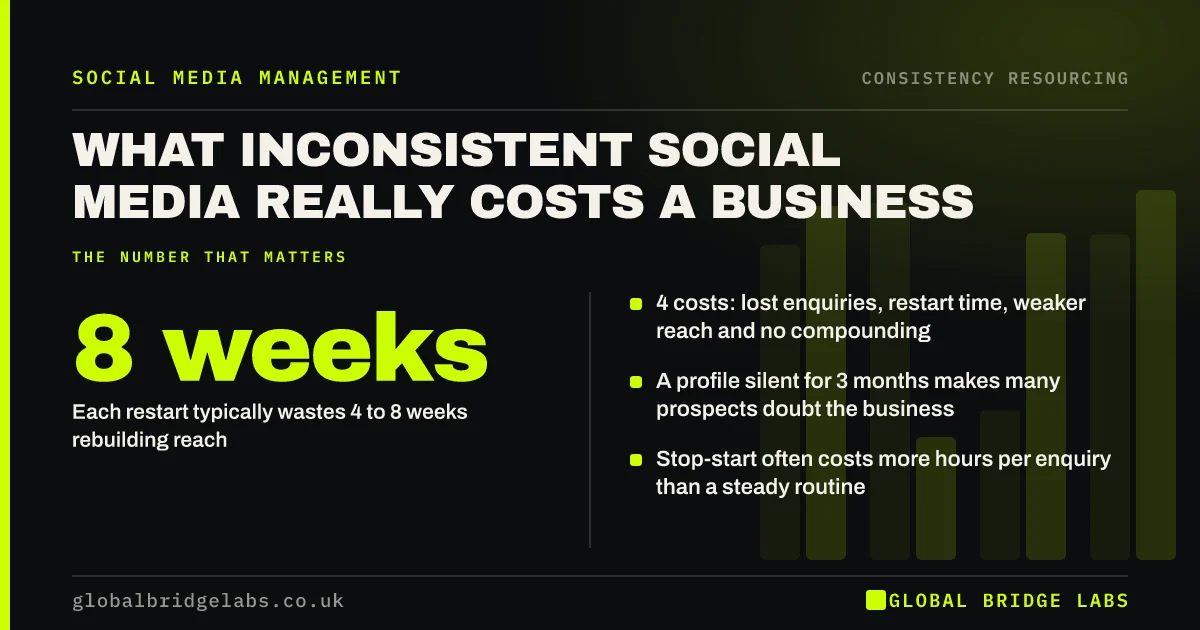
Inconsistent social media costs a business in four ways: enquiries lost to prospects who doubt an inactive profile, time wasted on repeated restarts, weaker reach after every gap, and content that never compounds. A stop-start pattern can cost more than a steady routine while producing less.
- 4 costs: lost enquiries, restart time, weaker reach and no compounding.
- Each restart typically wastes 4 to 8 weeks rebuilding reach.
- A profile silent for 3 months makes many prospects doubt the business.
- Stop-start often costs more hours per enquiry than a steady routine.
- The cheapest fix is a smaller cadence you can actually hold.
Want to see what inconsistency is costing you? Message us on WhatsApp.
Chat on WhatsApp →Why is inconsistent social media expensive?
Inconsistent social media is expensive because each gap throws away value already built and each restart pays setup costs again. Followers forget, reach falls, the team loses its rhythm and prospects see an abandoned profile. The business ends up paying for social media several times over without getting the compound benefit.
What are the four costs?
- Lost enquiries: prospects who check an inactive profile and choose someone else.
- Restart time: new planning, new templates and relearning tools each time.
- Weaker reach: the first weeks back reach fewer people while interaction rebuilds.
- No compounding: the content library, recognition and audience never accumulate.
How much time does stop-start waste?
In the UK accounts we have taken over, a typical restart takes 8 to 15 hours of planning, template rebuilding and catch-up posting, followed by four to eight weeks of weaker reach. A business that restarts three times a year can spend 30 to 45 hours on restarts alone. At about £16.27 per worked hour for a UK employee on the April 2026 National Living Wage, that is £490 to £730 of time producing nothing new, and far more at typical marketing salaries.
Want the restart cost worked out for your team? Message us on WhatsApp.
Chat on WhatsApp →How do lost enquiries add up?
Lost enquiries are hard to count because they never arrive. But if a trades business wins jobs worth an average of £3,000 and a silent profile loses even two enquiries a quarter to prospects who assume it has stopped trading, that is thousands of pounds a year in missed opportunities, far more than the cost of a modest, steady routine.
Why does inconsistency lead to viral chasing?
After a gap, businesses often try to make up for lost time with a big push, hoping one post will take off. That push is expensive, unpredictable and usually unsustainable, so it ends in another gap. The cycle repeats. Breaking it means accepting a smaller, steady routine.
How do you fix it cheaply?
- Cut to one channel and a cadence you can hold in your worst month.
- Batch a month of posts at a time.
- Keep a content bank of five evergreen posts.
- Write a short SOP so anyone can cover.
- Review monthly with the GBL Consistency Scorecard.
What does this look like in practice?
A UK building contractor had restarted Facebook and Instagram four times in two years, each time with a new plan and a burst of posts. When we mapped the hours, restarts accounted for over a third of all social media time. Moving to two posts a week on Facebook only, batched monthly, cut total hours and produced the firm's first steady stream of enquiries from social media.
What does a worked annual comparison look like?
- Stop-start: 3 restarts at 12 hours each, plus 20 weeks of bursts at 6 hours a week. About 156 hours.
- Steady: 48 weeks at 3 hours a week. About 144 hours.
- Stop-start leaves about 32 weeks of gaps or weak reach; steady leaves almost none.
- At £16.27 per worked hour, both cost roughly £2,300 to £2,500 in staff time.
- Same cost, very different result: only the steady plan compounds.
When is inconsistency acceptable?
When the channel was never important, when a planned pause is announced, or when the business deliberately winds a channel down. The cost comes from unplanned gaps on channels that prospects check. If a channel does not matter to buyers, close it properly rather than letting it drift.
Next step
Count how many times you have restarted social media in the last two years. If it is more than once, the answer is not a bigger plan but a smaller one you can keep.
Message us on WhatsApp and we will design a routine that ends the stop-start cycle.
Chat on WhatsApp →Sources and further reading
- National Minimum Wage and National Living Wage rates · GOV.UK
- Rates and thresholds for employers 2026 to 2027 · HM Revenue & Customs
- Meta Business Help Centre · Meta
Frequently asked questions
Does inconsistent posting hurt your business?
Yes. Gaps make profiles look inactive to prospects, weaken reach when you return, waste time on restarts and prevent content from compounding. The combined cost is often higher than a steady routine that produces more.
Is it better to post inconsistently than not at all?
Not necessarily. An abandoned profile can do more harm than a well-maintained minimal one. If you cannot post regularly, keep a minimum viable presence: current profile, pinned proof post, one post a week and prompt replies.
How much does it cost to restart social media?
Typically 8 to 15 hours of planning and setup, plus four to eight weeks of weaker reach. Repeated restarts can consume a large share of the total time spent on social media without adding anything new.
How do I stop the stop-start cycle on social media?
Choose a smaller cadence you can hold in your busiest month, batch monthly, keep a content bank and write a short SOP so others can cover. Review monthly and change one thing at a time.
Is inconsistent posting worse than posting less often?
Usually yes. A lower, steady cadence keeps the account active and compounding. Inconsistent posting with gaps and bursts often costs as much time while losing reach, trust and momentum after every gap.
Written by

Global Bridge Labs (GBL) is a UK–Sri Lanka partner for social media, websites and BPO. Everything here comes from client delivery, not theory.