On this page
- 01Key takeaways
- 02What are the real signals to quit?
- 03Which signals look like failure but are not?
- 04How do you leave without damage?
- 05Should you delete or dormant?
- 06What about sunk cost?
- 07What does this look like in practice?
- 08What should you do with the content you made?
- 09Next step
- 10Sources and further reading
- 11Frequently asked questions
Key takeaways
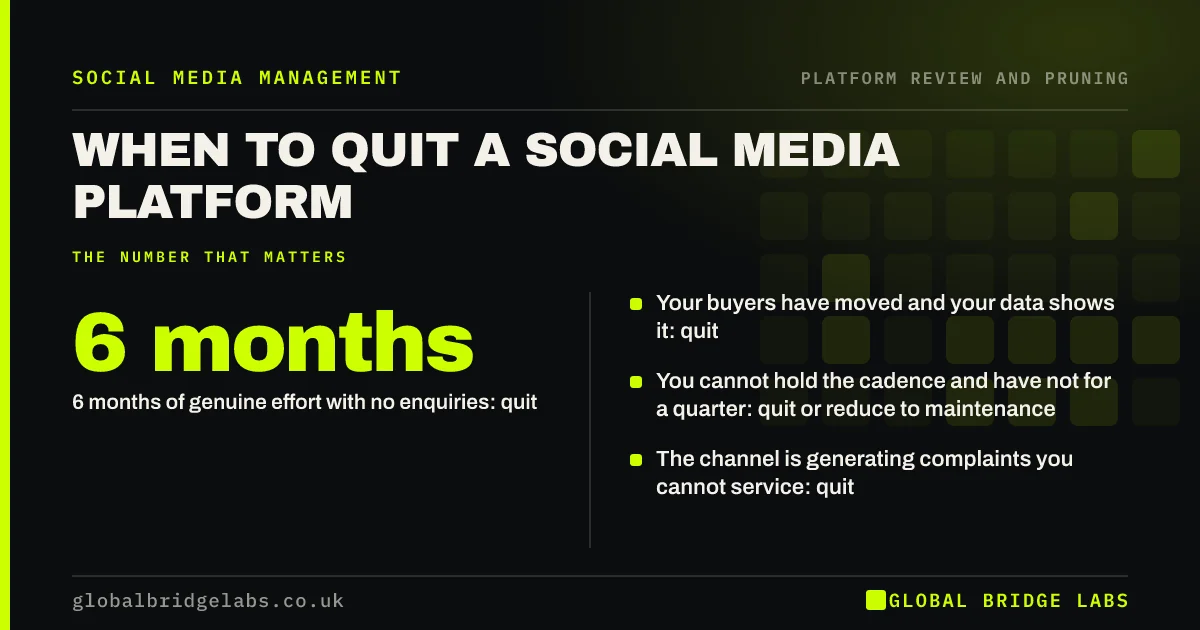
Quit when six months of genuine effort has produced no enquiries, when your buyers have visibly left, when you cannot sustain the cadence, or when the channel is damaging your reputation. Low engagement alone is not a reason.
- 6 months of genuine effort with no enquiries: quit.
- Your buyers have moved and your data shows it: quit.
- You cannot hold the cadence and have not for a quarter: quit or reduce to maintenance.
- The channel is generating complaints you cannot service: quit.
- Low engagement with rising enquiries: do not quit. You are measuring the wrong thing.
Unsure whether to close a channel? We will look at it with you on WhatsApp.
Chat on WhatsApp →What are the real signals to quit?
Four, and they are about outcomes and capacity rather than about vanity metrics. Six months of genuine effort with no enquiries is the clearest. Evidence that your buyers have moved is the second. Inability to sustain the required cadence is the third, and it is the most common.
The fourth is reputational: a channel generating service demands you cannot meet is actively harming you. An unanswered message queue visible to prospects costs more than the channel could ever return.
Which signals look like failure but are not?
Two, and both cause businesses to close channels that were working.
Falling engagement with steady or rising enquiries usually means your audience has become more commercial and less casual, which is an improvement. And low visible engagement on a B2B channel is normal, because the valuable behaviour, reading carefully and forwarding privately, leaves no public trace.
How do you leave without damage?
Deliberately, because a channel that is abandoned rather than closed keeps costing you. Five steps that take under an hour.
- Post a final update saying where you are active now, and pin it.
- Update the bio with the same redirect. Most people never see the pinned post.
- Set an auto-reply on messages pointing to a channel you do monitor.
- Remove the channel's icon from your website, email signature and print.
- Diary a quarterly check for messages, because some will still arrive.
We will handle the wind-down so nothing is left dangling. Ask on WhatsApp.
Chat on WhatsApp →Should you delete or dormant?
Neither, in most cases. Keep the account with a redirect rather than deleting it, because deleting frees the handle for someone else and loses any search presence you built.
What you must not do is leave it looking abandoned. A profile whose last post is fourteen months old, with unanswered messages, tells a prospective customer that the business may have stopped trading. That is worse than either alternative and it is the most common state we find.
What about sunk cost?
The followers you built are not an asset you are discarding; they were never yours. You rent attention on a social platform and the rent is paid weekly in content and replies. Stopping the payment means the attention goes, and that is true whether you close the account or simply post less.
The more useful framing is forward-looking: if you were choosing channels today with no history, would this one make the list? If the answer is no, the years already spent are not a reason to spend more.
What does this look like in practice?
A UK printing company kept a channel running for three years because it had 4,000 followers. Enquiries from it were approximately zero and had been for two years; the followers were mostly other printers and design students.
Closing it with a pinned redirect returned about three hours a week to a channel that was producing. Nobody noticed the absence. The 4,000 followers had been a number in a dashboard rather than a market for a long time.
What should you do with the content you made?
Reuse it. Two years of posts is a library of answers to real customer questions, and almost none of it is platform-specific once you strip the formatting.
The highest-value move is to turn the recurring questions into website pages, because those keep working in search long after the channel has closed. A post that got messages every time it ran is a page worth having.
Photographs and video go into the channel you kept. Nothing about closing a channel requires discarding the work, and businesses that treat the archive as a content bank find the next quarter considerably easier.
Do this before you close the account, because exporting later is harder and occasionally impossible.
Check the export includes your message history as well as your posts, since customer conversations are the part you are most likely to need later.
Next step
For each channel, ask one question: if I were choosing channels today with no history, would this make the list? Any channel where the answer is no should be at maintenance level or closed by the end of the month.
Message us on WhatsApp and we will decide which channels to close with you.
Chat on WhatsApp →Sources and further reading
- Google Search Console · Google
- Meta Business Help Centre · Meta
Frequently asked questions
When should a business stop using a social media platform?
After six months of genuine effort with no enquiries, when your data shows buyers have moved, when you cannot sustain the required cadence, or when it generates service demands you cannot meet. Low engagement alone is not a reason.
Is falling engagement a reason to quit a channel?
Not on its own, and acting on it closes working channels. Falling engagement alongside steady or rising enquiries usually means your audience has become more commercial and less casual, which is an improvement rather than a problem to be solved.
Should you delete a social media account you no longer use?
Usually not. Keep it with a pinned redirect, an updated bio and a message auto-reply, because deleting frees the handle for somebody else and loses whatever search presence it had. What you must avoid is leaving it visibly abandoned.
What about all the followers I built up?
You rented that attention rather than owning it, and the rent is paid weekly in content and replies. The better question is whether you would choose this channel today with no history. If not, past effort is not a reason to continue.
Written by

Global Bridge Labs (GBL) is a UK–Sri Lanka partner for social media, websites and BPO. Everything here comes from client delivery, not theory.