On this page
- 01Key takeaways
- 02What makes a clinic website different?
- 03Why do many clinic websites lose patients?
- 04What should a clinic website include?
- 05What regulation affects clinic websites?
- 06How should clinics handle health data online?
- 07Why does accessibility matter more for clinics?
- 08What does this look like in practice?
- 09Clinic website checklist
- 10Next step
- 11Sources and further reading
- 12Frequently asked questions
Key takeaways
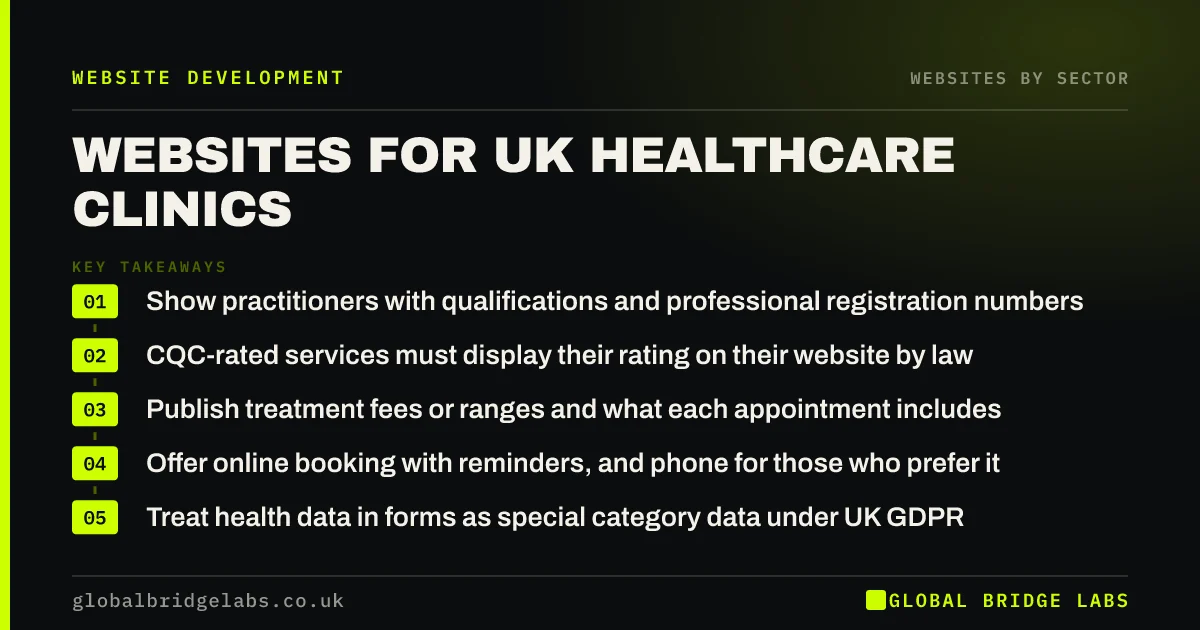
A UK healthcare clinic website must build trust quickly and handle information responsibly. That means clear treatment pages with fees, practitioner credentials and registration numbers, CQC ratings where required, easy online booking, accessible design, and careful handling of health data, which is special category data under UK GDPR.
- Show practitioners with qualifications and professional registration numbers.
- CQC-rated services must display their rating on their website by law.
- Publish treatment fees or ranges and what each appointment includes.
- Offer online booking with reminders, and phone for those who prefer it.
- Treat health data in forms as special category data under UK GDPR.
Want your clinic website reviewed for trust and compliance basics? Send us the URL on WhatsApp.
Chat on WhatsApp →What makes a clinic website different?
A clinic website is a website for a healthcare provider, such as a private GP, physiotherapy practice, dental practice, aesthetics clinic or therapy service, that explains treatments, demonstrates clinical credibility and lets patients book appointments.
Patients are often anxious, in pain or making a personal decision. They want reassurance about who will treat them, what will happen, what it costs and how soon they can be seen, and they are rightly cautious about sharing health information online.
Why do many clinic websites lose patients?
Many clinic websites are either clinical and cold, listing treatments in medical language, or promotional in ways that undermine trust. Few answer the practical questions patients actually have: how quickly can I be seen, how much will it cost, do I need a referral, and who will I see?
- Treatment pages in medical terminology only.
- No fees or insurance information.
- Practitioners without qualifications or registration details.
- Booking only by phone during clinic hours.
- Forms asking for health details without explanation.
What should a clinic website include?
Build around the patient's questions, in plain language.
- Treatment pages: who it helps, what happens, how long, recovery, fees.
- Practitioner profiles: qualifications, registration numbers, specialisms, photographs.
- CQC rating display where applicable, and regulator details.
- Fees, packages and insurance accepted.
- Online booking with availability, reminders and cancellation policy.
- Practical details: location, parking, accessibility, opening hours.
- Patient reviews, gathered and published in line with CMA guidance.
What regulation affects clinic websites?
Services registered with the Care Quality Commission that have received a rating must display it on their website, clearly and conspicuously, within 21 days of publication, under Regulation 20A. CQC provides a widget for this.
Health information collected through forms or booking tools is special category data under UK GDPR, which needs an additional condition for processing and extra care with security and suppliers. Advertising claims about treatments are also subject to the CAP Code and must be evidenced. Professional regulators, such as the GMC, GDC or HCPC, have their own standards on advertising.
Want your forms and booking flow checked for health data handling? Message us on WhatsApp.
Chat on WhatsApp →How should clinics handle health data online?
Collect the minimum. A first enquiry form rarely needs detailed medical history; that can be gathered securely at or before the appointment through a clinical system. Explain in plain words why you ask for any health information and how it is protected.
Choose booking and form providers that offer UK GDPR compliant processing agreements, store data securely, and do not use it for their own purposes. Avoid sending health details through general email where a secure system is available.
Why does accessibility matter more for clinics?
Patients are more likely than average to have visual, motor or cognitive impairments, temporary or permanent. The Equality Act 2010 requires reasonable adjustments, and WCAG 2.2 AA is the benchmark. Clear contrast, large tap targets, plain language and keyboard-accessible booking all help.
The trade-off is that some third-party booking tools are not fully accessible. Offer a phone alternative, and say so clearly.
What does this look like in practice?
A pattern in private clinics: a practitioner list without registration numbers, a CQC rating that is not displayed on the site, treatment pages with no fees, and booking only by phone while clinicians are with patients.
Adding registration details and the CQC widget, publishing fees, and introducing online booking with reminders addresses compliance and conversion together. Patients can book in the evening, when many of them are searching.
Clinic website checklist
Review these with your practice manager.
- Write treatment pages in plain language with fees.
- Show qualifications and registration numbers.
- Display your CQC rating if required.
- Offer online booking with reminders.
- Minimise health data in web forms.
- Use suppliers with UK GDPR agreements.
- Check accessibility of key pages and booking.
- Evidence any treatment claims.
Next step
If your clinic's website does not show fees, credentials or online booking, we will review it with you in 30 minutes and prioritise the changes.
Message us on WhatsApp for a clinic website review, or book a 30-minute consultation.
Chat on WhatsApp →Sources and further reading
- Display your CQC ratings · Care Quality Commission
- Special category data · Information Commissioner's Office
- Web Content Accessibility Guidelines (WCAG) 2.2 · W3C
Frequently asked questions
What should a private clinic website include?
Plain-language treatment pages with fees, practitioner profiles with qualifications and registration numbers, any required CQC rating, online booking with reminders, practical details such as location and accessibility, genuine patient reviews, and clear privacy information about how health data is handled.
Do I have to display my CQC rating on my website?
Yes, if your service has received a CQC rating and you have a website describing the service. Regulation 20A requires the rating to be displayed clearly and conspicuously within 21 days of publication. CQC provides a website widget to make this straightforward.
Can I collect health information through my website?
Yes, with care. Health information is special category data under UK GDPR, requiring an additional condition for processing and appropriate security. Collect only what you need, explain why, use suppliers with compliant processing agreements, and gather detailed history through a secure clinical system.
Should my clinic offer online booking?
Usually yes. Many patients search and book outside clinic hours, and online booking with reminders reduces phone admin and no-shows. Choose a system that integrates with your practice management software, and keep a phone alternative for patients who prefer it or cannot use the tool.
Written by

Global Bridge Labs (GBL) is a UK–Sri Lanka partner for social media, websites and BPO. Everything here comes from client delivery, not theory.